Budget committee advances $64 million Prop I emergency acquisition for affordable housing to full Board
November 17, 2021 | San Francisco County, California
This article was created by AI summarizing key points discussed. AI makes mistakes, so for full details and context, please refer to the video of the full meeting. Please report any errors so we can fix them. Report an error »
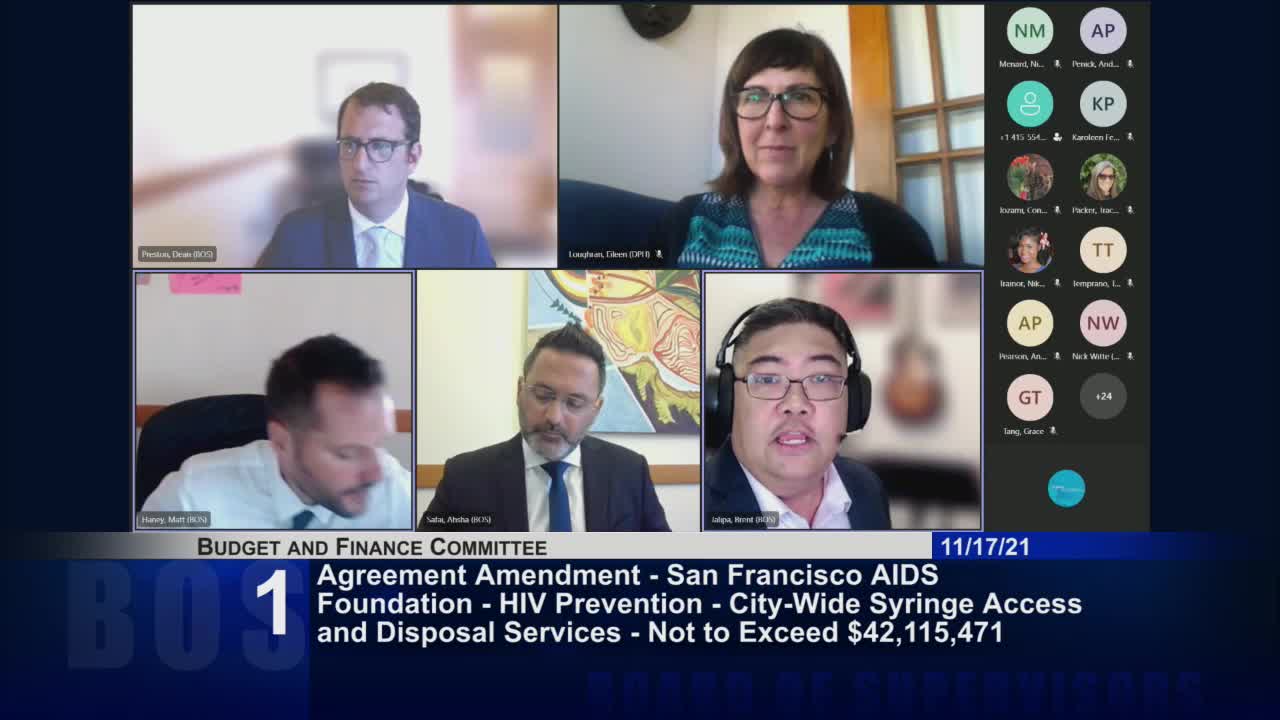
The Budget and Finance Committee on Nov. 17 advanced an ordinance to the full Board that would send $64.1 million of Proposition I transfer-tax revenue to a city emergency housing acquisition program intended to buy at-risk multifamily buildings and preserve them as permanently affordable housing.
Supervisor Dean Preston, the item’s lead, told the committee the funding would let the city “step in and purchase those buildings for permanently affordable housing and prevent pandemic-fueled displacement.” He said the Board’s oversight body recommended an emergency allocation after finding more than 100 multifamily buildings were on the market citywide.
The measure would draw on Prop I proceeds the Board set aside for social housing and rent relief. Preston said the proposition’s revenue was projected to produce about $128 million this year and that early receipts were running ahead of projections, giving the Board a chance to act now.
Caroline Fang, director of community real estate at Mission Economic Development Agency (Meta), described the small‑sites acquisition model that nonprofit developers use to buy small apartment buildings (4–25 units) from the speculative market and operate them as permanently affordable housing. Fang said the nonprofit cohort has experience and capacity but that the program needs more capital to scale.
MOHCD Director Shaw said the department is conducting a strategic review and capital/underwriting study through the Housing Accelerator Fund to improve geographic equity, underwriting rules and per‑unit subsidy levels. Shaw told the committee a draft of the study should be ready in 45–60 days and emphasized that acquisitions require both purchase capital and ongoing underwriting to ensure long‑term operation.
Community testimony was extensive and largely in favor: tenants, faith groups, labor unions and neighborhood organizations described imminent Ellis Act and owner‑sale displacement risks in districts across the city—naming buildings and neighborhoods—and urged immediate action.
Committee action: Supervisor Preston proposed duplicating the file so the rent‑relief portion and the housing‑stability portion could move separately. The committee adopted amendments to split the files, forwarded the housing stability allocation to the full Board with a positive recommendation and continued the rent‑relief duplicate to the call of the chair. Roll calls recorded the motions as adopted by the three committee members present.
What’s next: The housing stability file goes to the full Board with a positive recommendation; the rent‑relief file remains pending and was continued for future scheduling. MOHCD and the oversight board will continue refining per‑unit subsidies, underwriting parameters and a deployment plan for prioritized buildings.
Why it matters: Supporters say the appropriation converts a voter‑approved revenue stream into a time‑sensitive tool to halt displacement and preserve long‑term affordability. Critics and some supervisors urged caution—asking MOHCD to resolve program capacity, partner readiness and geographic equity before larger appropriation decisions.
Supervisor Dean Preston, the item’s lead, told the committee the funding would let the city “step in and purchase those buildings for permanently affordable housing and prevent pandemic-fueled displacement.” He said the Board’s oversight body recommended an emergency allocation after finding more than 100 multifamily buildings were on the market citywide.
The measure would draw on Prop I proceeds the Board set aside for social housing and rent relief. Preston said the proposition’s revenue was projected to produce about $128 million this year and that early receipts were running ahead of projections, giving the Board a chance to act now.
Caroline Fang, director of community real estate at Mission Economic Development Agency (Meta), described the small‑sites acquisition model that nonprofit developers use to buy small apartment buildings (4–25 units) from the speculative market and operate them as permanently affordable housing. Fang said the nonprofit cohort has experience and capacity but that the program needs more capital to scale.
MOHCD Director Shaw said the department is conducting a strategic review and capital/underwriting study through the Housing Accelerator Fund to improve geographic equity, underwriting rules and per‑unit subsidy levels. Shaw told the committee a draft of the study should be ready in 45–60 days and emphasized that acquisitions require both purchase capital and ongoing underwriting to ensure long‑term operation.
Community testimony was extensive and largely in favor: tenants, faith groups, labor unions and neighborhood organizations described imminent Ellis Act and owner‑sale displacement risks in districts across the city—naming buildings and neighborhoods—and urged immediate action.
Committee action: Supervisor Preston proposed duplicating the file so the rent‑relief portion and the housing‑stability portion could move separately. The committee adopted amendments to split the files, forwarded the housing stability allocation to the full Board with a positive recommendation and continued the rent‑relief duplicate to the call of the chair. Roll calls recorded the motions as adopted by the three committee members present.
What’s next: The housing stability file goes to the full Board with a positive recommendation; the rent‑relief file remains pending and was continued for future scheduling. MOHCD and the oversight board will continue refining per‑unit subsidies, underwriting parameters and a deployment plan for prioritized buildings.
Why it matters: Supporters say the appropriation converts a voter‑approved revenue stream into a time‑sensitive tool to halt displacement and preserve long‑term affordability. Critics and some supervisors urged caution—asking MOHCD to resolve program capacity, partner readiness and geographic equity before larger appropriation decisions.
Don't Miss a Word: See the Full Meeting!
Go beyond summaries. Unlock every video, transcript, and key insight with a Founder Membership.
✓
Get instant access to full meeting videos
✓
Search and clip any phrase from complete transcripts
✓
Receive AI-powered summaries & custom alerts
✓
Enjoy lifetime, unrestricted access to government data
30-day money-back guarantee
