Budget committee forwards $18.7M plan for semi‑congregate shelter at 711 Post Street amid neighborhood pushback
February 02, 2022 | San Francisco County, California
This article was created by AI summarizing key points discussed. AI makes mistakes, so for full details and context, please refer to the video of the full meeting. Please report any errors so we can fix them. Report an error »
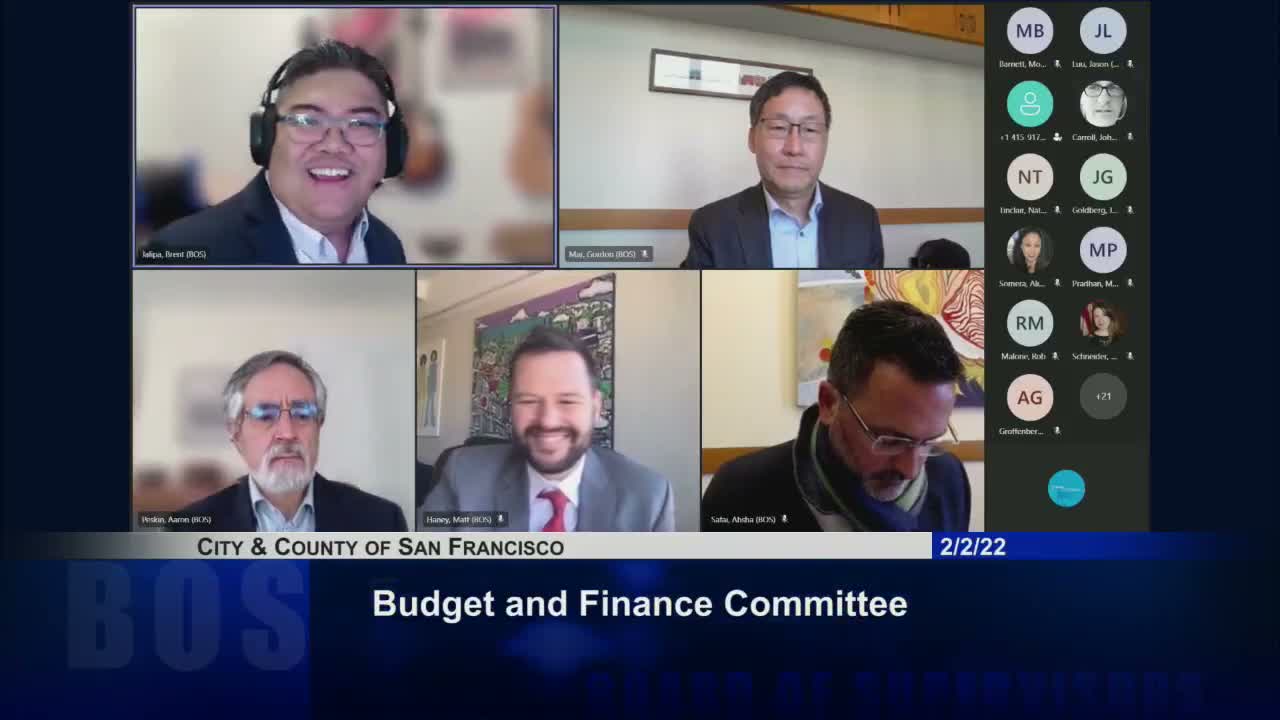
The San Francisco Budget & Finance Committee voted Feb. 2 to forward to the full Board of Supervisors a grant agreement that would authorize the Department of Homelessness and Supportive Housing (HSH) to lease and operate a semi‑congregate shelter at 711 Post Street with Urban Alchemy as the contractor.
Deputy Director Emily Cohen told the committee the former youth hostel includes 123 individual rooms and community space and is being proposed to serve “approximately 250 adults experiencing homelessness.” She described on‑site staff and 24/7 street activation and ambassador services provided by Urban Alchemy and said the contract term would run from Feb. 1, 2022, through June 30, 2024, for a total not‑to‑exceed amount of approximately $18,700,000. “HSH is very excited about the proposed semi‑congregate shelter at 711 Post Street,” Cohen said during her presentation.
The committee’s discussion centered on two recurring neighborhood demands: whether the city could acquire the building and how operations and public‑safety concerns would be addressed in practice. Cohen said the city had entered a letter of intent to begin due diligence on an acquisition and that the lease and contract contain termination and amendment provisions that would allow acquisition while preserving the ability to operate the shelter in the near term.
Vice Chair Supervisor Asha Safai and Supervisor Peskin both pressed HSH to codify commitments made to the Lower Nob Hill Neighborhood Alliance, including a firm cap of 250 beds and 24‑hour on‑site services. Cohen said HSH had agreed to a phased ramp‑up beginning at 150 beds and to deploy care coordinators and street practitioners to link guests to health and housing services. On weapons policy, Cohen said firearms found in the shelter would be confiscated and turned over to police and that possession would be cause for immediate removal.
Public comment lasted nearly two hours and showed a deep split in the neighborhood: callers in support emphasized the urgent need for shelter and the advantages of non‑congregate rooms; nearby residents, businesses and a neighborhood alliance urged delay until written contractual commitments and monitoring structures were in place, and some questioned Urban Alchemy’s capacity to run the largest shelter the organization would manage. Caller Zach Clifton said, “We need an emergency response and we need it today,” while several neighbors asked for a one‑week continuance to finalize amendments.
HSH Director Shereen McSpadden told the committee staff would meet the neighborhood in the next few days to translate verbal commitments into written amendments and to establish a neighborhood advisory body modeled on the Embarcadero Navigation Center’s advisory structure.
After discussion the committee adopted a non‑substantive amendment offered by HSH and voted to forward the item to the full Board with a positive recommendation as amended. The roll‑call tally recorded three ayes (Haney, Safai, Marr).
What happens next: the full Board is expected to consider the grant agreement on Feb. 8; HSH and the neighborhood alliance have committed to meet and attempt to codify operational commitments before that session.
Sources and authority: the clerk introduced the item citing Charter Section 9.118 and HSH’s planning/CEQA determinations; the HSH presentation, public comment and votes occurred on Feb. 2 at the Budget & Finance Committee meeting.
Deputy Director Emily Cohen told the committee the former youth hostel includes 123 individual rooms and community space and is being proposed to serve “approximately 250 adults experiencing homelessness.” She described on‑site staff and 24/7 street activation and ambassador services provided by Urban Alchemy and said the contract term would run from Feb. 1, 2022, through June 30, 2024, for a total not‑to‑exceed amount of approximately $18,700,000. “HSH is very excited about the proposed semi‑congregate shelter at 711 Post Street,” Cohen said during her presentation.
The committee’s discussion centered on two recurring neighborhood demands: whether the city could acquire the building and how operations and public‑safety concerns would be addressed in practice. Cohen said the city had entered a letter of intent to begin due diligence on an acquisition and that the lease and contract contain termination and amendment provisions that would allow acquisition while preserving the ability to operate the shelter in the near term.
Vice Chair Supervisor Asha Safai and Supervisor Peskin both pressed HSH to codify commitments made to the Lower Nob Hill Neighborhood Alliance, including a firm cap of 250 beds and 24‑hour on‑site services. Cohen said HSH had agreed to a phased ramp‑up beginning at 150 beds and to deploy care coordinators and street practitioners to link guests to health and housing services. On weapons policy, Cohen said firearms found in the shelter would be confiscated and turned over to police and that possession would be cause for immediate removal.
Public comment lasted nearly two hours and showed a deep split in the neighborhood: callers in support emphasized the urgent need for shelter and the advantages of non‑congregate rooms; nearby residents, businesses and a neighborhood alliance urged delay until written contractual commitments and monitoring structures were in place, and some questioned Urban Alchemy’s capacity to run the largest shelter the organization would manage. Caller Zach Clifton said, “We need an emergency response and we need it today,” while several neighbors asked for a one‑week continuance to finalize amendments.
HSH Director Shereen McSpadden told the committee staff would meet the neighborhood in the next few days to translate verbal commitments into written amendments and to establish a neighborhood advisory body modeled on the Embarcadero Navigation Center’s advisory structure.
After discussion the committee adopted a non‑substantive amendment offered by HSH and voted to forward the item to the full Board with a positive recommendation as amended. The roll‑call tally recorded three ayes (Haney, Safai, Marr).
What happens next: the full Board is expected to consider the grant agreement on Feb. 8; HSH and the neighborhood alliance have committed to meet and attempt to codify operational commitments before that session.
Sources and authority: the clerk introduced the item citing Charter Section 9.118 and HSH’s planning/CEQA determinations; the HSH presentation, public comment and votes occurred on Feb. 2 at the Budget & Finance Committee meeting.
Don't Miss a Word: See the Full Meeting!
Go beyond summaries. Unlock every video, transcript, and key insight with a Founder Membership.
✓
Get instant access to full meeting videos
✓
Search and clip any phrase from complete transcripts
✓
Receive AI-powered summaries & custom alerts
✓
Enjoy lifetime, unrestricted access to government data
30-day money-back guarantee
