Committee forwards street‑vending ordinance with proof‑of‑ownership and donation rules
March 02, 2022 | San Francisco County, California
This article was created by AI summarizing key points discussed. AI makes mistakes, so for full details and context, please refer to the video of the full meeting. Please report any errors so we can fix them. Report an error »
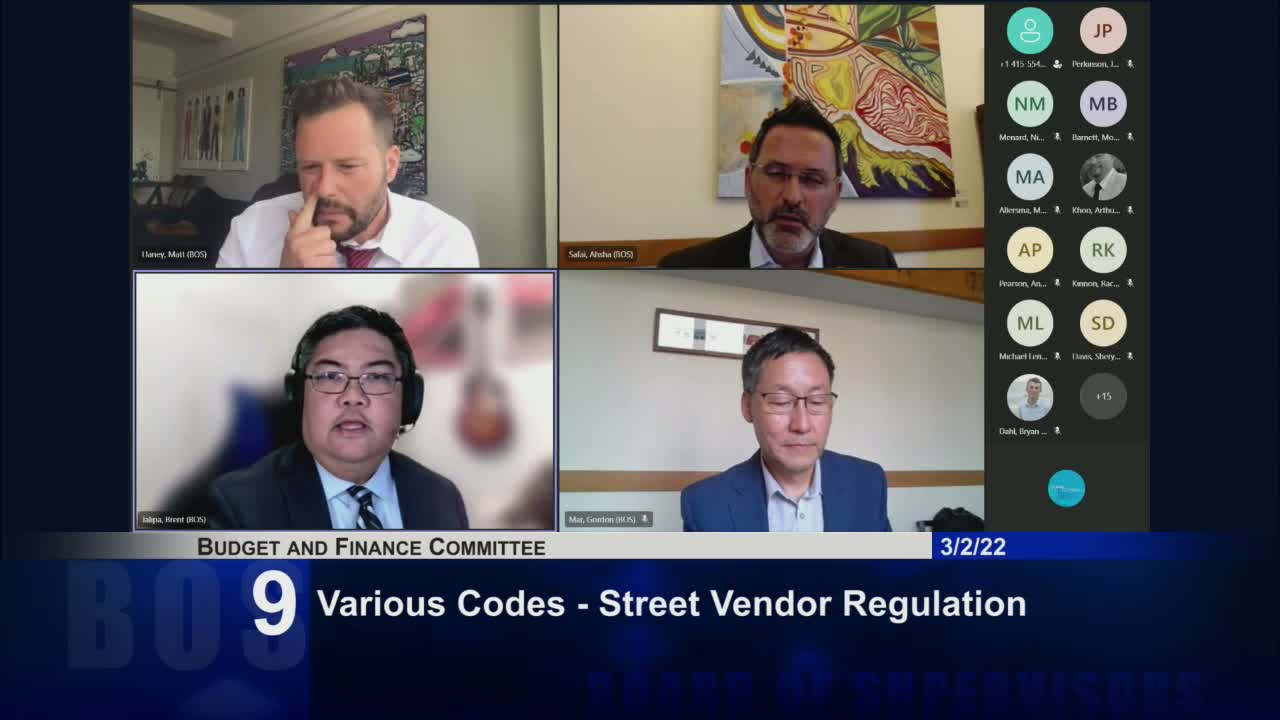
A San Francisco Board of Supervisors Budget & Finance Committee hearing on March 2, 2022 advanced a package of changes to the Public Works Code that would require permits for street vending, authorize administrative enforcement and set rules for confiscated goods and donations. Vice Chair Asha Safai and Supervisor Matt Haney presided over the discussion; Supervisor Ronan and the mayor’s office helped shape the substitute legislation.
The ordinance creates a centralized permitting process for vendors, requires proof of ownership for the sale of new and labeled items, and directs the Department of Public Works (DPW) to pursue outreach and education to bring vendors into compliance. Ivy Lee of the mayor’s office said the measure was designed to preserve legitimate, low‑barrier vending while targeting resales of stolen goods: "this does not apply to prepared food, this does not apply to street artists," she said.
Supervisor Ronan described the problem as organized resale operations that undercut brick‑and‑mortar businesses and said the ordinance is intended to "stop people from selling stolen goods, but not punish immigrant street vendors." The Budget and Legislative Analyst (BLA) estimated the new program would require about 13.8 full‑time equivalent positions to implement enforcement and outreach; the BLA also noted that enforcement worked best when paired with law enforcement in pilot studies but left policy judgment to the Board of Supervisors.
On procedural protections, the ordinance includes a 48‑hour "cure" window before fines or confiscation, and an appeal process. The bill would require DPW to store vendors’ items while an appeal is pending and, if an appeal is not resolved within 90 days, to donate non‑food items to organizations serving people experiencing homelessness. Supervisor Ronan said the donation language was designed to minimize storage costs and put urgently needed goods to community use.
Supporters at public comment included merchants and market operators who said the measure would help reclaim UN Plaza and mid‑market commercial corridors. Opponents and advocates urged careful implementation to avoid criminalizing poverty and to ensure low‑barrier access to permits.
The committee adopted amendments offered during the hearing and voted to forward the ordinance to the full Board with a positive recommendation; Member Gordon Marr was recorded as absent for the final roll call and the clerk noted two ayes on the roll call taken at the remote meeting (the record shows Vice Chair Asha Safai and Chair Matt Haney voting in favor). The Board will consider the ordinance at the full hearing.
The ordinance creates a centralized permitting process for vendors, requires proof of ownership for the sale of new and labeled items, and directs the Department of Public Works (DPW) to pursue outreach and education to bring vendors into compliance. Ivy Lee of the mayor’s office said the measure was designed to preserve legitimate, low‑barrier vending while targeting resales of stolen goods: "this does not apply to prepared food, this does not apply to street artists," she said.
Supervisor Ronan described the problem as organized resale operations that undercut brick‑and‑mortar businesses and said the ordinance is intended to "stop people from selling stolen goods, but not punish immigrant street vendors." The Budget and Legislative Analyst (BLA) estimated the new program would require about 13.8 full‑time equivalent positions to implement enforcement and outreach; the BLA also noted that enforcement worked best when paired with law enforcement in pilot studies but left policy judgment to the Board of Supervisors.
On procedural protections, the ordinance includes a 48‑hour "cure" window before fines or confiscation, and an appeal process. The bill would require DPW to store vendors’ items while an appeal is pending and, if an appeal is not resolved within 90 days, to donate non‑food items to organizations serving people experiencing homelessness. Supervisor Ronan said the donation language was designed to minimize storage costs and put urgently needed goods to community use.
Supporters at public comment included merchants and market operators who said the measure would help reclaim UN Plaza and mid‑market commercial corridors. Opponents and advocates urged careful implementation to avoid criminalizing poverty and to ensure low‑barrier access to permits.
The committee adopted amendments offered during the hearing and voted to forward the ordinance to the full Board with a positive recommendation; Member Gordon Marr was recorded as absent for the final roll call and the clerk noted two ayes on the roll call taken at the remote meeting (the record shows Vice Chair Asha Safai and Chair Matt Haney voting in favor). The Board will consider the ordinance at the full hearing.
Don't Miss a Word: See the Full Meeting!
Go beyond summaries. Unlock every video, transcript, and key insight with a Founder Membership.
✓
Get instant access to full meeting videos
✓
Search and clip any phrase from complete transcripts
✓
Receive AI-powered summaries & custom alerts
✓
Enjoy lifetime, unrestricted access to government data
30-day money-back guarantee
