Budget committee backs Clean Power SF participation in 69 MW ‘Tumbleweed’ long‑duration storage project
March 16, 2022 | San Francisco County, California
This article was created by AI summarizing key points discussed. AI makes mistakes, so for full details and context, please refer to the video of the full meeting. Please report any errors so we can fix them. Report an error »
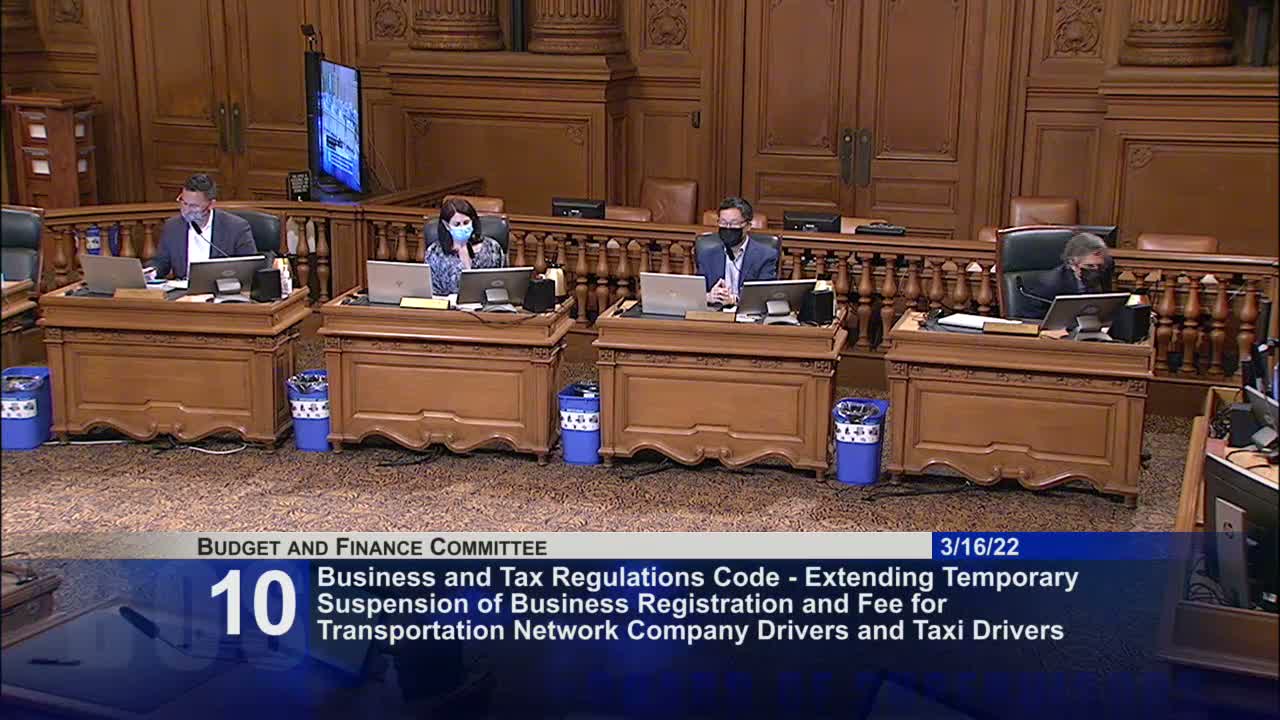
The San Francisco Board of Supervisors’ Budget and Finance Committee on March 16 voted to send to the full Board a resolution authorizing the San Francisco Public Utilities Commission’s Clean Power SF program to participate in the Tumbleweed long‑duration energy storage project through a joint powers agency called CC Power. The committee’s positive recommendation follows a staff presentation that described the project as a 69‑megawatt, 8‑hour lithium‑ion battery to be built in Rosamond, Kern County, by developer LS Power Renewables, with a guaranteed commercial operation date of June 1, 2026, and a 15‑year purchase term.
Why it matters: The project is intended to help Clean Power SF meet a California Public Utilities Commission order requiring retail sellers under its jurisdiction to procure long‑duration storage. Clean Power SF’s share of the project is structured so its total payments over 15 years will not exceed $65 million, and the procurement would cover roughly half of Clean Power SF’s identified obligation under the CPUC order.
Clean Power SF Director Mike Himes and staff described the procurement through CC Power as a way to obtain scale and lower costs by pooling demand across multiple community choice aggregators. “By pooling our demand through CC Power, we’re able to achieve greater economies of scale and participate in a larger project that can deliver a lower cost of storage to our ratepayers,” Himes said.
Supervisors asked about labor and environmental safeguards. Himes said the developer has committed contractually to use a project labor agreement and that the project will be subject to the California Environmental Quality Act review in Kern County before operations. “The agreements we’re entering into will be terminated if the developer fails to do so,” he said when describing a non‑substantive amendment adding CEQA language.
Committee analysts noted the procurement responds to an explicit CPUC order and that the SFPuc and Clean Power SF have incorporated the expected payments into Clean Power SF’s financial plan. Nick Menard of the Budget and Legislative Analyst’s office told the committee the proposal covers Clean Power SF’s compliance obligation and is budgeted in its 10‑year financial plan.
What’s next: The committee voted to accept the minor amendments and forward the resolution to the full Board with a positive recommendation. The full Board will consider the ordinance on its next agenda; execution of the agreements is conditioned on CEQA clearance in Kern County and commercial operation in 2026.
Why it matters: The project is intended to help Clean Power SF meet a California Public Utilities Commission order requiring retail sellers under its jurisdiction to procure long‑duration storage. Clean Power SF’s share of the project is structured so its total payments over 15 years will not exceed $65 million, and the procurement would cover roughly half of Clean Power SF’s identified obligation under the CPUC order.
Clean Power SF Director Mike Himes and staff described the procurement through CC Power as a way to obtain scale and lower costs by pooling demand across multiple community choice aggregators. “By pooling our demand through CC Power, we’re able to achieve greater economies of scale and participate in a larger project that can deliver a lower cost of storage to our ratepayers,” Himes said.
Supervisors asked about labor and environmental safeguards. Himes said the developer has committed contractually to use a project labor agreement and that the project will be subject to the California Environmental Quality Act review in Kern County before operations. “The agreements we’re entering into will be terminated if the developer fails to do so,” he said when describing a non‑substantive amendment adding CEQA language.
Committee analysts noted the procurement responds to an explicit CPUC order and that the SFPuc and Clean Power SF have incorporated the expected payments into Clean Power SF’s financial plan. Nick Menard of the Budget and Legislative Analyst’s office told the committee the proposal covers Clean Power SF’s compliance obligation and is budgeted in its 10‑year financial plan.
What’s next: The committee voted to accept the minor amendments and forward the resolution to the full Board with a positive recommendation. The full Board will consider the ordinance on its next agenda; execution of the agreements is conditioned on CEQA clearance in Kern County and commercial operation in 2026.
Don't Miss a Word: See the Full Meeting!
Go beyond summaries. Unlock every video, transcript, and key insight with a Founder Membership.
✓
Get instant access to full meeting videos
✓
Search and clip any phrase from complete transcripts
✓
Receive AI-powered summaries & custom alerts
✓
Enjoy lifetime, unrestricted access to government data
30-day money-back guarantee
