Supervisors back two‑year pilot letting commercial property owners opt into city-run graffiti abatement
July 13, 2022 | San Francisco County, California
This article was created by AI summarizing key points discussed. AI makes mistakes, so for full details and context, please refer to the video of the full meeting. Please report any errors so we can fix them. Report an error »
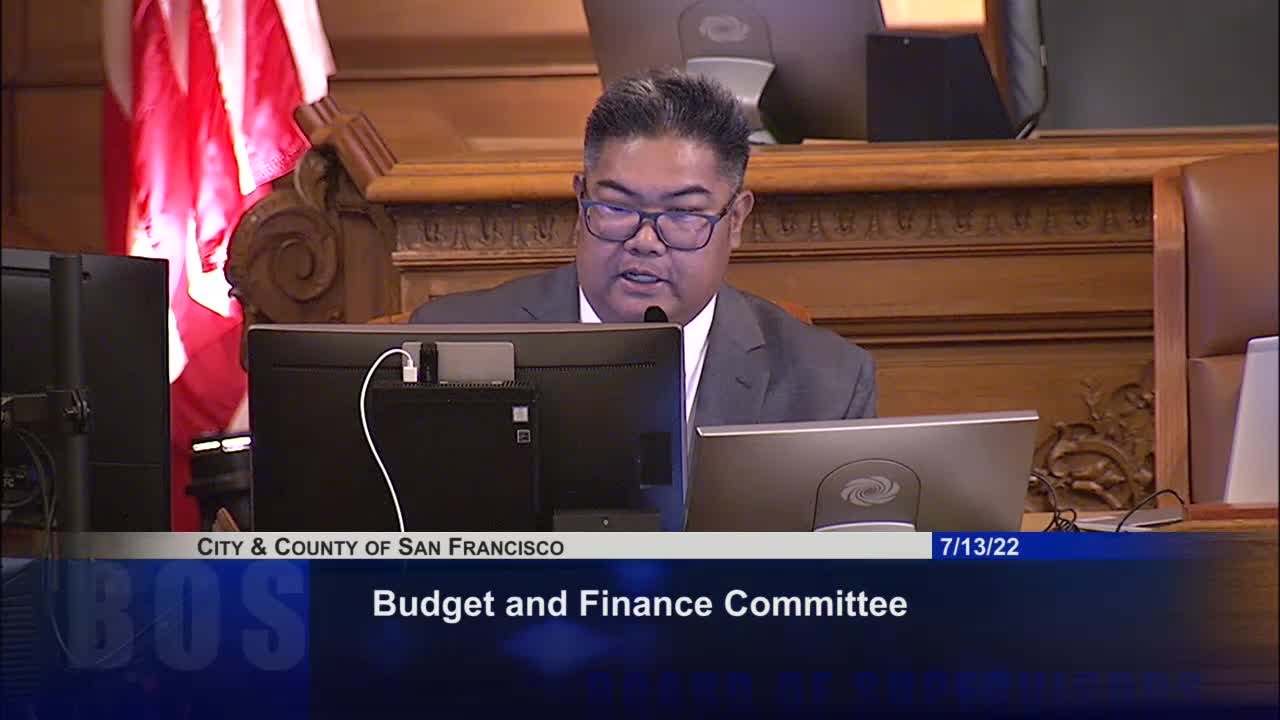
San Francisco’s Budget & Finance Committee on July 13 advanced an ordinance that would let property owners along commercial corridors opt into a two‑year pilot for city‑run graffiti abatement.
The ordinance, introduced as Item 15, would amend the Public Works Code so Public Works can proactively paint over graffiti on participating parcels and establish regular patrol routes. Jennifer Feaver, representing Supervisor (Melgar)ʼs office, told the committee the pilot is intended to support small businesses and revitalize commercial corridors. She said the proposal includes a $2 million annual add‑back to Public Works (about $4 million over two years) to staff crews, and that the department would design application and operational details.
The budget analyst, Nick Menard, said current code places responsibility for graffiti abatement on property owners and that the pilot shifts responsibility on an opt‑in basis. Menard noted the Board had previously waived fines during the pandemic but that waiver has expired. He flagged the program as a policy question for the Board and pointed committee members to workload and staffing estimates that, in his view, made the $2 million per year appropriation reasonable relative to the proposed staff complement.
Supervisors pressed staff on several operational details. Chair Supervisor Hillary Ronan and others asked how businesses and residential owners on commercial corridors would sign up and whether the pilot would be first‑come/first‑served; Feaver and Public Works staff said eligibility would be based on zoning (commercial corridors) and that the sign‑up process would be created by Public Works and likely be posted online. Public Works staff (Jonathan Pang) said the budgeted staffing was intended to cover corridor requests and that crews would also generate proactive service orders when they observed graffiti. Vice Chair Supervisor Asha Safaie asked about coordination with the Police Department and the District Attorney to pursue enforcement against repeat offenders; Public Works confirmed it already coordinates in some cases (for example pretrial diversion) but said the proposed ordinance itself is silent on enforcement provisions.
Committee members expressed support for the pilot but asked for clear outreach to supervisors’ offices and to small businesses, and for Public Works to publish straightforward enrollment forms. After discussion and the BLA presentation, the committee voted to forward the ordinance to the full Board with a positive recommendation; the roll call recorded unanimous approval.
The ordinance will next go to the full Board of Supervisors for final action. If approved, the city will still need to finalize the application procedures, routes and operational details before the pilot begins.
The ordinance, introduced as Item 15, would amend the Public Works Code so Public Works can proactively paint over graffiti on participating parcels and establish regular patrol routes. Jennifer Feaver, representing Supervisor (Melgar)ʼs office, told the committee the pilot is intended to support small businesses and revitalize commercial corridors. She said the proposal includes a $2 million annual add‑back to Public Works (about $4 million over two years) to staff crews, and that the department would design application and operational details.
The budget analyst, Nick Menard, said current code places responsibility for graffiti abatement on property owners and that the pilot shifts responsibility on an opt‑in basis. Menard noted the Board had previously waived fines during the pandemic but that waiver has expired. He flagged the program as a policy question for the Board and pointed committee members to workload and staffing estimates that, in his view, made the $2 million per year appropriation reasonable relative to the proposed staff complement.
Supervisors pressed staff on several operational details. Chair Supervisor Hillary Ronan and others asked how businesses and residential owners on commercial corridors would sign up and whether the pilot would be first‑come/first‑served; Feaver and Public Works staff said eligibility would be based on zoning (commercial corridors) and that the sign‑up process would be created by Public Works and likely be posted online. Public Works staff (Jonathan Pang) said the budgeted staffing was intended to cover corridor requests and that crews would also generate proactive service orders when they observed graffiti. Vice Chair Supervisor Asha Safaie asked about coordination with the Police Department and the District Attorney to pursue enforcement against repeat offenders; Public Works confirmed it already coordinates in some cases (for example pretrial diversion) but said the proposed ordinance itself is silent on enforcement provisions.
Committee members expressed support for the pilot but asked for clear outreach to supervisors’ offices and to small businesses, and for Public Works to publish straightforward enrollment forms. After discussion and the BLA presentation, the committee voted to forward the ordinance to the full Board with a positive recommendation; the roll call recorded unanimous approval.
The ordinance will next go to the full Board of Supervisors for final action. If approved, the city will still need to finalize the application procedures, routes and operational details before the pilot begins.
View the Full Meeting & All Its Details
This article offers just a summary. Unlock complete video, transcripts, and insights as a Founder Member.
✓
Watch full, unedited meeting videos
✓
Search every word spoken in unlimited transcripts
✓
AI summaries & real-time alerts (all government levels)
✓
Permanent access to expanding government content
30-day money-back guarantee
