Committee asks City offices to produce financing plan for $1.6B'$4B emergency firefighting water system expansion
September 14, 2022 | San Francisco County, California
This article was created by AI summarizing key points discussed. AI makes mistakes, so for full details and context, please refer to the video of the full meeting. Please report any errors so we can fix them. Report an error »
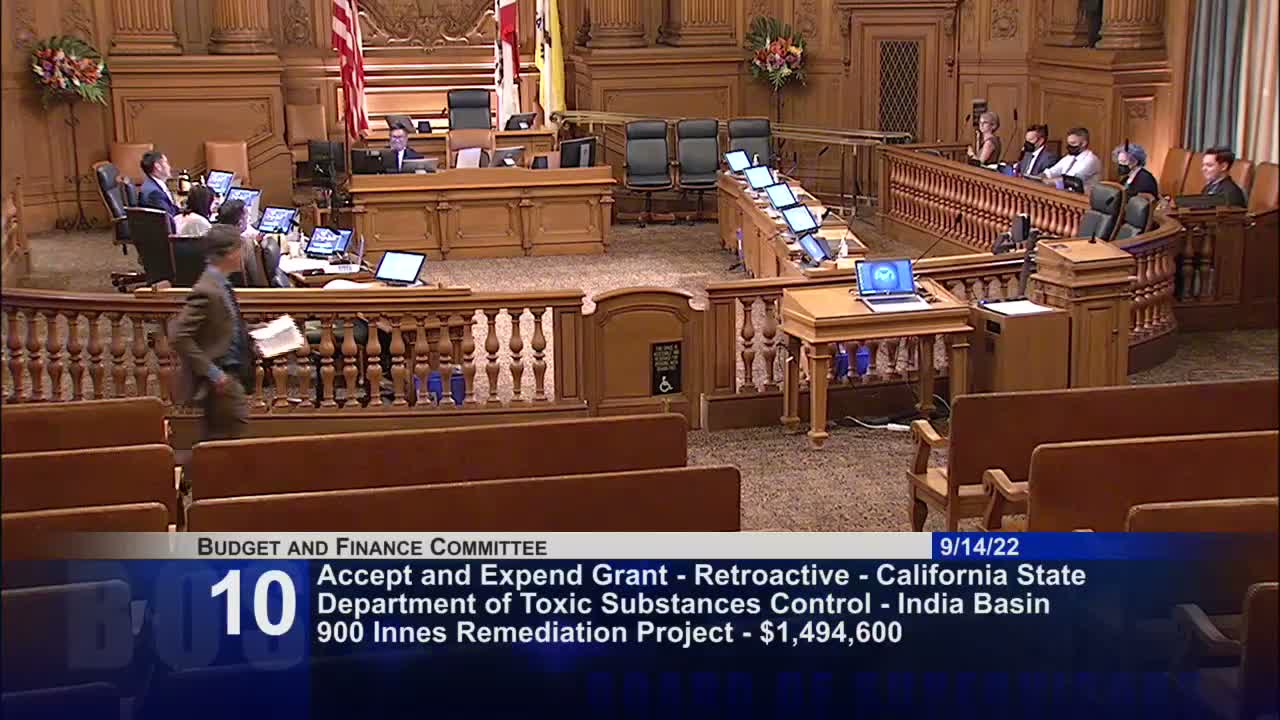
The Budget & Finance Committee unanimously adopted a resolution on Sept. 13 requesting that the Office of Resilience and Capital Planning prepare a financing plan by Dec. 31, 2022, to expand the city's Emergency Firefighting Water Supply (EFWS) to neighborhoods currently without dedicated high-pressure hydrant coverage.
Brian Strong, director of the Office of Resilience and Capital Planning, outlined the history and status of the EFWS: the system's high-pressure pipelines and dedicated hydrants date to the early 20th century and were installed to provide a separate water source for firefighting after large earthquakes. Recent bond programs have funded maintenance and partial expansion; city staff and consultants estimate that completing full coverage could cost in the range of $1.6 billion (BLA 2021 estimate in 2021 dollars) and, depending on sequencing and construction-price escalation, $2'$4 billion.
Strong told the committee that the financing plan will examine a range of revenue sources and tools: general obligation (GO) bonds, federal and state funding, community facility or infrastructure financing districts, development agreements or impact fees, and other revenue mechanisms. City departments also noted the capital program's constrained capacity (the presentation cited about $1.2 billion headroom in the City's current capacity) and the competing demands from seismic, sea-level rise, housing and other priorities.
Supervisors pressed staff about program alternatives to physical pipe expansion. Strong and others cited programmatic strategies from the Community Action Plan for Seismic Safety and the climate action plan: targeted gas shutoff valve programs, building decarbonization, intumescent coatings and education measures could reduce fire risk and complement EFWS expansion. The committee and public commenters agreed the issue is urgent: one speaker pointed to recent earthquakes and localized infrastructure failures and urged expedited action.
Committee member Supervisor Mar said the resolution reflects years of work and asked that the financing plan evaluate both large bond measures and alternative funding sources; the committee adopted several non-substantive language changes (including naming specific city reservoirs in a resolve clause) and forwarded the amended resolution to the full Board with a positive recommendation.
Next steps: Staff will produce the requested financing plan by Dec. 31, 2022, examining GO bonds, state and federal grant opportunities, financing districts and other mechanisms, and return to the Board for further action and prioritization as part of the city's upcoming capital-plan cycle.
Brian Strong, director of the Office of Resilience and Capital Planning, outlined the history and status of the EFWS: the system's high-pressure pipelines and dedicated hydrants date to the early 20th century and were installed to provide a separate water source for firefighting after large earthquakes. Recent bond programs have funded maintenance and partial expansion; city staff and consultants estimate that completing full coverage could cost in the range of $1.6 billion (BLA 2021 estimate in 2021 dollars) and, depending on sequencing and construction-price escalation, $2'$4 billion.
Strong told the committee that the financing plan will examine a range of revenue sources and tools: general obligation (GO) bonds, federal and state funding, community facility or infrastructure financing districts, development agreements or impact fees, and other revenue mechanisms. City departments also noted the capital program's constrained capacity (the presentation cited about $1.2 billion headroom in the City's current capacity) and the competing demands from seismic, sea-level rise, housing and other priorities.
Supervisors pressed staff about program alternatives to physical pipe expansion. Strong and others cited programmatic strategies from the Community Action Plan for Seismic Safety and the climate action plan: targeted gas shutoff valve programs, building decarbonization, intumescent coatings and education measures could reduce fire risk and complement EFWS expansion. The committee and public commenters agreed the issue is urgent: one speaker pointed to recent earthquakes and localized infrastructure failures and urged expedited action.
Committee member Supervisor Mar said the resolution reflects years of work and asked that the financing plan evaluate both large bond measures and alternative funding sources; the committee adopted several non-substantive language changes (including naming specific city reservoirs in a resolve clause) and forwarded the amended resolution to the full Board with a positive recommendation.
Next steps: Staff will produce the requested financing plan by Dec. 31, 2022, examining GO bonds, state and federal grant opportunities, financing districts and other mechanisms, and return to the Board for further action and prioritization as part of the city's upcoming capital-plan cycle.
Don't Miss a Word: See the Full Meeting!
Go beyond summaries. Unlock every video, transcript, and key insight with a Founder Membership.
✓
Get instant access to full meeting videos
✓
Search and clip any phrase from complete transcripts
✓
Receive AI-powered summaries & custom alerts
✓
Enjoy lifetime, unrestricted access to government data
30-day money-back guarantee
