Committee extends 33 Golf cabin lease and accepts $10.8M state encampment grant to fund shelters
February 15, 2023 | San Francisco County, California
This article was created by AI summarizing key points discussed. AI makes mistakes, so for full details and context, please refer to the video of the full meeting. Please report any errors so we can fix them. Report an error »
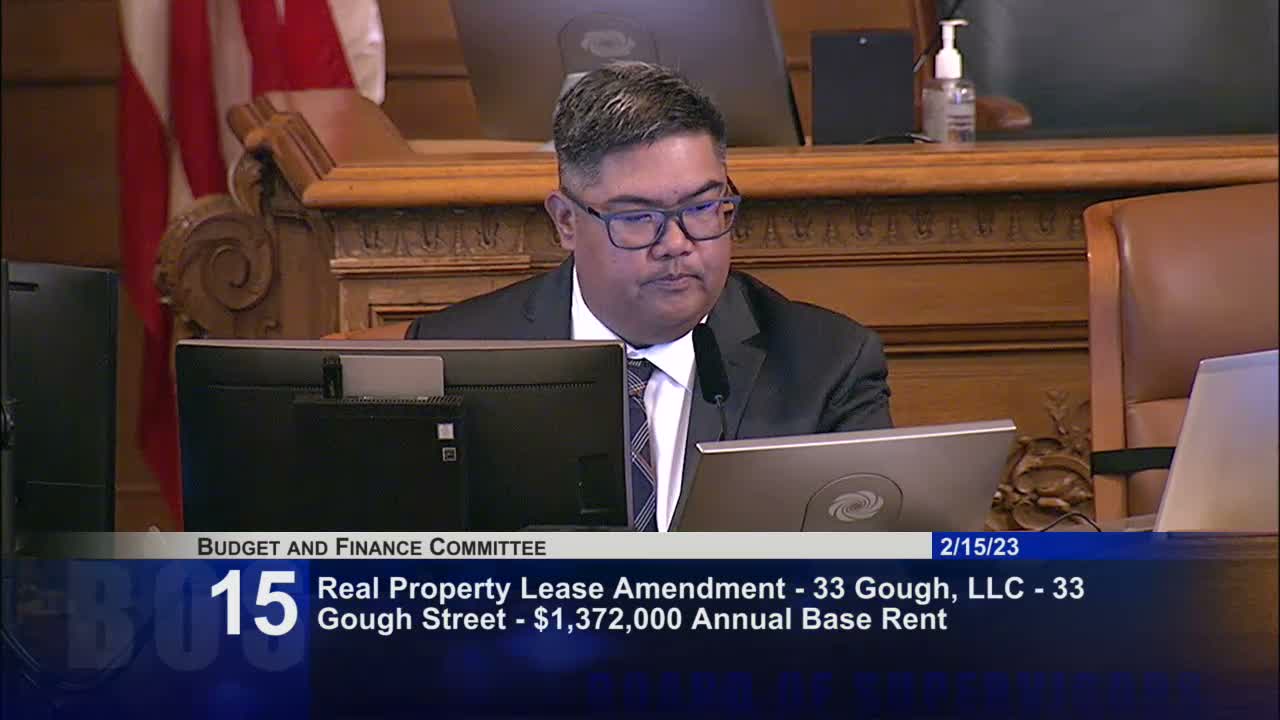
The Budget & Finance Committee on Feb. 15 forwarded to the full board a two‑year extension of the city's lease for the 33 Golf cabin community and a separate resolution authorizing the Department of Homelessness and Supportive Housing (HSH) to accept a $10.8 million Encampment Resolution grant from the state.
Emily Cohen, deputy director of communications and legislative affairs at HSH, said the lease amendment would extend the term through March 2025 (with a one‑year option) and set base rent at $1.3 million per year. "This was the first cabin community or tiny‑home community piloted in San Francisco," Cohen said, and HSH described the site as providing privacy and on‑site services including meals, showers and case management.
HSH deputy director of administration and finance Gigi Whitley provided an operating-cost breakdown: annual contract operations of about $3.2 million (Urban Alchemy contract), lease and taxes roughly $1.7 million, and meals about $528,000, for a total operating budget around $5.5 million a year. HSH said the site has 70 cabins with capacity to serve about 100 people and that, to date, it has served 128 households (156 people) with 16 exiting to shelter or permanent housing.
Supervisor Asha Safai and others pressed HSH about staffing ratios and scalability. Safai noted the high per‑unit operating cost (BLA cited roughly $78,000 per cabin per year) and asked whether donated capital (the cabins and installation) could be replicated at scale. HSH said the original cabins and installation were provided by partners (Tipping Point, Dignity Moves) and estimated a hypothetical all‑in cost of roughly $50,000–$60,000 per cabin if the city procured a similar model.
Public commenters included a resident of 33 Golf, who described the cabins as providing safety and dignity, and funders/operators (Tipping Point, Dignity Moves) who supported the extension but acknowledged challenges to scale. HSH said the state grant award — roughly $10.8 million — will allocate about $9.9 million to shelter capacity (including 33 Golf), $830,000 to hire five additional outreach workers, and $65,000 for an ADA‑accessible transport vehicle. The state requires obligation of funds by June 30, 2024 and spend‑down by June 30, 2025.
After extended discussion focused on cost drivers, staffing and data collection, the committee voted to forward both the lease amendment and the state grant acceptance to the full board with a positive recommendation.
Emily Cohen, deputy director of communications and legislative affairs at HSH, said the lease amendment would extend the term through March 2025 (with a one‑year option) and set base rent at $1.3 million per year. "This was the first cabin community or tiny‑home community piloted in San Francisco," Cohen said, and HSH described the site as providing privacy and on‑site services including meals, showers and case management.
HSH deputy director of administration and finance Gigi Whitley provided an operating-cost breakdown: annual contract operations of about $3.2 million (Urban Alchemy contract), lease and taxes roughly $1.7 million, and meals about $528,000, for a total operating budget around $5.5 million a year. HSH said the site has 70 cabins with capacity to serve about 100 people and that, to date, it has served 128 households (156 people) with 16 exiting to shelter or permanent housing.
Supervisor Asha Safai and others pressed HSH about staffing ratios and scalability. Safai noted the high per‑unit operating cost (BLA cited roughly $78,000 per cabin per year) and asked whether donated capital (the cabins and installation) could be replicated at scale. HSH said the original cabins and installation were provided by partners (Tipping Point, Dignity Moves) and estimated a hypothetical all‑in cost of roughly $50,000–$60,000 per cabin if the city procured a similar model.
Public commenters included a resident of 33 Golf, who described the cabins as providing safety and dignity, and funders/operators (Tipping Point, Dignity Moves) who supported the extension but acknowledged challenges to scale. HSH said the state grant award — roughly $10.8 million — will allocate about $9.9 million to shelter capacity (including 33 Golf), $830,000 to hire five additional outreach workers, and $65,000 for an ADA‑accessible transport vehicle. The state requires obligation of funds by June 30, 2024 and spend‑down by June 30, 2025.
After extended discussion focused on cost drivers, staffing and data collection, the committee voted to forward both the lease amendment and the state grant acceptance to the full board with a positive recommendation.
View the Full Meeting & All Its Details
This article offers just a summary. Unlock complete video, transcripts, and insights as a Founder Member.
✓
Watch full, unedited meeting videos
✓
Search every word spoken in unlimited transcripts
✓
AI summaries & real-time alerts (all government levels)
✓
Permanent access to expanding government content
30-day money-back guarantee
