Supervisors hear New York evidence as San Francisco grapples with stalled wellness‑hub plan
January 11, 2023 | San Francisco County, California
This article was created by AI summarizing key points discussed. AI makes mistakes, so for full details and context, please refer to the video of the full meeting. Please report any errors so we can fix them. Report an error »
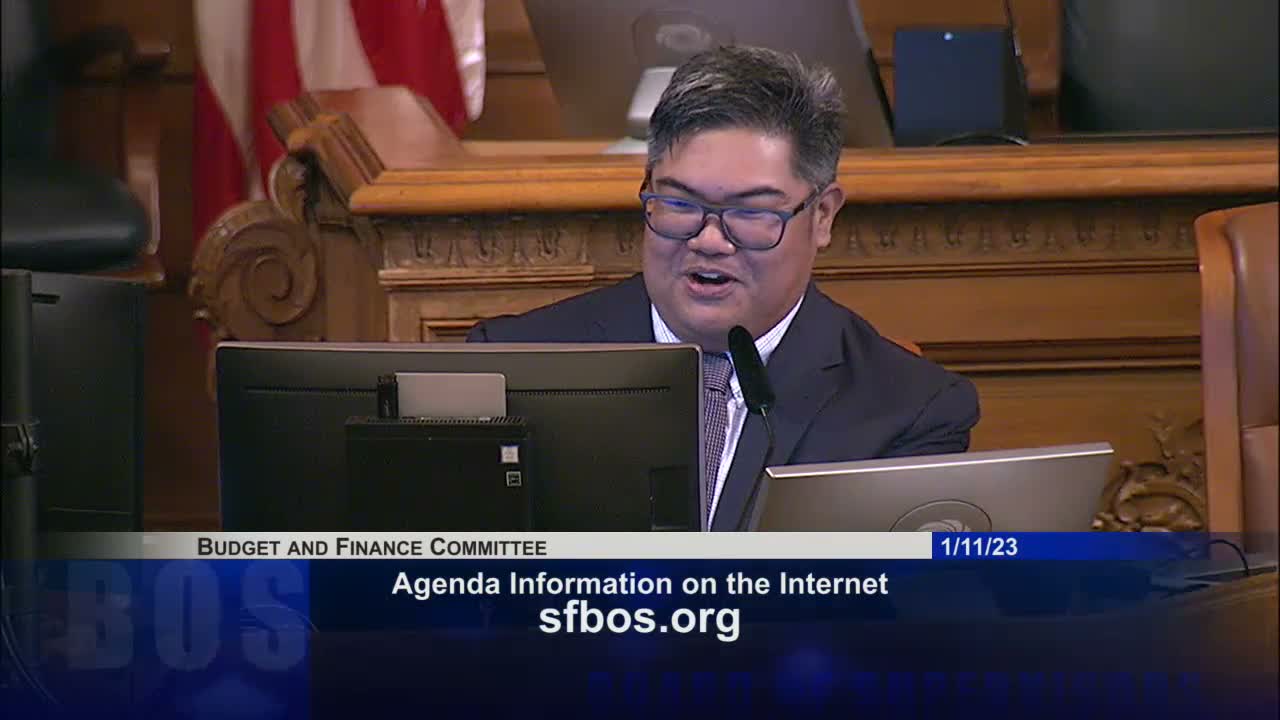
San Francisco’s Budget & Finance Committee heard prolonged testimony and public comment on Jan. 11 as supervisors sought answers about why the city’s Department of Public Health paused plans to open “wellness hubs” that would include supervised consumption areas.
Chair Supervisor Hillary Ronan opened the hearing by calling in outside experts from New York and the academic community and by showing a short OnPoint NYC video. Ronan said DPH had prepared a plan to open wellness hubs offering overdose‑prevention services, but “for reasons that are not entirely clear… the plan to open wellness centers came to a screeching halt.” She urged city officials to explain the change and to move with urgency to curb deaths and improve street conditions.
Why it matters: San Francisco recorded roughly 700 overdose deaths in the prior year and supervisors said the city has an urgent need for interventions that both save lives and reduce public drug use. Supporters argue that supervised consumption and integrated drop‑in services provide immediate overdose reversal, link people to treatment, and reduce improperly discarded syringes and public injection.
Evidence and operations from New York
Alex Kral, an epidemiologist, summarized peer‑reviewed literature from more than three decades and dozens of jurisdictions. He told the committee that international and emerging U.S. studies consistently show reduced overdose deaths, lower rates of syringe sharing and public injection, higher linkage to health and social services and measurable community benefits. “They reduce overdose deaths,” Kral said, describing the breadth of evidence.
Sam Rivera, executive director of OnPoint NYC, described the two sanctioned New York overdose prevention centers opened in late 2022. Rivera said the sites had supervised tens of thousands of consumptions, recorded hundreds of on‑site overdose interventions and reported zero on‑site fatalities. He described partnerships with local precincts and the district attorney’s offices and said the centers were funded through a mix of philanthropic support, non‑city grants and larger city funding for associated services. Rivera summarized a key operational point plainly: “If you use an OPC, you don’t have to die.”
City staff and public safety questions
San Francisco’s police and fire officials pressed OnPoint and the researchers on operational details: what level of care staff provide, when 911 is activated, and how a site affects EMS call volumes. Rivera and Kral said New York’s model treats most opioid overdoses on site and rarely triggers 911; they and researchers pointed to published evaluations showing reduced ambulance calls and fewer emergency department visits among site users.
Officials from the mayor’s office and the Department of Public Health emphasized the need to resolve legal and procedural questions. Anne Dunning, the mayor’s budget director, said the mayor supports the New York model in principle and that “our next step is to work with the City Attorney’s Office to… figure out the structure, and to make it happen.” Deputy City Attorney Anne Pearson later told the committee the city attorney has publicly expressed support for the New York model but that legal advice is provided confidentially to departments.
Public comment and community reaction
More than two dozen speakers during public comment urged rapid action. Providers, advocates and residents described the Tenderloin navigation center’s earlier, temporary work and said reopening and expanding wellness hubs would save lives and provide dignity and access to services. Some callers and commenters urged stronger community outreach, while a smaller set of callers raised concerns about neighborhood impacts and the need for more treatment beds.
Committee action and next steps
After testimony and public comment, Chair Ronan moved to "declare this hearing held and file this item." The committee approved the motion unanimously.
The hearing produced a clear set of tasks: supervisors asked city departments to (1) describe what DPH and the mayor’s office have done since the overdose prevention plan was shared previously; (2) identify specific legal definitions and guardrails that City Attorney and other offices require before a hub could open; and (3) return with concrete next steps — including funding sources and operational agreements — that would allow one or more pilot sites to open.
What’s next: Committee members said they want rapid, specific follow‑up from the mayor’s office, the city attorney and DPH so the board can consider whether to authorize or facilitate sites running with nonprofit operators. The city attorney has indicated public support for the New York model, but the committee asked departments to brief supervisors on precise legal language and funding strategies before action is taken.
Chair Supervisor Hillary Ronan opened the hearing by calling in outside experts from New York and the academic community and by showing a short OnPoint NYC video. Ronan said DPH had prepared a plan to open wellness hubs offering overdose‑prevention services, but “for reasons that are not entirely clear… the plan to open wellness centers came to a screeching halt.” She urged city officials to explain the change and to move with urgency to curb deaths and improve street conditions.
Why it matters: San Francisco recorded roughly 700 overdose deaths in the prior year and supervisors said the city has an urgent need for interventions that both save lives and reduce public drug use. Supporters argue that supervised consumption and integrated drop‑in services provide immediate overdose reversal, link people to treatment, and reduce improperly discarded syringes and public injection.
Evidence and operations from New York
Alex Kral, an epidemiologist, summarized peer‑reviewed literature from more than three decades and dozens of jurisdictions. He told the committee that international and emerging U.S. studies consistently show reduced overdose deaths, lower rates of syringe sharing and public injection, higher linkage to health and social services and measurable community benefits. “They reduce overdose deaths,” Kral said, describing the breadth of evidence.
Sam Rivera, executive director of OnPoint NYC, described the two sanctioned New York overdose prevention centers opened in late 2022. Rivera said the sites had supervised tens of thousands of consumptions, recorded hundreds of on‑site overdose interventions and reported zero on‑site fatalities. He described partnerships with local precincts and the district attorney’s offices and said the centers were funded through a mix of philanthropic support, non‑city grants and larger city funding for associated services. Rivera summarized a key operational point plainly: “If you use an OPC, you don’t have to die.”
City staff and public safety questions
San Francisco’s police and fire officials pressed OnPoint and the researchers on operational details: what level of care staff provide, when 911 is activated, and how a site affects EMS call volumes. Rivera and Kral said New York’s model treats most opioid overdoses on site and rarely triggers 911; they and researchers pointed to published evaluations showing reduced ambulance calls and fewer emergency department visits among site users.
Officials from the mayor’s office and the Department of Public Health emphasized the need to resolve legal and procedural questions. Anne Dunning, the mayor’s budget director, said the mayor supports the New York model in principle and that “our next step is to work with the City Attorney’s Office to… figure out the structure, and to make it happen.” Deputy City Attorney Anne Pearson later told the committee the city attorney has publicly expressed support for the New York model but that legal advice is provided confidentially to departments.
Public comment and community reaction
More than two dozen speakers during public comment urged rapid action. Providers, advocates and residents described the Tenderloin navigation center’s earlier, temporary work and said reopening and expanding wellness hubs would save lives and provide dignity and access to services. Some callers and commenters urged stronger community outreach, while a smaller set of callers raised concerns about neighborhood impacts and the need for more treatment beds.
Committee action and next steps
After testimony and public comment, Chair Ronan moved to "declare this hearing held and file this item." The committee approved the motion unanimously.
The hearing produced a clear set of tasks: supervisors asked city departments to (1) describe what DPH and the mayor’s office have done since the overdose prevention plan was shared previously; (2) identify specific legal definitions and guardrails that City Attorney and other offices require before a hub could open; and (3) return with concrete next steps — including funding sources and operational agreements — that would allow one or more pilot sites to open.
What’s next: Committee members said they want rapid, specific follow‑up from the mayor’s office, the city attorney and DPH so the board can consider whether to authorize or facilitate sites running with nonprofit operators. The city attorney has indicated public support for the New York model, but the committee asked departments to brief supervisors on precise legal language and funding strategies before action is taken.
View the Full Meeting & All Its Details
This article offers just a summary. Unlock complete video, transcripts, and insights as a Founder Member.
✓
Watch full, unedited meeting videos
✓
Search every word spoken in unlimited transcripts
✓
AI summaries & real-time alerts (all government levels)
✓
Permanent access to expanding government content
30-day money-back guarantee
