Supervisors press MOHCD, PUC and PG&E over $13M in loan increases tied to power‑connection delays
April 19, 2023 | San Francisco County, California
This article was created by AI summarizing key points discussed. AI makes mistakes, so for full details and context, please refer to the video of the full meeting. Please report any errors so we can fix them. Report an error »
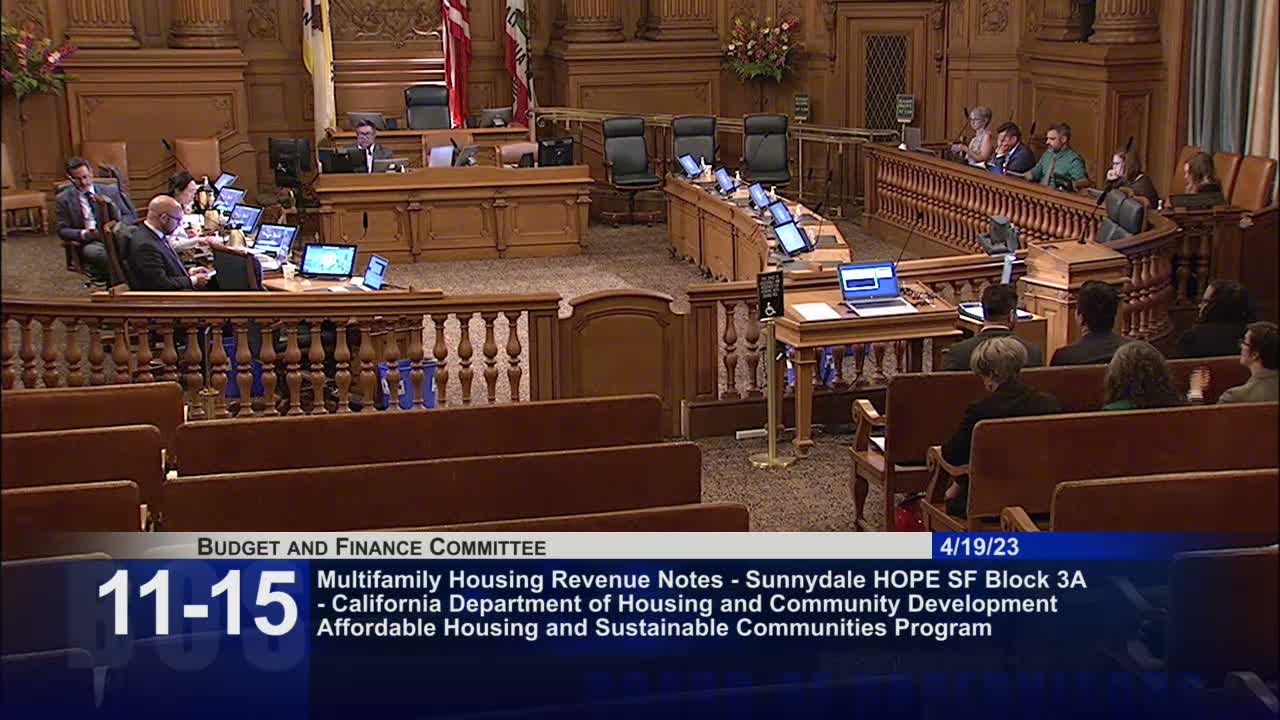
Two MOHCD loan amendments asking for roughly $13.2 million in additional city loan funds came before the Budget & Finance Committee on April 19 after projects encountered unexpected costs and schedule delays tied to wholesale power‑distribution redesign and PG&E/PUC approvals.
MOHCD Deputy Lydia Ealy said the requests — a $4.2 million increase for 555 Larkin (Turk 500 Associates) and an $8.98 million increase for 4840 Mission — are driven by a shift in the projects’ status to wholesale distribution, required engineering redesigns, trenching and off‑site infrastructure work, and delays that increased construction interest and reduced tax‑credit equity. MOHCD staff described cascading financial impacts: loss of a permanent‑loan rate lock, increased interest carry, and tax‑credit equity adjustments that reduced available equity. MOHCD said these are costs ‘‘beyond the developers’ control.’’
The BLA highlighted the city funding implications and recommended committee consideration of the policy question: whether the city should absorb these unanticipated costs or seek alternative funding and cost‑sharing. Supervisor Safai and others pressed MOHCD, SFPUC and PG&E for alternatives and asked why the expenditures cannot be treated as shared infrastructure or paid from restricted PUC funds. Catherine Spalding of SFPUC Power Enterprise said city charter provisions, Proposition 26 constraints and SFPUC rules limit the utility’s ability to pay costs that benefit a single customer; she also said the City is actively litigating certain PG&E requirements at the Federal Energy Regulatory Commission and that the City has negotiated a forward path to reduce such costs for future projects.
Community advocates and project sponsors told the committee that the funding would enable lease‑up and occupancy and urged approval so projects could move forward; developers warned that continued delay would cost months of additional interest and defer occupancy of affordable units. Committee members expressed frustration at recurring PG&E/PUC delays and discussed state legislative remedies; several supervisors asked MOHCD to pursue cost‑sharing where feasible and to return with strategies to avoid repeating these funding requests.
Because the matter raises a policy question about the city’s role in covering distribution‑infrastructure costs, and because the amendment language related to an easement was not finalized, the committee voted to forward the two items to the full Board without recommendation and approved a technical amendment striking the easement language until it is completed.
MOHCD Deputy Lydia Ealy said the requests — a $4.2 million increase for 555 Larkin (Turk 500 Associates) and an $8.98 million increase for 4840 Mission — are driven by a shift in the projects’ status to wholesale distribution, required engineering redesigns, trenching and off‑site infrastructure work, and delays that increased construction interest and reduced tax‑credit equity. MOHCD staff described cascading financial impacts: loss of a permanent‑loan rate lock, increased interest carry, and tax‑credit equity adjustments that reduced available equity. MOHCD said these are costs ‘‘beyond the developers’ control.’’
The BLA highlighted the city funding implications and recommended committee consideration of the policy question: whether the city should absorb these unanticipated costs or seek alternative funding and cost‑sharing. Supervisor Safai and others pressed MOHCD, SFPUC and PG&E for alternatives and asked why the expenditures cannot be treated as shared infrastructure or paid from restricted PUC funds. Catherine Spalding of SFPUC Power Enterprise said city charter provisions, Proposition 26 constraints and SFPUC rules limit the utility’s ability to pay costs that benefit a single customer; she also said the City is actively litigating certain PG&E requirements at the Federal Energy Regulatory Commission and that the City has negotiated a forward path to reduce such costs for future projects.
Community advocates and project sponsors told the committee that the funding would enable lease‑up and occupancy and urged approval so projects could move forward; developers warned that continued delay would cost months of additional interest and defer occupancy of affordable units. Committee members expressed frustration at recurring PG&E/PUC delays and discussed state legislative remedies; several supervisors asked MOHCD to pursue cost‑sharing where feasible and to return with strategies to avoid repeating these funding requests.
Because the matter raises a policy question about the city’s role in covering distribution‑infrastructure costs, and because the amendment language related to an easement was not finalized, the committee voted to forward the two items to the full Board without recommendation and approved a technical amendment striking the easement language until it is completed.
Don't Miss a Word: See the Full Meeting!
Go beyond summaries. Unlock every video, transcript, and key insight with a Founder Membership.
✓
Get instant access to full meeting videos
✓
Search and clip any phrase from complete transcripts
✓
Receive AI-powered summaries & custom alerts
✓
Enjoy lifetime, unrestricted access to government data
30-day money-back guarantee
