Supervisors hear airport workers as Airlines for America appeals Healthy Airport Ordinance
May 17, 2023 | San Francisco County, California
This article was created by AI summarizing key points discussed. AI makes mistakes, so for full details and context, please refer to the video of the full meeting. Please report any errors so we can fix them. Report an error »
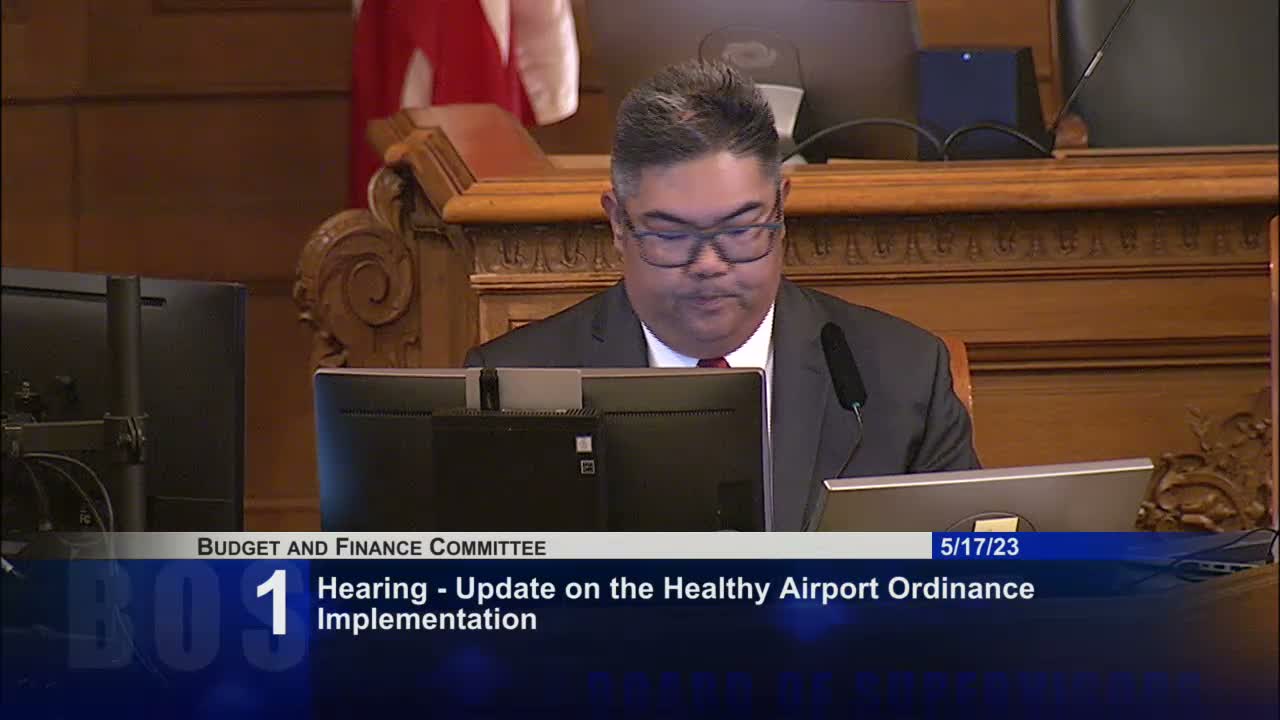
Chair Connie Chan convened the Budget & Finance Committee on May 17 for a hearing on the San Francisco Healthy Airport Ordinance and its implementation, drawing large public turnout from airport workers and union representatives. President Aaron Peskin, a cosponsor of the hearing, told the committee that Airlines for America sued the city in 2021 and the case is now pending before the Ninth Circuit after a district court upheld the ordinance.
Peskin said the committee needed to examine the ordinance’s fiscal effects on the Department of Public Health and on the upcoming city budget. “When our city workers…do not have adequate health care, that ultimately impacts our budget in other ways,” Peskin said. Deputy City Attorney Anne Pearson told the panel she could not speculate whether an invalidated ordinance could continue to bind parties by contract or bargaining agreements.
Kathy Widener, Government Affairs Director at San Francisco International Airport, said she provided the clerk a list of covered employers — “70 airlines including cargo and passenger and 91 service providers” — and confirmed that airport leases and permits include language requiring compliance with the HAO, the city’s Minimum Compensation Ordinance (MCO), and related standards. Widener said the airport lacks a complete, current retention analysis based on badging data and offered to pursue that research for the committee.
Unions and airport workers described the stakes in personal terms. Jane Martin of SEIU United Service Workers West said retention is a crisis: “Over 60% have been there less than 3 years,” she said, and urged faster progress at the bargaining table. Tom Scribe, an SFO bartender and Local 2 member, said, “I got my job at the airport because of the health care…If we lost those health care benefits…you would see the damage that would be done in our community.” Multiple speakers described medical debt, two‑job households and staffing shortages that they said stem from low wages and loss of benefits.
Committee members pressed the airport on possible models to preserve staff health benefits, including whether workers could be city employees or whether costs could flow to airlines through lease or rate structures. Widener said converting contractor employees into SFO employees or negotiating those costs with airlines are ideas the airport has not studied in detail and would require airline buy‑in.
After hearing testimony and presentations, Chair Chan moved to continue Item 1 to the call of the chair so staff and the budget and legislative analyst can follow up during the budget process; the motion passed on a 3‑0 roll call. The hearing record and additional materials provided by MOHCD, the airport and the unions will accompany future budget deliberations and any follow‑up committee hearings.
Next steps: the committee continued the matter to the call of the chair and asked staff to return with additional data on retention, the list of covered employers (filed with the clerk) and cost estimates for any city‑led options such as making SFO the master contractor or transitioning roles to airport employment.
Peskin said the committee needed to examine the ordinance’s fiscal effects on the Department of Public Health and on the upcoming city budget. “When our city workers…do not have adequate health care, that ultimately impacts our budget in other ways,” Peskin said. Deputy City Attorney Anne Pearson told the panel she could not speculate whether an invalidated ordinance could continue to bind parties by contract or bargaining agreements.
Kathy Widener, Government Affairs Director at San Francisco International Airport, said she provided the clerk a list of covered employers — “70 airlines including cargo and passenger and 91 service providers” — and confirmed that airport leases and permits include language requiring compliance with the HAO, the city’s Minimum Compensation Ordinance (MCO), and related standards. Widener said the airport lacks a complete, current retention analysis based on badging data and offered to pursue that research for the committee.
Unions and airport workers described the stakes in personal terms. Jane Martin of SEIU United Service Workers West said retention is a crisis: “Over 60% have been there less than 3 years,” she said, and urged faster progress at the bargaining table. Tom Scribe, an SFO bartender and Local 2 member, said, “I got my job at the airport because of the health care…If we lost those health care benefits…you would see the damage that would be done in our community.” Multiple speakers described medical debt, two‑job households and staffing shortages that they said stem from low wages and loss of benefits.
Committee members pressed the airport on possible models to preserve staff health benefits, including whether workers could be city employees or whether costs could flow to airlines through lease or rate structures. Widener said converting contractor employees into SFO employees or negotiating those costs with airlines are ideas the airport has not studied in detail and would require airline buy‑in.
After hearing testimony and presentations, Chair Chan moved to continue Item 1 to the call of the chair so staff and the budget and legislative analyst can follow up during the budget process; the motion passed on a 3‑0 roll call. The hearing record and additional materials provided by MOHCD, the airport and the unions will accompany future budget deliberations and any follow‑up committee hearings.
Next steps: the committee continued the matter to the call of the chair and asked staff to return with additional data on retention, the list of covered employers (filed with the clerk) and cost estimates for any city‑led options such as making SFO the master contractor or transitioning roles to airport employment.
Don't Miss a Word: See the Full Meeting!
Go beyond summaries. Unlock every video, transcript, and key insight with a Founder Membership.
✓
Get instant access to full meeting videos
✓
Search and clip any phrase from complete transcripts
✓
Receive AI-powered summaries & custom alerts
✓
Enjoy lifetime, unrestricted access to government data
30-day money-back guarantee
