Supervisors forward police-code reforms to ease entertainment permitting and limit commission handling of criminal-history data
November 29, 2023 | San Francisco County, California
This article was created by AI summarizing key points discussed. AI makes mistakes, so for full details and context, please refer to the video of the full meeting. Please report any errors so we can fix them. Report an error »
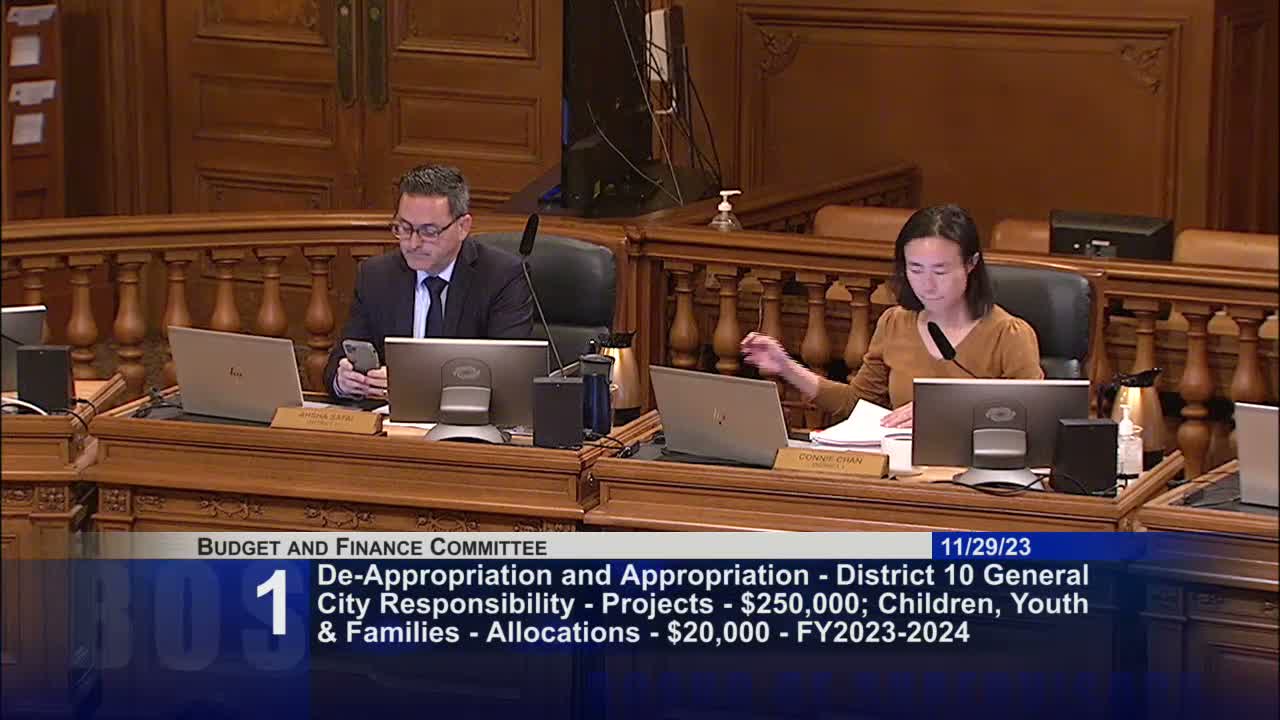
The Budget & Finance Committee on Nov. 29 advanced police‑code changes intended to simplify permits for nightlife and entertainment businesses and to modernize the Entertainment Commission’s application process.
Maggie Weiland, director of the San Francisco Entertainment Commission, said the package would waive initial application and license fees for businesses transitioning from pandemic 'just add music' permissions or newly eligible because of recent zoning changes, eliminate outdated permit categories and mandatory hearings for billiard‑parlor permits, and allow the commission to require security plans only when necessary.
Ben Van Houten of the Office of Economic and Workforce Development detailed technical reforms: removing archaic references (for example, masked‑ball permits), narrowing the categories of criminal charges that must be reported, and clarifying when applications must be resubmitted after more than 12 months of inactivity.
Supervisor Connie Chan pressed for clarity on public‑safety thresholds. Weiland and Van Houten said the commission will refer every application to public‑safety agencies (police, fire, DBI, public health) and can require a security plan or issue an administrative order to revise one. The commission emphasized an annual inspection program and the ability to escalate matters to the full commission for hearings when warranted.
A key change removes the Entertainment Commission’s role in collecting criminal‑history disclosures and instead strengthens referral review by the police department. Weiland said the change aims to protect sensitive applicant data from public records disclosure while keeping police access to background checks and retaining the department’s ability to flag concerns.
Supervisor Asha Safaiye expressed reservations about removing application disclosures without an explicit mechanism to ensure police review of the same details; staff said current referral codes still require the commission to send applications to police and that the city attorney supports the approach.
With no public speakers, Chair Chan moved the item to the full Board with a positive recommendation. The committee recorded the motion as passed.
Maggie Weiland, director of the San Francisco Entertainment Commission, said the package would waive initial application and license fees for businesses transitioning from pandemic 'just add music' permissions or newly eligible because of recent zoning changes, eliminate outdated permit categories and mandatory hearings for billiard‑parlor permits, and allow the commission to require security plans only when necessary.
Ben Van Houten of the Office of Economic and Workforce Development detailed technical reforms: removing archaic references (for example, masked‑ball permits), narrowing the categories of criminal charges that must be reported, and clarifying when applications must be resubmitted after more than 12 months of inactivity.
Supervisor Connie Chan pressed for clarity on public‑safety thresholds. Weiland and Van Houten said the commission will refer every application to public‑safety agencies (police, fire, DBI, public health) and can require a security plan or issue an administrative order to revise one. The commission emphasized an annual inspection program and the ability to escalate matters to the full commission for hearings when warranted.
A key change removes the Entertainment Commission’s role in collecting criminal‑history disclosures and instead strengthens referral review by the police department. Weiland said the change aims to protect sensitive applicant data from public records disclosure while keeping police access to background checks and retaining the department’s ability to flag concerns.
Supervisor Asha Safaiye expressed reservations about removing application disclosures without an explicit mechanism to ensure police review of the same details; staff said current referral codes still require the commission to send applications to police and that the city attorney supports the approach.
With no public speakers, Chair Chan moved the item to the full Board with a positive recommendation. The committee recorded the motion as passed.
View the Full Meeting & All Its Details
This article offers just a summary. Unlock complete video, transcripts, and insights as a Founder Member.
✓
Watch full, unedited meeting videos
✓
Search every word spoken in unlimited transcripts
✓
AI summaries & real-time alerts (all government levels)
✓
Permanent access to expanding government content
30-day money-back guarantee
