Supervisors approve emergency declaration to replace ZSFG chillers, cooling towers after catastrophic failure
January 10, 2024 | San Francisco County, California
This article was created by AI summarizing key points discussed. AI makes mistakes, so for full details and context, please refer to the video of the full meeting. Please report any errors so we can fix them. Report an error »
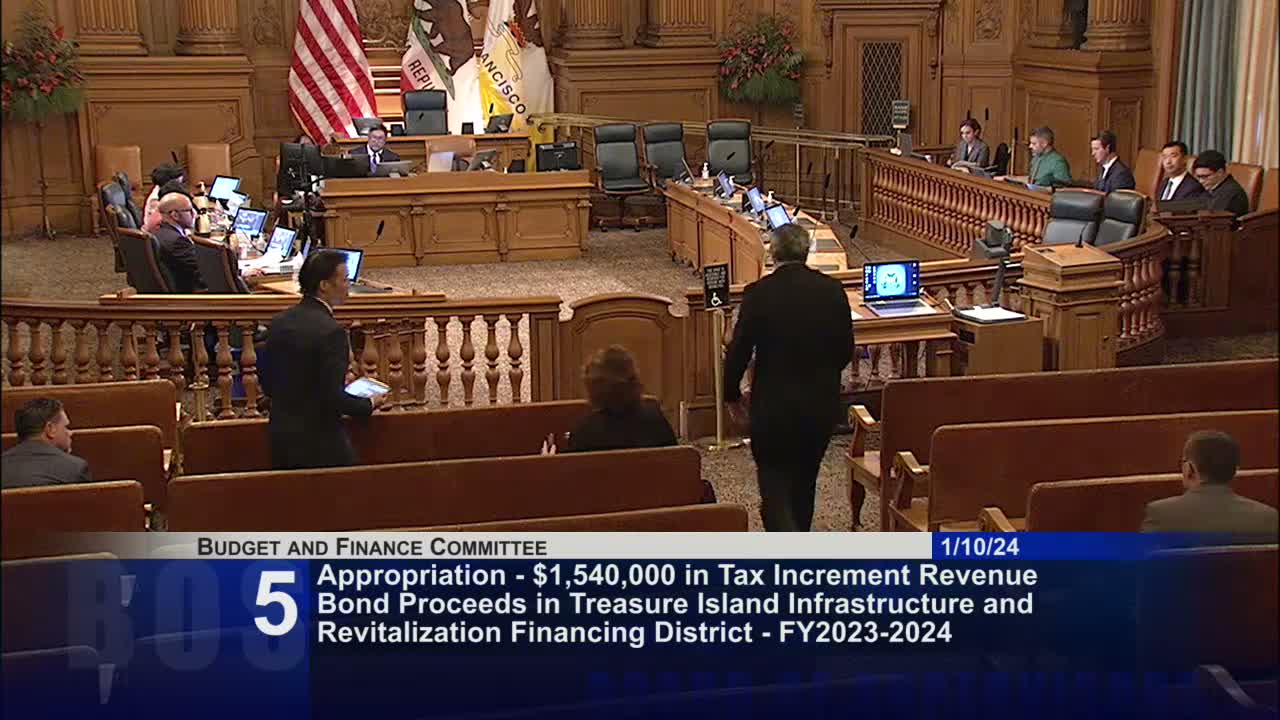
Chair Supervisor Connie Chan opened the discussion by thanking staff and noting, “thank goodness no one was hurt,” after the September cooling-tower failure that ejected heavy fan blades.
The Budget and Finance Committee voted to forward an emergency declaration for work at Zuckerberg San Francisco General Hospital (ZSFG) that Public Works and the Department of Public Health say is necessary to protect patients and staff and to avoid suspension of outpatient and inpatient services. Gabriel Lim, senior architect with Public Works, described the failure and the need to replace chillers, boilers and cooling towers and said temporary mobile cooling has provided stopgap relief.
Deputy department staff said the failure occurred on Sept. 6, 2023, when cooling towers catastrophically failed and blew fan blades into parking areas; they emphasized the towers are unrepairable and must be replaced. Jason Zook, executive project manager at ZSFG, told the committee the emergency declaration will speed the schedule: “by approving this emergency declaration, we can save 6 to 8 months off the total duration of the project,” reducing escalation risk.
The Budget and Legislative Analyst’s report notes the chiller/cooling-tower replacement has been planned since 2011 and listed roughly $26 million in prior general-fund allocations and $34.7 million in certificate-of-participation debt approved in 2020. BLA summarized the remaining project costs on its report and said the work is funded by previously approved general-fund dollars and planned debt issuance.
Committee members pressed staff on project cost and oversight. Chair Chan asked whether the emergency declaration, which waives certain procurement requirements under Administrative Code §6.6, contains a cap or a mechanism to return to the Board should costs rise. Deputy City Attorney Sarah Crowley responded that the Board’s vote is a determination that an emergency exists and that “there’s no cap imposed if the board approves this going forward without the chapter 6 requirements,” and that approval does not automatically trigger a return to the Board for additional authorization.
Chan said she was concerned about leaving open-ended waiver authority for very large projects and asked staff to bring back proposals to clarify thresholds in administrative code for when the Board should rehear cost increases or reauthorize. After extended discussion, the committee voted to forward the resolution to the full Board without recommendation.
Next steps: the committee’s action forwards the emergency declaration to the Board of Supervisors for final approval; staff said bids are due Jan. 19, 2024, with construction expected to start in March–April 2024 and completion currently forecast for 2026.
The Budget and Finance Committee voted to forward an emergency declaration for work at Zuckerberg San Francisco General Hospital (ZSFG) that Public Works and the Department of Public Health say is necessary to protect patients and staff and to avoid suspension of outpatient and inpatient services. Gabriel Lim, senior architect with Public Works, described the failure and the need to replace chillers, boilers and cooling towers and said temporary mobile cooling has provided stopgap relief.
Deputy department staff said the failure occurred on Sept. 6, 2023, when cooling towers catastrophically failed and blew fan blades into parking areas; they emphasized the towers are unrepairable and must be replaced. Jason Zook, executive project manager at ZSFG, told the committee the emergency declaration will speed the schedule: “by approving this emergency declaration, we can save 6 to 8 months off the total duration of the project,” reducing escalation risk.
The Budget and Legislative Analyst’s report notes the chiller/cooling-tower replacement has been planned since 2011 and listed roughly $26 million in prior general-fund allocations and $34.7 million in certificate-of-participation debt approved in 2020. BLA summarized the remaining project costs on its report and said the work is funded by previously approved general-fund dollars and planned debt issuance.
Committee members pressed staff on project cost and oversight. Chair Chan asked whether the emergency declaration, which waives certain procurement requirements under Administrative Code §6.6, contains a cap or a mechanism to return to the Board should costs rise. Deputy City Attorney Sarah Crowley responded that the Board’s vote is a determination that an emergency exists and that “there’s no cap imposed if the board approves this going forward without the chapter 6 requirements,” and that approval does not automatically trigger a return to the Board for additional authorization.
Chan said she was concerned about leaving open-ended waiver authority for very large projects and asked staff to bring back proposals to clarify thresholds in administrative code for when the Board should rehear cost increases or reauthorize. After extended discussion, the committee voted to forward the resolution to the full Board without recommendation.
Next steps: the committee’s action forwards the emergency declaration to the Board of Supervisors for final approval; staff said bids are due Jan. 19, 2024, with construction expected to start in March–April 2024 and completion currently forecast for 2026.
View the Full Meeting & All Its Details
This article offers just a summary. Unlock complete video, transcripts, and insights as a Founder Member.
✓
Watch full, unedited meeting videos
✓
Search every word spoken in unlimited transcripts
✓
AI summaries & real-time alerts (all government levels)
✓
Permanent access to expanding government content
30-day money-back guarantee
