Budget & Finance Committee backs plan to phase out PFAS in firefighters' turnout gear
May 01, 2024 | San Francisco County, California
This article was created by AI summarizing key points discussed. AI makes mistakes, so for full details and context, please refer to the video of the full meeting. Please report any errors so we can fix them. Report an error »
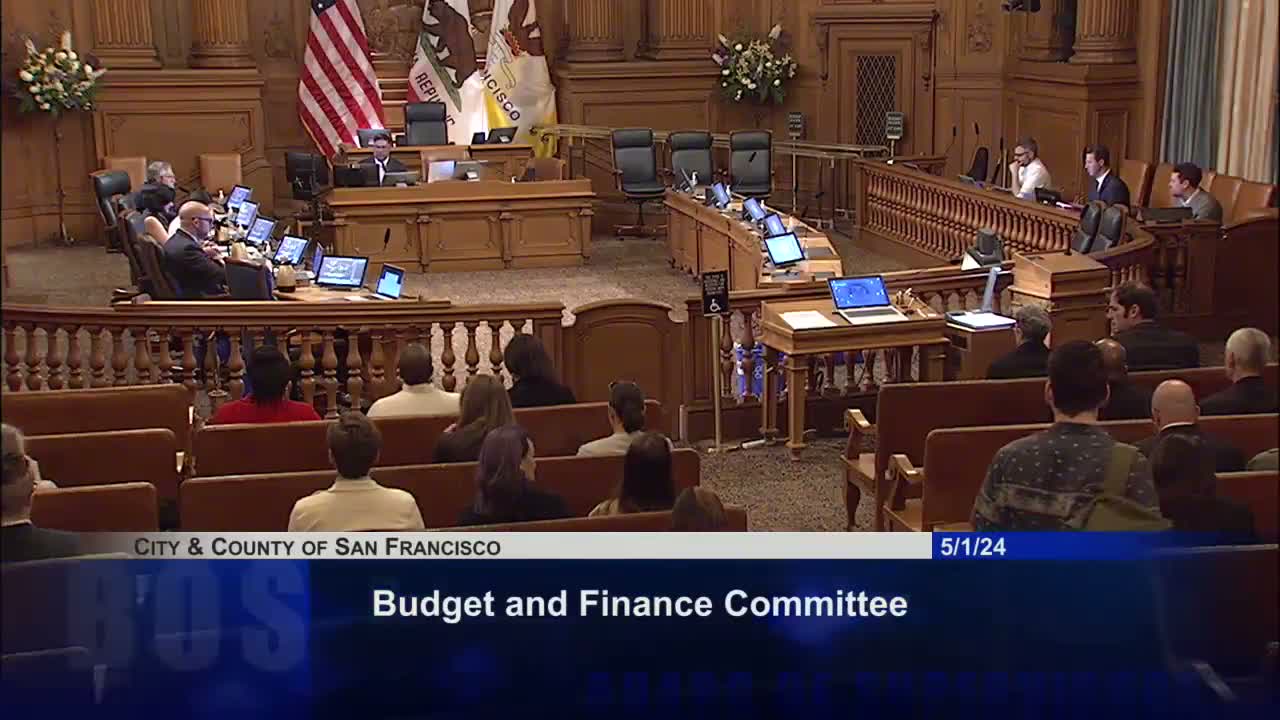
San Francisco's Budget & Finance Committee on May 1 advanced an ordinance to the full Board that would phase out per- and polyfluoroalkyl substances (PFAS) in firefighters' personal protective gear by June 30, 2026.
Board President Aaron Peskin, sponsor of the ordinance, told the committee the measure would make the city "the first city in the country to ban cancer-causing chemicals from our firefighters' personal protective gear." He said the legislation sets a timeline and a labor-management process for implementing a phase-out and requires regular reports back to the Board and Fire Commission.
Chief Janine Nicholson and Adam Wood of the San Francisco Firefighters Cancer Prevention Foundation described research and ongoing wear tests. Wood cited federal research and recent tests and said the National Institute of Standards and Technology (NIST) identified PFAS in turnout materials; "those chemicals will migrate to all 3 layers of the garment," he said, arguing there is no safe level of PFAS in gear.
Chief Nicholson outlined operational constraints and procurement realities: the department is conducting a 90-day wear test with 10 members using samples from two vendors and said only one vendor (Lion) currently has product availability with about a three-month lead time. She cautioned about longevity and durability trade-offs and noted the department's current budget includes $900,000 for turnout purchases but that replacing all sets could cost in the range of $10.2 million to $11.5 million, depending on unit pricing and useful life.
The Budget and Legislative Analyst placed the estimated cost to meet the June 2026 deadline at $10.1 million and noted the department currently budgets about $850,000 annually for uniform replacement; after the $2.3 million FEMA grant Menard said is pending at the controller's office, the department would need to add roughly $3.1 million per year over the next two years to meet the deadline.
Union leadership urged action. Floyd Rollins, president of Local 798, called the ordinance "groundbreaking" and said legislative support is essential to move the effort forward.
The committee voted to forward the ordinance to the full Board with a positive recommendation (Mandelmann, Melgar and Chan voting aye). The committee docketed the ordinance for Board consideration with the requirement that departments report progress as called for in the measure.
Board President Aaron Peskin, sponsor of the ordinance, told the committee the measure would make the city "the first city in the country to ban cancer-causing chemicals from our firefighters' personal protective gear." He said the legislation sets a timeline and a labor-management process for implementing a phase-out and requires regular reports back to the Board and Fire Commission.
Chief Janine Nicholson and Adam Wood of the San Francisco Firefighters Cancer Prevention Foundation described research and ongoing wear tests. Wood cited federal research and recent tests and said the National Institute of Standards and Technology (NIST) identified PFAS in turnout materials; "those chemicals will migrate to all 3 layers of the garment," he said, arguing there is no safe level of PFAS in gear.
Chief Nicholson outlined operational constraints and procurement realities: the department is conducting a 90-day wear test with 10 members using samples from two vendors and said only one vendor (Lion) currently has product availability with about a three-month lead time. She cautioned about longevity and durability trade-offs and noted the department's current budget includes $900,000 for turnout purchases but that replacing all sets could cost in the range of $10.2 million to $11.5 million, depending on unit pricing and useful life.
The Budget and Legislative Analyst placed the estimated cost to meet the June 2026 deadline at $10.1 million and noted the department currently budgets about $850,000 annually for uniform replacement; after the $2.3 million FEMA grant Menard said is pending at the controller's office, the department would need to add roughly $3.1 million per year over the next two years to meet the deadline.
Union leadership urged action. Floyd Rollins, president of Local 798, called the ordinance "groundbreaking" and said legislative support is essential to move the effort forward.
The committee voted to forward the ordinance to the full Board with a positive recommendation (Mandelmann, Melgar and Chan voting aye). The committee docketed the ordinance for Board consideration with the requirement that departments report progress as called for in the measure.
View the Full Meeting & All Its Details
This article offers just a summary. Unlock complete video, transcripts, and insights as a Founder Member.
✓
Watch full, unedited meeting videos
✓
Search every word spoken in unlimited transcripts
✓
AI summaries & real-time alerts (all government levels)
✓
Permanent access to expanding government content
30-day money-back guarantee
