Port advances nonbinding term sheet for Pier 3032 and Seawall Lot 330, flags $125 million infrastructure gap
April 24, 2024 | San Francisco County, California
This article was created by AI summarizing key points discussed. AI makes mistakes, so for full details and context, please refer to the video of the full meeting. Please report any errors so we can fix them. Report an error »
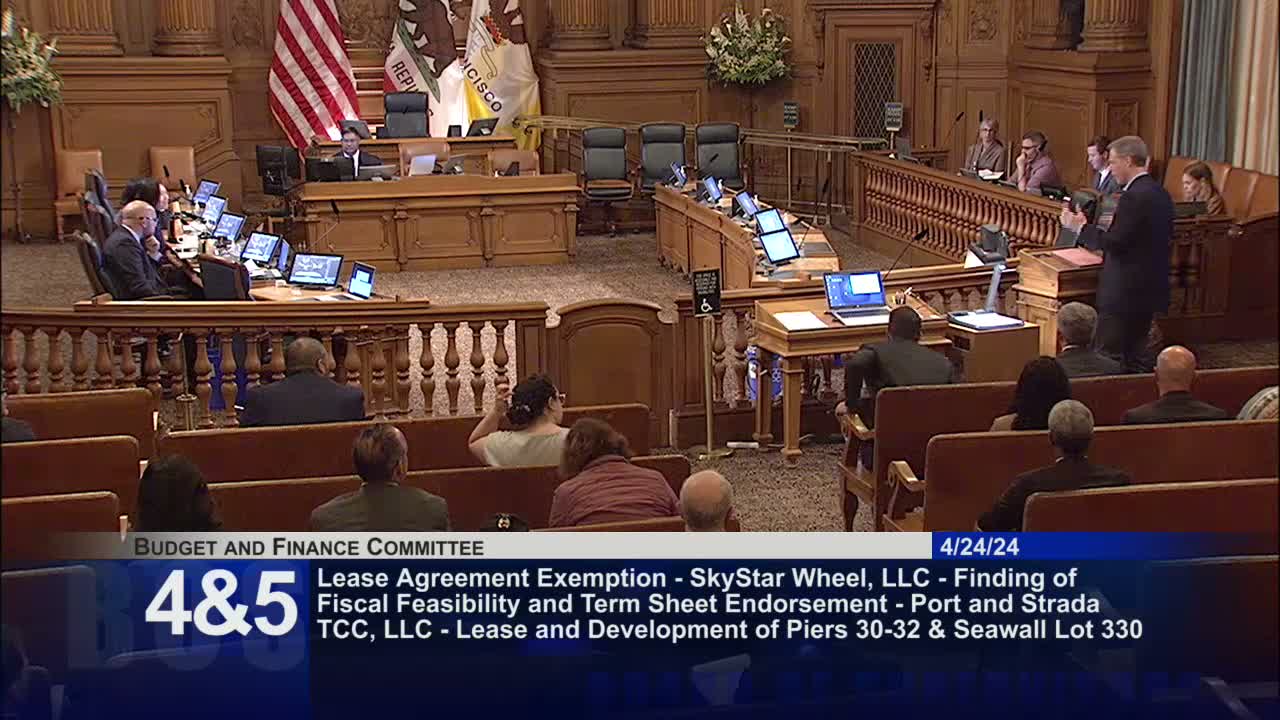
San Francisco port officials asked the Board of Supervisors’ Budget and Finance Committee on April 24 to endorse a nonbinding term sheet for a large redevelopment that pairs residential construction on Seawall Lot 330 with reconstruction of Pier 3032.
Wyatt Donnelly Landolt, a port project lead, said the proposal would deliver about 713 residential units across multiple phases, dedicate a parcel for a 100‑unit affordable building, and rebuild Pier 3032 with office, retail and public market hall space alongside major seawall and horizontal infrastructure improvements. The term sheet contemplates public financing tools—including a community facilities district (CFD) and an infrastructure financing district (IFD)—to help close financing gaps.
The budget and legislative analyst’s fiscal review included with the item estimates net ongoing general‑fund revenue of roughly $2.48 million from the piers if the project proceeds as structured. But Donnelly Landolt and port staff reported a remaining infrastructure funding shortfall of about $125 million on the pier component; they said bridging that gap could require adjustments such as additional public financing, impact‑fee changes, tax increment, or state and federal grants. Construction on Lot 330 is projected, in the current timeline, to begin in 2028 with Pier 3032 work anticipated from 2031 to 2035; the port said LDDA execution is planned in 2026.
Committee members pressed staff on risk allocation related to phasing. Vice Chair Rafael Mendelmann noted the danger of advancing the residential side while the pier side remains unfunded, reducing the public returns that underpin many of the public financing tools. Port staff said the term sheet contains triggers and reallocation measures to concentrate public financing on Pier 3032 if the developer does not meet milestones, and emphasized that the term sheet is nonbinding and subject to future change.
Community and labor supporters spoke in favor of the plan. Katie Liddell, co‑chair of the Port’s Northern Advisory Committee, and Rudy Gonzalez of the San Francisco Building and Construction Trades Council praised the developer’s public outreach, the inclusion of public access features and the potential jobs generated by construction. Port staff also highlighted coordination with the Army Corps for seismic and flood resilience work and said the project could complement federally supported seawall investments.
The committee voted to forward the port’s fiscal‑feasibility endorsement and the term sheet to the full Board of Supervisors with a positive recommendation and asked the port to return with a finalized financing plan when transaction documents are ready.
What’s next: the port will pursue environmental review, continue regulatory coordination including with the Army Corps and the Bay Conservation and Development Commission, and work to identify public and private sources to close the $125 million shortfall before returning with final transaction documents.
Wyatt Donnelly Landolt, a port project lead, said the proposal would deliver about 713 residential units across multiple phases, dedicate a parcel for a 100‑unit affordable building, and rebuild Pier 3032 with office, retail and public market hall space alongside major seawall and horizontal infrastructure improvements. The term sheet contemplates public financing tools—including a community facilities district (CFD) and an infrastructure financing district (IFD)—to help close financing gaps.
The budget and legislative analyst’s fiscal review included with the item estimates net ongoing general‑fund revenue of roughly $2.48 million from the piers if the project proceeds as structured. But Donnelly Landolt and port staff reported a remaining infrastructure funding shortfall of about $125 million on the pier component; they said bridging that gap could require adjustments such as additional public financing, impact‑fee changes, tax increment, or state and federal grants. Construction on Lot 330 is projected, in the current timeline, to begin in 2028 with Pier 3032 work anticipated from 2031 to 2035; the port said LDDA execution is planned in 2026.
Committee members pressed staff on risk allocation related to phasing. Vice Chair Rafael Mendelmann noted the danger of advancing the residential side while the pier side remains unfunded, reducing the public returns that underpin many of the public financing tools. Port staff said the term sheet contains triggers and reallocation measures to concentrate public financing on Pier 3032 if the developer does not meet milestones, and emphasized that the term sheet is nonbinding and subject to future change.
Community and labor supporters spoke in favor of the plan. Katie Liddell, co‑chair of the Port’s Northern Advisory Committee, and Rudy Gonzalez of the San Francisco Building and Construction Trades Council praised the developer’s public outreach, the inclusion of public access features and the potential jobs generated by construction. Port staff also highlighted coordination with the Army Corps for seismic and flood resilience work and said the project could complement federally supported seawall investments.
The committee voted to forward the port’s fiscal‑feasibility endorsement and the term sheet to the full Board of Supervisors with a positive recommendation and asked the port to return with a finalized financing plan when transaction documents are ready.
What’s next: the port will pursue environmental review, continue regulatory coordination including with the Army Corps and the Bay Conservation and Development Commission, and work to identify public and private sources to close the $125 million shortfall before returning with final transaction documents.
Don't Miss a Word: See the Full Meeting!
Go beyond summaries. Unlock every video, transcript, and key insight with a Founder Membership.
✓
Get instant access to full meeting videos
✓
Search and clip any phrase from complete transcripts
✓
Receive AI-powered summaries & custom alerts
✓
Enjoy lifetime, unrestricted access to government data
30-day money-back guarantee
