Board committee backs transfer of century-old Civic Center steam loop and advances two long-term city leases
April 17, 2024 | San Francisco County, California
This article was created by AI summarizing key points discussed. AI makes mistakes, so for full details and context, please refer to the video of the full meeting. Please report any errors so we can fix them. Report an error »
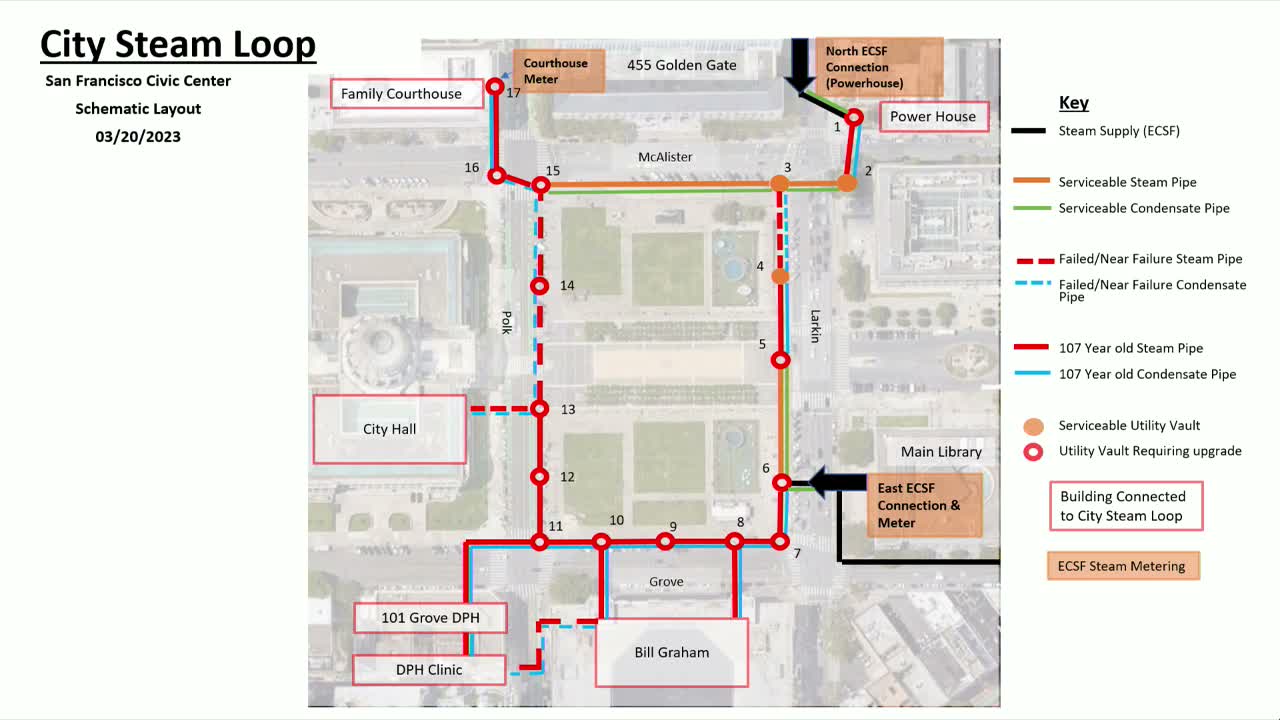
The Budget and Finance Committee on April 17 forwarded to the full Board a multi-part real estate package that would transfer ownership of the century-old Civic Center steam loop to Energy Center San Francisco and approve long-term leases for city occupancy at 1145 and 1455 Market Street.
President of the Board Aaron Peskin, the package sponsor, summarized the deal as a plan to move an aging, high-liability asset out of direct city maintenance while preserving service to civic facilities. Real Estate Director Andrico Penick told the committee the loop—built in 1915—has suffered deferred maintenance and that emergency and replacement needs would cost the city an estimated $4.9 million for immediate repairs and roughly $12 million to replace corroding piping and valves. Under the proposed transfer, the city would convey the loop to ECSF for $1 and pay ECSF $3.1 million to complete emergency repairs; ECSF would assume future maintenance and liabilities and the city would contract to buy steam from ECSF for five years.
Penick said the agreement includes easements to permit ECSF to access portions of the loop and an indemnity structure that separates city liability for incidents occurring before the transfer from ECSF’s liability after the transfer; the city would continue to indemnify ECSF for claims for up to three years that relate to pre-transfer damage, a window Penick said aligns with typical statutes of limitation. The Budget and Legislative Analyst recommended adding a resolve clause that “the public interest or necessity demands or will not be inconvenienced by the transfer,” language the committee adopted as an amendment.
The package also includes two major office leases: a 10‑year lease (with two five‑year options) at 1145 Market Street starting at $29.95 per sq. ft. and a 21‑year lease at 1455 Market Street at $40 per sq. ft. that begins May 1. Penick said consolidating departments into those leases—moving multiple city offices out of older, seismically vulnerable buildings—would reduce ongoing general‑fund lease costs, provide swing space during buildouts and create an option to purchase if sufficient occupancy thresholds are met.
Supporters at the hearing included representatives from the building trades and tenant advocates who said the moves create union jobs and long‑term cost savings. Brendan Cox of Lighthouse for the Blind and Visually Impaired and other nonprofit stakeholders urged the committee to consider impacts on local nonprofits; the committee discussed but did not adopt a requirement that lease extension options be subject to future board approval, instead directing Real Estate to provide advance notice to the Board when it plans to exercise options.
The committee voted 3–0 to forward items 7, 8 and 9 with the BLA‑recommended amendments and additional notice language to the full Board. Next steps: the agreements will return to the Board of Supervisors for a final vote and, in the case of the steam‑loop transfer, subsequent work to schedule and begin emergency repairs once approvals and easements are finalized.
President of the Board Aaron Peskin, the package sponsor, summarized the deal as a plan to move an aging, high-liability asset out of direct city maintenance while preserving service to civic facilities. Real Estate Director Andrico Penick told the committee the loop—built in 1915—has suffered deferred maintenance and that emergency and replacement needs would cost the city an estimated $4.9 million for immediate repairs and roughly $12 million to replace corroding piping and valves. Under the proposed transfer, the city would convey the loop to ECSF for $1 and pay ECSF $3.1 million to complete emergency repairs; ECSF would assume future maintenance and liabilities and the city would contract to buy steam from ECSF for five years.
Penick said the agreement includes easements to permit ECSF to access portions of the loop and an indemnity structure that separates city liability for incidents occurring before the transfer from ECSF’s liability after the transfer; the city would continue to indemnify ECSF for claims for up to three years that relate to pre-transfer damage, a window Penick said aligns with typical statutes of limitation. The Budget and Legislative Analyst recommended adding a resolve clause that “the public interest or necessity demands or will not be inconvenienced by the transfer,” language the committee adopted as an amendment.
The package also includes two major office leases: a 10‑year lease (with two five‑year options) at 1145 Market Street starting at $29.95 per sq. ft. and a 21‑year lease at 1455 Market Street at $40 per sq. ft. that begins May 1. Penick said consolidating departments into those leases—moving multiple city offices out of older, seismically vulnerable buildings—would reduce ongoing general‑fund lease costs, provide swing space during buildouts and create an option to purchase if sufficient occupancy thresholds are met.
Supporters at the hearing included representatives from the building trades and tenant advocates who said the moves create union jobs and long‑term cost savings. Brendan Cox of Lighthouse for the Blind and Visually Impaired and other nonprofit stakeholders urged the committee to consider impacts on local nonprofits; the committee discussed but did not adopt a requirement that lease extension options be subject to future board approval, instead directing Real Estate to provide advance notice to the Board when it plans to exercise options.
The committee voted 3–0 to forward items 7, 8 and 9 with the BLA‑recommended amendments and additional notice language to the full Board. Next steps: the agreements will return to the Board of Supervisors for a final vote and, in the case of the steam‑loop transfer, subsequent work to schedule and begin emergency repairs once approvals and easements are finalized.
Don't Miss a Word: See the Full Meeting!
Go beyond summaries. Unlock every video, transcript, and key insight with a Founder Membership.
✓
Get instant access to full meeting videos
✓
Search and clip any phrase from complete transcripts
✓
Receive AI-powered summaries & custom alerts
✓
Enjoy lifetime, unrestricted access to government data
30-day money-back guarantee
