OEWD outlines equity-focused small-business relief: $152.6M department budget, expanded grants and 0% loans
May 11, 2022 | San Francisco County, California
This article was created by AI summarizing key points discussed. AI makes mistakes, so for full details and context, please refer to the video of the full meeting. Please report any errors so we can fix them. Report an error »
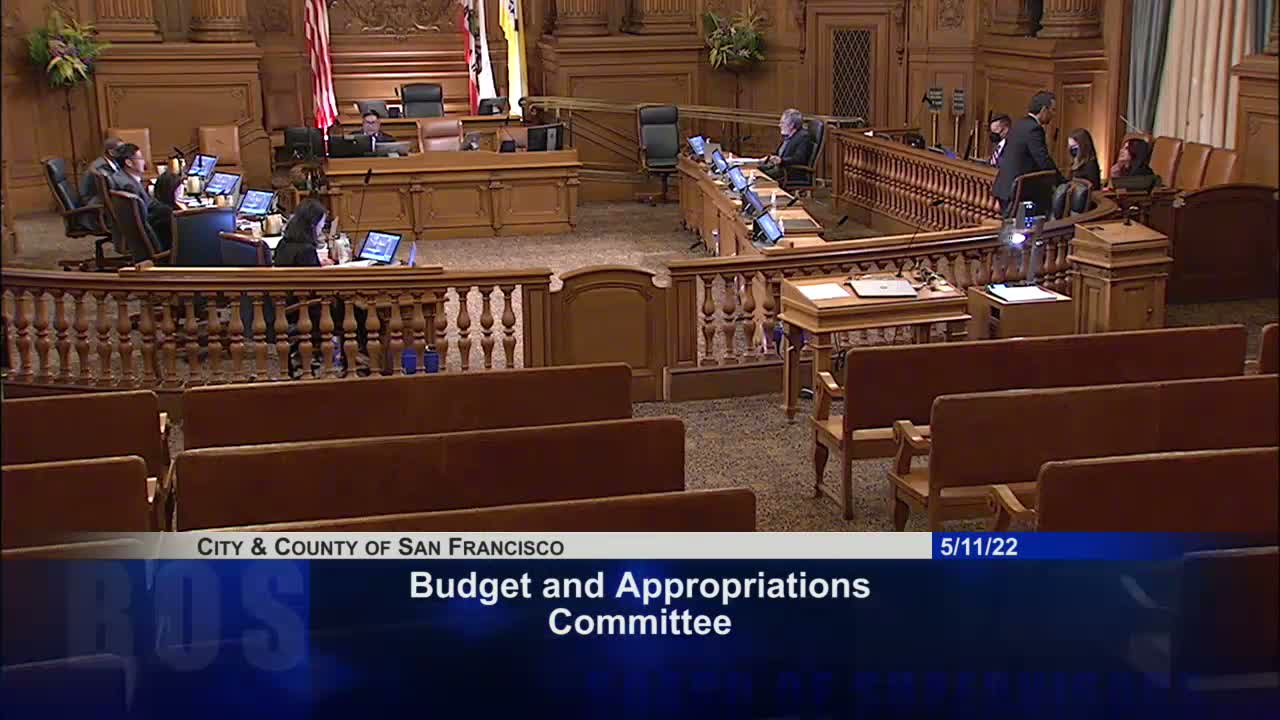
Kate Sophos, executive director of the city's Office of Economic and Workforce Development, told the Budget & Appropriations Committee on May 11 that OEWD's recovery work centers on racial and economic equity and that small-business programs will be a priority in the coming budget. "Our vision is about equity," Sophos said, adding that the department has reorganized to strengthen linkages between workforce and small-business programs.
Sophos said the department's approved fiscal-year budget at the time was about $152,600,000 and that the Office of Small Business and Invest in Neighborhoods together account for roughly $48,000,000 of that total. She told supervisors that OEWD relies on 102 community partners to extend services and is operating with about 21% of positions vacant, which she said has constrained program delivery.
Why it matters: Supervisors framed the hearing around whether pandemic-era relief reached micro and low-revenue businesses and whether OEWD's spending is distributed equitably across neighborhoods. Supervisors asked for finer-grain reporting on recipients' employee counts, gross revenues and neighborhood-level award totals so the board can assess whether the smallest businesses are being reached.
Key program numbers and descriptions presented to the committee: OEWD said it provided more than 3,000 awards in the past year across grants and leveraged loans. Sophos described a leveraged-loan approach in which the city invested about $2 million of public funds to buy down interest rates, producing more than $20 million in 0% loans to small businesses (loans up to $100,000). Regular grant tiers ranged from roughly $2,500 to $25,000. Sophos also described a $2 million commercial rent repayment pilot that drew more than $10 million in applicant demand, underscoring that demand outstrips available funds.
Language access and legal assistance: In response to questioning, Sophos and Diana Ponce de Leon, Invest in Neighborhoods director, said OEWD and partners ran multilingual webinars (Spanish, Mandarin, Cantonese) and contracted pro bono legal providers (including the San Francisco Bar Association) to provide mediation and negotiation assistance; the Bar reports quarterly on cases and outcomes and staff said they will compile and share more detailed metrics and case-resolution counts with supervisors.
Targeting micro and low-revenue businesses: Supervisors pressed OEWD on definitions. OEWD said it uses the administrative-code definition used when the Office of Small Business was established (firms with 100 or fewer employees) for many datasets, but that many grant programs include gross-receipts thresholds (commonly $2.5 million) and that OEWD's micro-business priority typically targets firms with five or fewer employees. OEWD staff said grant applications ask about gross revenue so that awards can be prioritized to lower-revenue businesses.
Program design and equity: Sophos highlighted Dreamkeeper-funded pilots — for example, cohort training with Children's Council to expand home-based childcare and a Black business development cohort run by SF Black Wall Street — and said OEWD is piloting standardized impact metrics to better track whether trainings lead to new businesses or other sustained outcomes. She described consolidation of the Small Business Development Center with the Office of Small Business to centralize permitting and client navigation.
What supervisors asked for next: Multiple supervisors requested a district-by-district breakdown of investments (including the Invest in Neighborhoods portfolio), demographic and gender breakdowns of grant recipients, and outcome metrics tied to technical assistance (for instance, numbers showing how many trainees subsequently opened businesses). OEWD committed to compiling and returning with the requested data.
The committee continued the item to the call of the chair for follow-up reporting and additional data requests.
Sophos said the department's approved fiscal-year budget at the time was about $152,600,000 and that the Office of Small Business and Invest in Neighborhoods together account for roughly $48,000,000 of that total. She told supervisors that OEWD relies on 102 community partners to extend services and is operating with about 21% of positions vacant, which she said has constrained program delivery.
Why it matters: Supervisors framed the hearing around whether pandemic-era relief reached micro and low-revenue businesses and whether OEWD's spending is distributed equitably across neighborhoods. Supervisors asked for finer-grain reporting on recipients' employee counts, gross revenues and neighborhood-level award totals so the board can assess whether the smallest businesses are being reached.
Key program numbers and descriptions presented to the committee: OEWD said it provided more than 3,000 awards in the past year across grants and leveraged loans. Sophos described a leveraged-loan approach in which the city invested about $2 million of public funds to buy down interest rates, producing more than $20 million in 0% loans to small businesses (loans up to $100,000). Regular grant tiers ranged from roughly $2,500 to $25,000. Sophos also described a $2 million commercial rent repayment pilot that drew more than $10 million in applicant demand, underscoring that demand outstrips available funds.
Language access and legal assistance: In response to questioning, Sophos and Diana Ponce de Leon, Invest in Neighborhoods director, said OEWD and partners ran multilingual webinars (Spanish, Mandarin, Cantonese) and contracted pro bono legal providers (including the San Francisco Bar Association) to provide mediation and negotiation assistance; the Bar reports quarterly on cases and outcomes and staff said they will compile and share more detailed metrics and case-resolution counts with supervisors.
Targeting micro and low-revenue businesses: Supervisors pressed OEWD on definitions. OEWD said it uses the administrative-code definition used when the Office of Small Business was established (firms with 100 or fewer employees) for many datasets, but that many grant programs include gross-receipts thresholds (commonly $2.5 million) and that OEWD's micro-business priority typically targets firms with five or fewer employees. OEWD staff said grant applications ask about gross revenue so that awards can be prioritized to lower-revenue businesses.
Program design and equity: Sophos highlighted Dreamkeeper-funded pilots — for example, cohort training with Children's Council to expand home-based childcare and a Black business development cohort run by SF Black Wall Street — and said OEWD is piloting standardized impact metrics to better track whether trainings lead to new businesses or other sustained outcomes. She described consolidation of the Small Business Development Center with the Office of Small Business to centralize permitting and client navigation.
What supervisors asked for next: Multiple supervisors requested a district-by-district breakdown of investments (including the Invest in Neighborhoods portfolio), demographic and gender breakdowns of grant recipients, and outcome metrics tied to technical assistance (for instance, numbers showing how many trainees subsequently opened businesses). OEWD committed to compiling and returning with the requested data.
The committee continued the item to the call of the chair for follow-up reporting and additional data requests.
View the Full Meeting & All Its Details
This article offers just a summary. Unlock complete video, transcripts, and insights as a Founder Member.
✓
Watch full, unedited meeting videos
✓
Search every word spoken in unlimited transcripts
✓
AI summaries & real-time alerts (all government levels)
✓
Permanent access to expanding government content
30-day money-back guarantee
