Controller says budget relies on $1 billion in one‑time funding, warns of heightened risks to reserves
June 15, 2022 | San Francisco County, California
This article was created by AI summarizing key points discussed. AI makes mistakes, so for full details and context, please refer to the video of the full meeting. Please report any errors so we can fix them. Report an error »
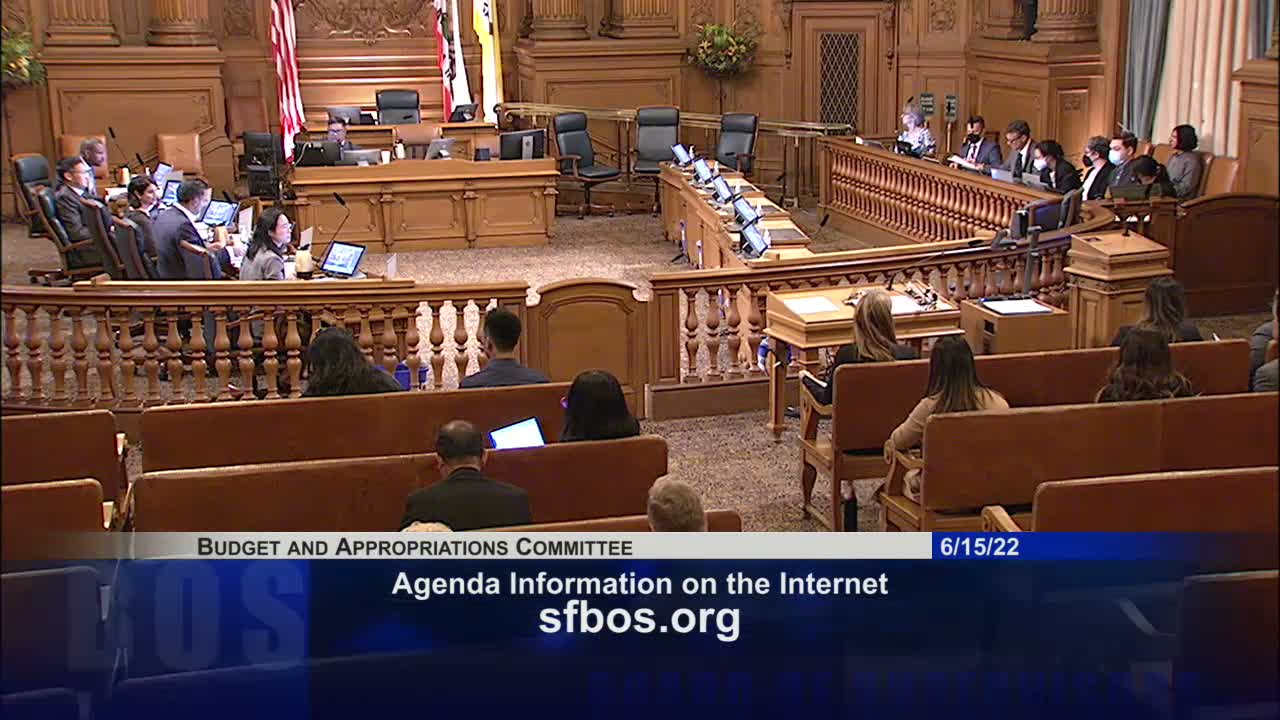
San Francisco’s budget team told the Board of Supervisors’ Budget and Appropriations Committee on June 15 that the mayor’s proposed two‑year spending plan relies heavily on one‑time sources and carries meaningful downside risk.
City Controller Ben Rosenfield, presenting the office’s annual revenue letter, said the revenue assumptions in the mayor’s proposal are “reasonable” but stressed the plan depends on about $1,000,000,000 in one‑time money — federal disaster reimbursements, remaining pandemic‑era funding, reserves and one‑time uses — and would draw down city reserves substantially if adopted as proposed. “Given the solutions used to balance the proposed budget in front of you, we think it’s likely that the structural imbalance that exists in year 3 and beyond is larger than we projected in March,” Rosenfield said.
Rosenfield and his revenue manager, Carol Lou, described the assumptions behind major tax lines that feed the general fund: a 4% roll growth assumption for property assessments, an assumption that office occupancies will remain partly depressed and a 33% telecommute rate for office workers that primarily reduces business‑tax receipts. Carol Lou showed how the November 2020 ballot measures and one‑off, high‑value property transfers boosted last year’s totals and cautioned that transfer tax revenue is especially volatile: “Less than 1% of transactions drive more than 50% of this revenue,” she said.
Supervisors pressed staff on how the 33% telecommute assumption was derived and how it affects business tax and daytime population revenues. Rosenfield said the office used a combination of corporate communications from the city’s largest payers, tax‑filing behavior and private surveys to arrive at the telework estimate, and that the assumption affects business‑tax forecasts most directly while having little immediate effect on property tax and other large, lagging sources.
Public comment on the revenue letter emphasized basic needs priorities and one‑off local hardships. Multiple callers asked supervisors to direct more funding toward repairs of elevators in single‑room occupancy hotels that leave seniors and residents with disabilities unable to access services.
After the presentation and hearing, Chair Hillary Ronan moved to “file” the controller’s report — a procedural motion that the committee approved unanimously by roll call.
What’s next: Rosenfield’s office recommended supervisors treat the two‑year plan as a spending plan that both the mayor and Board will need to actively manage, and staff said they will track the incoming state budget and other developments closely as the committee considers final changes.
Sources: Presentation and Q&A at the Budget & Appropriations Committee hearing, June 15, 2022; Controller Ben Rosenfield and revenue manager Carol Lou.
City Controller Ben Rosenfield, presenting the office’s annual revenue letter, said the revenue assumptions in the mayor’s proposal are “reasonable” but stressed the plan depends on about $1,000,000,000 in one‑time money — federal disaster reimbursements, remaining pandemic‑era funding, reserves and one‑time uses — and would draw down city reserves substantially if adopted as proposed. “Given the solutions used to balance the proposed budget in front of you, we think it’s likely that the structural imbalance that exists in year 3 and beyond is larger than we projected in March,” Rosenfield said.
Rosenfield and his revenue manager, Carol Lou, described the assumptions behind major tax lines that feed the general fund: a 4% roll growth assumption for property assessments, an assumption that office occupancies will remain partly depressed and a 33% telecommute rate for office workers that primarily reduces business‑tax receipts. Carol Lou showed how the November 2020 ballot measures and one‑off, high‑value property transfers boosted last year’s totals and cautioned that transfer tax revenue is especially volatile: “Less than 1% of transactions drive more than 50% of this revenue,” she said.
Supervisors pressed staff on how the 33% telecommute assumption was derived and how it affects business tax and daytime population revenues. Rosenfield said the office used a combination of corporate communications from the city’s largest payers, tax‑filing behavior and private surveys to arrive at the telework estimate, and that the assumption affects business‑tax forecasts most directly while having little immediate effect on property tax and other large, lagging sources.
Public comment on the revenue letter emphasized basic needs priorities and one‑off local hardships. Multiple callers asked supervisors to direct more funding toward repairs of elevators in single‑room occupancy hotels that leave seniors and residents with disabilities unable to access services.
After the presentation and hearing, Chair Hillary Ronan moved to “file” the controller’s report — a procedural motion that the committee approved unanimously by roll call.
What’s next: Rosenfield’s office recommended supervisors treat the two‑year plan as a spending plan that both the mayor and Board will need to actively manage, and staff said they will track the incoming state budget and other developments closely as the committee considers final changes.
Sources: Presentation and Q&A at the Budget & Appropriations Committee hearing, June 15, 2022; Controller Ben Rosenfield and revenue manager Carol Lou.
View the Full Meeting & All Its Details
This article offers just a summary. Unlock complete video, transcripts, and insights as a Founder Member.
✓
Watch full, unedited meeting videos
✓
Search every word spoken in unlimited transcripts
✓
AI summaries & real-time alerts (all government levels)
✓
Permanent access to expanding government content
30-day money-back guarantee
