OEWD proposes $10M for small‑business grants and $25M for downtown/Tenderloin investments while cutting some workforce programs
June 15, 2022 | San Francisco County, California
This article was created by AI summarizing key points discussed. AI makes mistakes, so for full details and context, please refer to the video of the full meeting. Please report any errors so we can fix them. Report an error »
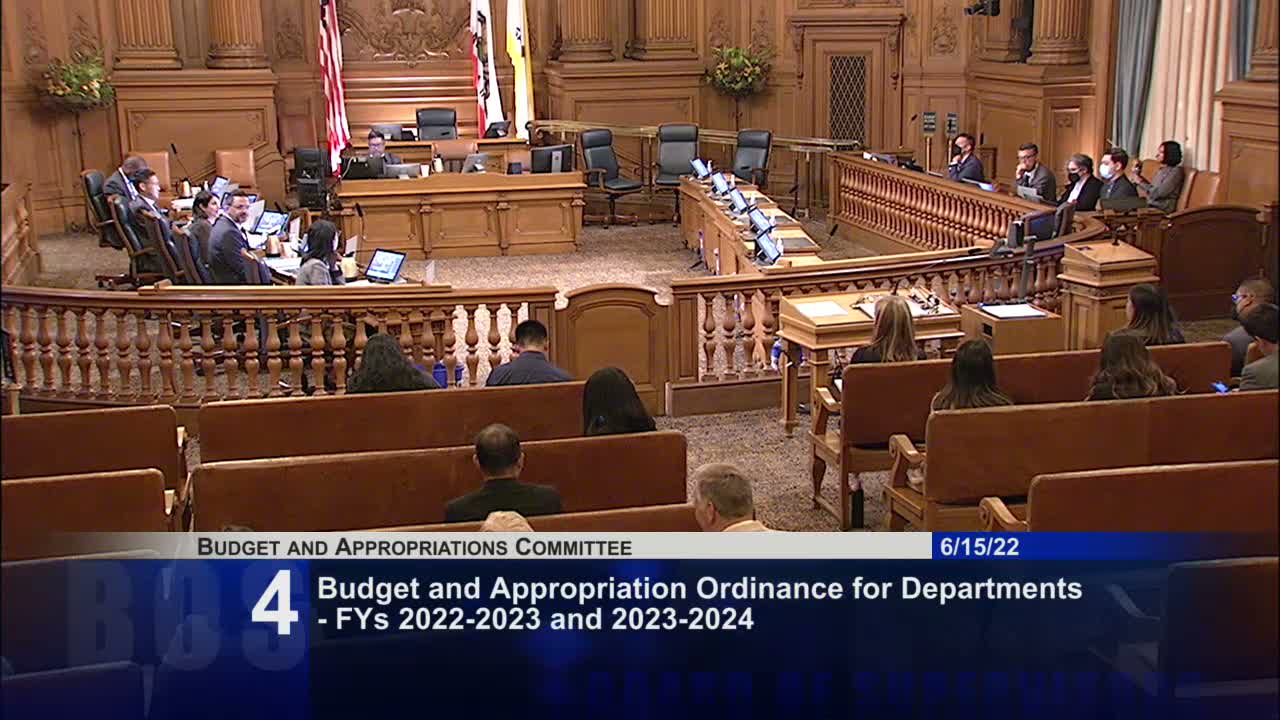
The Office of Economic & Workforce Development presented its two‑year budget to the committee, stressing equity‑driven recovery while acknowledging difficult tradeoffs. The department proposed a $10,000,000 round of small‑business grants to replenish high‑demand programs (commercial rent relief and 0% loan programs) and a $25,000,000 package to support Mid‑Market and the Tenderloin: safety ambassadors, UN Plaza/Fulton Mall/Civic Center activation and sustained deployment for downtown wayfinding and activation.
Director Montana Cruz said the two‑year OEWD baseline is roughly $156,600,000 for FY 22‑23 with $151 FTE, noting the FY 23‑24 budget drops as one‑time COVID investments wind down. CFO Merrick Pascual told supervisors the workforce development budget decreases by about $13,400,000 largely because prior year one‑time recovery services and hub funding are ending. OEWD plans to stretch remaining resources through programmatic redesign and shared systems to measure impact more effectively.
Supervisors pressed OEWD on equity and geographic distribution: why downtown recovery receives visible new money while workforce programs focused on BIPOC neighborhoods are reduced. OEWD said the $10M grants and prioritization metrics will favor small and micro businesses in opportunity communities and BIPOC‑led organizations; the agency said 13 of 22 vacant positions were in hiring and 7 new positions were requested to increase on‑the‑ground capacity and a vacancy‑mitigation specialist would identify root causes of retail vacancies.
The debate reflected a larger board tension: short‑term downtown activation to boost tourism and jobs versus sustained neighborhood workforce and community investments. OEWD asked to be monitored on implementation and to report back on the BLA performance audit recommendations and updated impact metrics.
Ending: Supervisors signaled willingness to consider the new small‑business grant money and asked OEWD to return with details on program design, prioritization and staffing impacts.
Director Montana Cruz said the two‑year OEWD baseline is roughly $156,600,000 for FY 22‑23 with $151 FTE, noting the FY 23‑24 budget drops as one‑time COVID investments wind down. CFO Merrick Pascual told supervisors the workforce development budget decreases by about $13,400,000 largely because prior year one‑time recovery services and hub funding are ending. OEWD plans to stretch remaining resources through programmatic redesign and shared systems to measure impact more effectively.
Supervisors pressed OEWD on equity and geographic distribution: why downtown recovery receives visible new money while workforce programs focused on BIPOC neighborhoods are reduced. OEWD said the $10M grants and prioritization metrics will favor small and micro businesses in opportunity communities and BIPOC‑led organizations; the agency said 13 of 22 vacant positions were in hiring and 7 new positions were requested to increase on‑the‑ground capacity and a vacancy‑mitigation specialist would identify root causes of retail vacancies.
The debate reflected a larger board tension: short‑term downtown activation to boost tourism and jobs versus sustained neighborhood workforce and community investments. OEWD asked to be monitored on implementation and to report back on the BLA performance audit recommendations and updated impact metrics.
Ending: Supervisors signaled willingness to consider the new small‑business grant money and asked OEWD to return with details on program design, prioritization and staffing impacts.
Don't Miss a Word: See the Full Meeting!
Go beyond summaries. Unlock every video, transcript, and key insight with a Founder Membership.
✓
Get instant access to full meeting videos
✓
Search and clip any phrase from complete transcripts
✓
Receive AI-powered summaries & custom alerts
✓
Enjoy lifetime, unrestricted access to government data
30-day money-back guarantee
