Public Works budgets for Prop B split and adds crews as vacancies top 20% amid debate over COPs for paving
June 15, 2022 | San Francisco County, California
This article was created by AI summarizing key points discussed. AI makes mistakes, so for full details and context, please refer to the video of the full meeting. Please report any errors so we can fix them. Report an error »
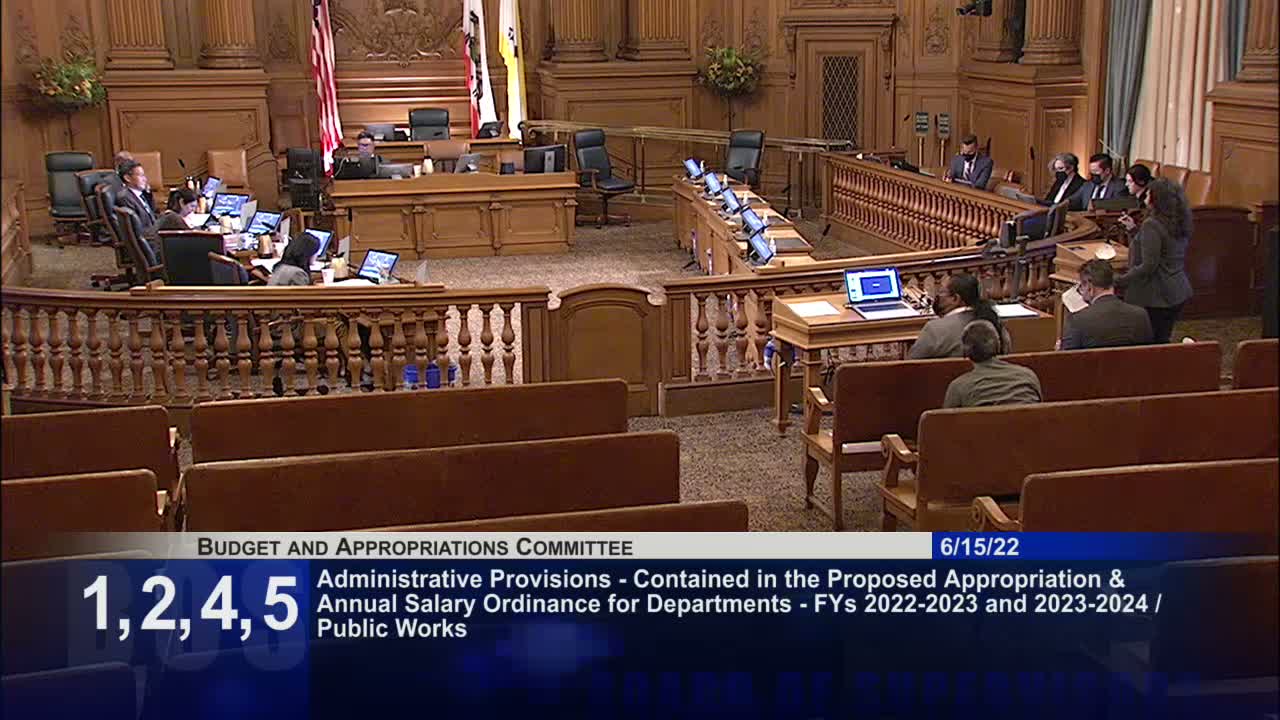
Public Works told the Budget & Appropriations Committee on June 15 that splitting the department to create a separate Sanitation & Streets (SAS) agency — required by Proposition B — will change where administrative functions live and will require new recruiting and operating capacity.
Interim Director Carla Short walked the committee through the reorganization chart she is implementing if the city proceeds with Prop B: three remaining bureaus will stay in Public Works (Building Design & Construction; Infrastructure Design & Construction; Street Use & Mapping) while Sanitation & Streets will inherit street repair, urban forestry, and street and environmental services. The mayor’s proposed budget includes the administrative staff needed to stand up the separate departments and budgeted about 73 new positions tied to the Prop B implementation, most of them HR, accounting and commission support roles for the two new agencies.
Public Works officials highlighted chronic workforce shortages: the department reported a 21.7% vacancy rate overall and about 75 general‑fund vacancies — 70 of them in Street & Environmental Services (SES). Short and CFO Bruce Robertson said hiring has been slowed by pandemic delays to practical exams (mechanic, arborist and laborer tests), a tight local labor market for frontline trades, and limited DHR onboarding capacity. To cope, Public Works has used temporary hires (99‑16s) and other short‑term staffing and expects to add 45 temporary corridor workers plus nine new enhanced‑cleaning (permanent) staff in the mayor’s budget; those corridor workers will be deployed citywide and the enhanced‑cleaning positions will support downtown needs while freeing other crews to return to neighborhood routes.
Supervisors pressed the department about how quickly vacancies can be filled and whether the mayor’s budget priorities (downtown activations and safety investments) come at the expense of neighborhood cleaning. Public Works said the new hires and a planned push to get HR capacity filled are intended to restore services citywide, and that temporary workers have already been used to preserve service levels in high‑need areas while permanent hiring proceeds.
A point of contention: the mayor’s capital plan assumes $30,000,000 in certificates of participation (COPs) for street resurfacing in 2023, a financing mechanism several supervisors questioned during the hearing. Budget staff and the mayor’s budget office said the capital planning committee recommended the COPs as part of a low‑scenario capital package to preserve multi‑year paving activity while general‑fund availability remains constrained, but supervisors asked the mayor’s office to explain the fiscal prudence of debt financing for resurfacing with a lifecycle shorter than the debt term.
What’s next: Public Works will work with the Controller and DHR to prioritize rapid hires for street cleaning and report back with lists of capital projects that are not yet in contract so supervisors can evaluate re‑prioritization.
Interim Director Carla Short walked the committee through the reorganization chart she is implementing if the city proceeds with Prop B: three remaining bureaus will stay in Public Works (Building Design & Construction; Infrastructure Design & Construction; Street Use & Mapping) while Sanitation & Streets will inherit street repair, urban forestry, and street and environmental services. The mayor’s proposed budget includes the administrative staff needed to stand up the separate departments and budgeted about 73 new positions tied to the Prop B implementation, most of them HR, accounting and commission support roles for the two new agencies.
Public Works officials highlighted chronic workforce shortages: the department reported a 21.7% vacancy rate overall and about 75 general‑fund vacancies — 70 of them in Street & Environmental Services (SES). Short and CFO Bruce Robertson said hiring has been slowed by pandemic delays to practical exams (mechanic, arborist and laborer tests), a tight local labor market for frontline trades, and limited DHR onboarding capacity. To cope, Public Works has used temporary hires (99‑16s) and other short‑term staffing and expects to add 45 temporary corridor workers plus nine new enhanced‑cleaning (permanent) staff in the mayor’s budget; those corridor workers will be deployed citywide and the enhanced‑cleaning positions will support downtown needs while freeing other crews to return to neighborhood routes.
Supervisors pressed the department about how quickly vacancies can be filled and whether the mayor’s budget priorities (downtown activations and safety investments) come at the expense of neighborhood cleaning. Public Works said the new hires and a planned push to get HR capacity filled are intended to restore services citywide, and that temporary workers have already been used to preserve service levels in high‑need areas while permanent hiring proceeds.
A point of contention: the mayor’s capital plan assumes $30,000,000 in certificates of participation (COPs) for street resurfacing in 2023, a financing mechanism several supervisors questioned during the hearing. Budget staff and the mayor’s budget office said the capital planning committee recommended the COPs as part of a low‑scenario capital package to preserve multi‑year paving activity while general‑fund availability remains constrained, but supervisors asked the mayor’s office to explain the fiscal prudence of debt financing for resurfacing with a lifecycle shorter than the debt term.
What’s next: Public Works will work with the Controller and DHR to prioritize rapid hires for street cleaning and report back with lists of capital projects that are not yet in contract so supervisors can evaluate re‑prioritization.
View the Full Meeting & All Its Details
This article offers just a summary. Unlock complete video, transcripts, and insights as a Founder Member.
✓
Watch full, unedited meeting videos
✓
Search every word spoken in unlimited transcripts
✓
AI summaries & real-time alerts (all government levels)
✓
Permanent access to expanding government content
30-day money-back guarantee
