Berkeley report: San Francisco’s climate action plan could cost billions; recommends bonds, parcel tax and equity safeguards
March 15, 2023 | San Francisco County, California
This article was created by AI summarizing key points discussed. AI makes mistakes, so for full details and context, please refer to the video of the full meeting. Please report any errors so we can fix them. Report an error »
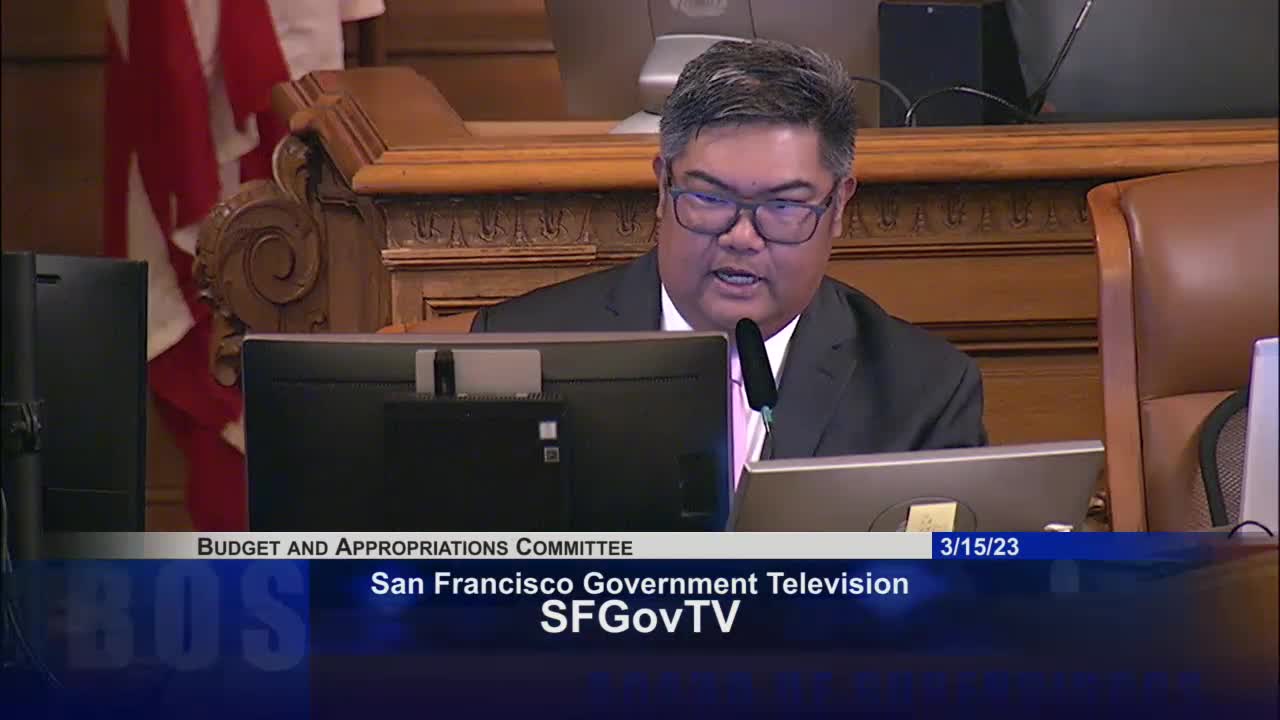
A UC Berkeley team that studied how San Francisco might pay for its Climate Action Plan told the Board of Supervisors’ Budget and Appropriations Committee on March 15 that the price tag for the city’s net‑zero by 2040 goals ranges from the low billions to the tens of billions. “If all 31 strategies were at the lowest end of that cost estimate … we calculate that to be about $2,300,000,000,” the report said, and the consultants presented a conservative high‑end scenario of roughly $22,000,000,000 to implement the plan in full.
The report, prepared by the Berkeley Center for Law, Energy and the Environment (CLE) with civic stakeholder input, proposed three broad revenue approaches: a set of general obligation (GO) “geo‑bonds” targeted to building decarbonization, an expansion of an affordable‑housing accelerator fund, and a transportation bond focused on transit and EV infrastructure; a package of near‑term measures such as a modest gross‑receipts surcharge on the largest firms and a parcel tax; and medium‑term tools including congestion pricing, expansion of residential parking permit revenue and a targeted commercial building carbon fee.
CLE senior fellow Ted Lam said the team’s process included more than 50 interviews, stakeholder convenings and technical review. “We were tasked with identifying equitable strategies to raise revenue and to invest in the CAP,” he told supervisors. The consultants also recommended dedicating portions of bond proceeds to low‑income and transit‑rich neighborhoods, seeding a city green‑bank or revolving loan fund, and designing bonds to deliver community‑scale competitive grants.
The Office of Resilience and Capital Planning told the committee the city’s existing constrained GO‑bond capacity means a large climate bond would be a significant share of available capacity; Director Brian Strong said a climate bond in the $650 million‑to‑$1.1 billion range would consume roughly half the city’s ten‑year GO capacity under the planning tax‑rate constraint used in the capital plan. Controller Ben Rosenfield noted that authorized but unissued bonds affect planning capacity even before they appear on tax bills.
Department of the Environment staff and climate advocates told the committee they support a mix of approaches and stressed equity mechanisms: a community oversight council, racial‑equity impact assessments for large programs, and funding for nonprofits to implement projects locally. CLE and department presenters emphasized that much of the funding need could be matched by federal and state grants and private partners, but city dollars will be required to unlock and leverage those funds.
What’s next: The committee heard the presentation and public comment and voted to file the hearing. Supervisors and staff said the city will need further, department‑level cost refinement and a follow‑up discussion during the mayor’s June budget cycle and the Board’s March/June budget process to consider concrete ballot measures and implementation steps.
The report, prepared by the Berkeley Center for Law, Energy and the Environment (CLE) with civic stakeholder input, proposed three broad revenue approaches: a set of general obligation (GO) “geo‑bonds” targeted to building decarbonization, an expansion of an affordable‑housing accelerator fund, and a transportation bond focused on transit and EV infrastructure; a package of near‑term measures such as a modest gross‑receipts surcharge on the largest firms and a parcel tax; and medium‑term tools including congestion pricing, expansion of residential parking permit revenue and a targeted commercial building carbon fee.
CLE senior fellow Ted Lam said the team’s process included more than 50 interviews, stakeholder convenings and technical review. “We were tasked with identifying equitable strategies to raise revenue and to invest in the CAP,” he told supervisors. The consultants also recommended dedicating portions of bond proceeds to low‑income and transit‑rich neighborhoods, seeding a city green‑bank or revolving loan fund, and designing bonds to deliver community‑scale competitive grants.
The Office of Resilience and Capital Planning told the committee the city’s existing constrained GO‑bond capacity means a large climate bond would be a significant share of available capacity; Director Brian Strong said a climate bond in the $650 million‑to‑$1.1 billion range would consume roughly half the city’s ten‑year GO capacity under the planning tax‑rate constraint used in the capital plan. Controller Ben Rosenfield noted that authorized but unissued bonds affect planning capacity even before they appear on tax bills.
Department of the Environment staff and climate advocates told the committee they support a mix of approaches and stressed equity mechanisms: a community oversight council, racial‑equity impact assessments for large programs, and funding for nonprofits to implement projects locally. CLE and department presenters emphasized that much of the funding need could be matched by federal and state grants and private partners, but city dollars will be required to unlock and leverage those funds.
What’s next: The committee heard the presentation and public comment and voted to file the hearing. Supervisors and staff said the city will need further, department‑level cost refinement and a follow‑up discussion during the mayor’s June budget cycle and the Board’s March/June budget process to consider concrete ballot measures and implementation steps.
View the Full Meeting & All Its Details
This article offers just a summary. Unlock complete video, transcripts, and insights as a Founder Member.
✓
Watch full, unedited meeting videos
✓
Search every word spoken in unlimited transcripts
✓
AI summaries & real-time alerts (all government levels)
✓
Permanent access to expanding government content
30-day money-back guarantee
