911 and ambulance metrics slip as dispatch and hospital offload delays strain response system
March 01, 2023 | San Francisco County, California
This article was created by AI summarizing key points discussed. AI makes mistakes, so for full details and context, please refer to the video of the full meeting. Please report any errors so we can fix them. Report an error »
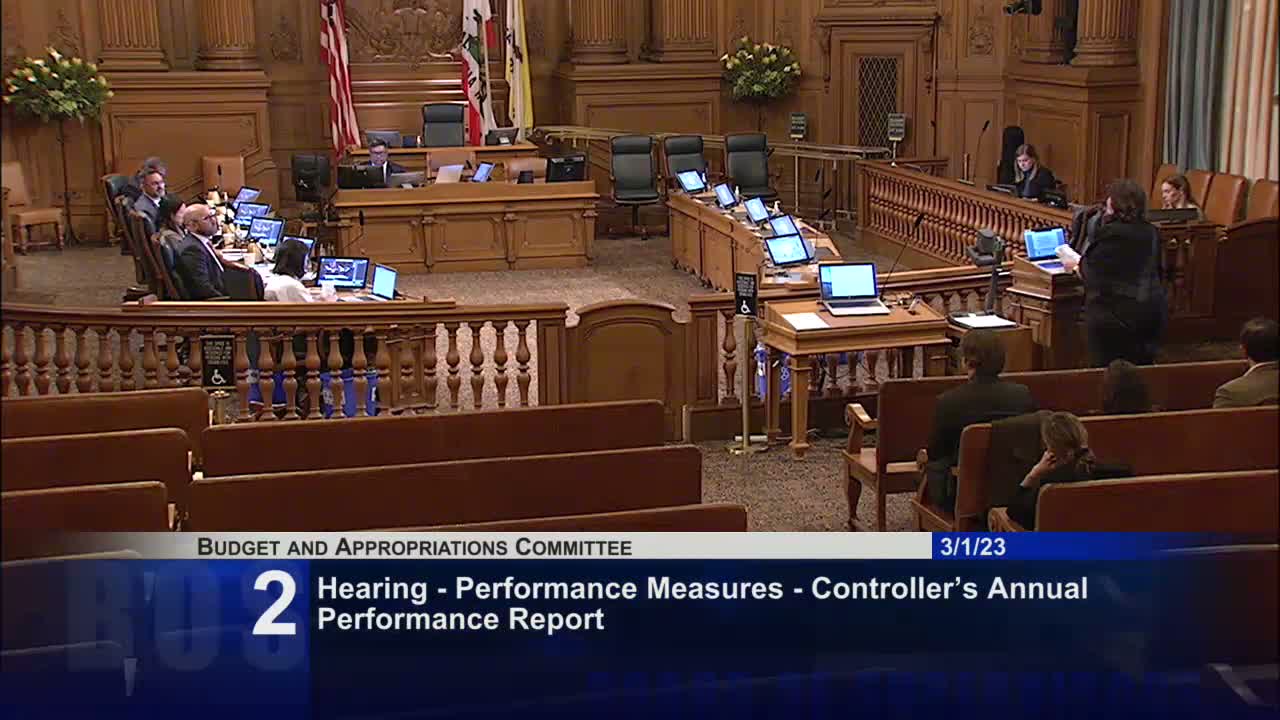
City performance data presented to the Budget & Appropriations Committee showed declines in emergency response metrics that supervisors described as alarming and that department leaders linked to multi‑year staffing shortfalls across dispatch, ambulance providers and hospitals.
The city performance director highlighted a range of measures in the annual report and told the committee that "the final number for 2022 is 37 fatalities, which is the highest since this policy was enacted by the city," calling attention to Vision Zero metrics and the broader role of performance monitoring.
On 911 dispatching, Robert Smuts of the Department of Emergency Management said effective dispatcher staffing fell from pre‑pandemic levels in the mid‑150s to roughly 100, driven by a hiring freeze early in the pandemic, vaccine‑related separations and difficulty recruiting qualified applicants. Smuts described the hiring and certification timeline candidly: "From date of application to date of hire, it takes approximately 10 months...From date of hire to when the employee is able to do work on their own...it's about 10 months" — producing about 20 months before new recruits fully affect service capacity.
DEM reported recent recruitment gains after hiring a dedicated recruiter in October 2022; the office cited a rise in applicants from the low hundreds to several hundreds in the two months following the hire. Department leaders cautioned that even with extra recruits, training, background checks and attrition mean it will take time to restore effective staffing; Smuts estimated full staffing could come toward the end of 2025, with service standards potentially returnable before then.
The Fire Department's EMS leaders described mixed operational outcomes: adding 60 paramedic FTEs in fiscal 2021–22 briefly increased ambulance availability and reduced "medic‑to‑follow" or phantom calls by over 50 percent, but longer hospital offload times (APOD) and rising call complexity have increased ambulances' time on task. Deputy Chief Tom O'Connor said APOD — the time an ambulance waits at a hospital to transfer care — increased by about 19 minutes between 2019 and 2022 and that the 90th‑percentile APOD recently measured roughly 51 minutes at the system level.
Hospital leaders said diversion and staffing vary across facilities. Dr. Ehrlich of San Francisco General said diversion has been aggressively managed and that February diversion at the General improved to about 45 percent; department staff noted the General tends to perform better on some metrics than certain private hospitals, but overall APOD and diversion remain significant constraints on EMS capacity.
Supervisors pressed for timelines and cross‑agency solutions. Committee members asked whether the city can accelerate hiring and certification processes; DEM noted state and POST requirements limit how quickly some steps can be shortened, while the Department of Human Resources and unions are working on retention and hiring reforms. Committee members also discussed how increased demand for behavioral health and overdose responses shifts workload across the emergency system.
Next procedural steps: the committee will use this performance information to evaluate budget supplemental requests (including public safety and emergency services needs) in the upcoming budget process and asked departments for follow‑up data on hiring timelines and APOD breakdowns by hospital.
The city performance director highlighted a range of measures in the annual report and told the committee that "the final number for 2022 is 37 fatalities, which is the highest since this policy was enacted by the city," calling attention to Vision Zero metrics and the broader role of performance monitoring.
On 911 dispatching, Robert Smuts of the Department of Emergency Management said effective dispatcher staffing fell from pre‑pandemic levels in the mid‑150s to roughly 100, driven by a hiring freeze early in the pandemic, vaccine‑related separations and difficulty recruiting qualified applicants. Smuts described the hiring and certification timeline candidly: "From date of application to date of hire, it takes approximately 10 months...From date of hire to when the employee is able to do work on their own...it's about 10 months" — producing about 20 months before new recruits fully affect service capacity.
DEM reported recent recruitment gains after hiring a dedicated recruiter in October 2022; the office cited a rise in applicants from the low hundreds to several hundreds in the two months following the hire. Department leaders cautioned that even with extra recruits, training, background checks and attrition mean it will take time to restore effective staffing; Smuts estimated full staffing could come toward the end of 2025, with service standards potentially returnable before then.
The Fire Department's EMS leaders described mixed operational outcomes: adding 60 paramedic FTEs in fiscal 2021–22 briefly increased ambulance availability and reduced "medic‑to‑follow" or phantom calls by over 50 percent, but longer hospital offload times (APOD) and rising call complexity have increased ambulances' time on task. Deputy Chief Tom O'Connor said APOD — the time an ambulance waits at a hospital to transfer care — increased by about 19 minutes between 2019 and 2022 and that the 90th‑percentile APOD recently measured roughly 51 minutes at the system level.
Hospital leaders said diversion and staffing vary across facilities. Dr. Ehrlich of San Francisco General said diversion has been aggressively managed and that February diversion at the General improved to about 45 percent; department staff noted the General tends to perform better on some metrics than certain private hospitals, but overall APOD and diversion remain significant constraints on EMS capacity.
Supervisors pressed for timelines and cross‑agency solutions. Committee members asked whether the city can accelerate hiring and certification processes; DEM noted state and POST requirements limit how quickly some steps can be shortened, while the Department of Human Resources and unions are working on retention and hiring reforms. Committee members also discussed how increased demand for behavioral health and overdose responses shifts workload across the emergency system.
Next procedural steps: the committee will use this performance information to evaluate budget supplemental requests (including public safety and emergency services needs) in the upcoming budget process and asked departments for follow‑up data on hiring timelines and APOD breakdowns by hospital.
View the Full Meeting & All Its Details
This article offers just a summary. Unlock complete video, transcripts, and insights as a Founder Member.
✓
Watch full, unedited meeting videos
✓
Search every word spoken in unlimited transcripts
✓
AI summaries & real-time alerts (all government levels)
✓
Permanent access to expanding government content
30-day money-back guarantee
