Health department warns federal HIV funding has fallen; advocates urge sustained local backfills
May 04, 2022 | San Francisco County, California
This article was created by AI summarizing key points discussed. AI makes mistakes, so for full details and context, please refer to the video of the full meeting. Please report any errors so we can fix them. Report an error »
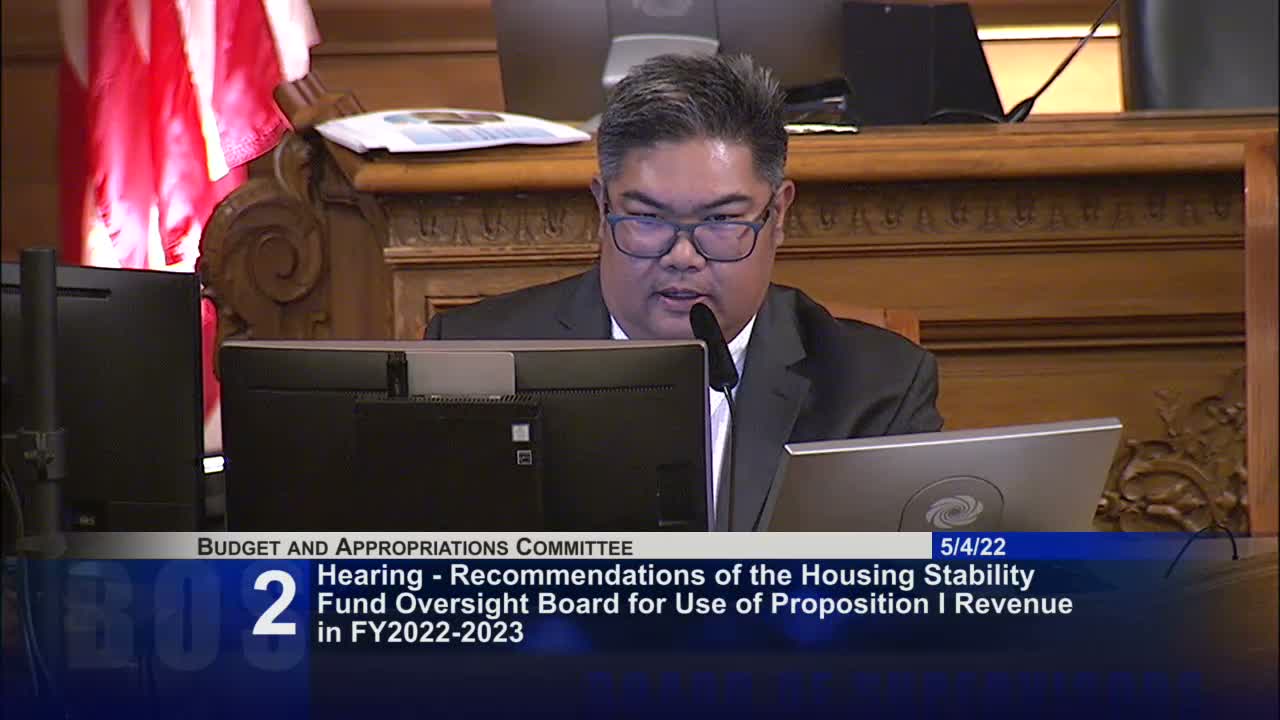
Department of Public Health officials outlined changes in federal HIV funding and a proposed reorganization of prevention services at a May 4 Budget & Appropriations Committee hearing, prompting repeated pleas from providers and long‑term survivors to maintain local backfill and bolster services for aging people with HIV.
Bill Bloom, director of HIV Health Services, told supervisors that federal funding for HIV care has trended downward over two decades and that current HIV‑care funding is ‘‘just a little over $15,000,000,’’ noting the city has historically used local general fund dollars to offset federal cuts. Tracy Packer (DPH prevention director) described a shift in CDC prevention formulae in 2018 that prioritized areas with rising disparities—mainly in the South—leading to funding reductions for some long‑standing San Francisco prevention contracts. DPH convened community input and proposed ‘‘Health Access Points’’ (HAPs), population‑specific, equity‑focused one‑stop sites to integrate HIV, hepatitis C, STI, harm‑reduction and overdose‑prevention services.
Supervisors and many speakers in public comment—providers, legal advocates and long‑term survivors—expressed concern that the restructured prevention RFP and contract reallocations could destabilize the established safety net during the transition. Advocates asked for parity cost‑of‑doing‑business increases for Ryan White contracts, more housing subsidies and additional mental‑health funding for long‑term survivors. Representative Bill Hirsch of the AIDS Legal Referral Panel urged the city to commit to backfilling federal losses and to ensure continuity of care.
DPH said the RFP process awarded HAP contracts to the highest‑scoring applicants and that capacity‑building funds would be available to help newly funded agencies ramp up services; DPH also said award notifications were pending public release. Mayor’s Budget Director Ashley Grafenberger said the mayor historically has backfilled cuts and would consider requests when the mayor’s budget is introduced.
The committee voted to file the hearing; supervisors said they would monitor the transition and requested follow‑up to ensure gaps do not appear as contracts shift.
Bill Bloom, director of HIV Health Services, told supervisors that federal funding for HIV care has trended downward over two decades and that current HIV‑care funding is ‘‘just a little over $15,000,000,’’ noting the city has historically used local general fund dollars to offset federal cuts. Tracy Packer (DPH prevention director) described a shift in CDC prevention formulae in 2018 that prioritized areas with rising disparities—mainly in the South—leading to funding reductions for some long‑standing San Francisco prevention contracts. DPH convened community input and proposed ‘‘Health Access Points’’ (HAPs), population‑specific, equity‑focused one‑stop sites to integrate HIV, hepatitis C, STI, harm‑reduction and overdose‑prevention services.
Supervisors and many speakers in public comment—providers, legal advocates and long‑term survivors—expressed concern that the restructured prevention RFP and contract reallocations could destabilize the established safety net during the transition. Advocates asked for parity cost‑of‑doing‑business increases for Ryan White contracts, more housing subsidies and additional mental‑health funding for long‑term survivors. Representative Bill Hirsch of the AIDS Legal Referral Panel urged the city to commit to backfilling federal losses and to ensure continuity of care.
DPH said the RFP process awarded HAP contracts to the highest‑scoring applicants and that capacity‑building funds would be available to help newly funded agencies ramp up services; DPH also said award notifications were pending public release. Mayor’s Budget Director Ashley Grafenberger said the mayor historically has backfilled cuts and would consider requests when the mayor’s budget is introduced.
The committee voted to file the hearing; supervisors said they would monitor the transition and requested follow‑up to ensure gaps do not appear as contracts shift.
Don't Miss a Word: See the Full Meeting!
Go beyond summaries. Unlock every video, transcript, and key insight with a Founder Membership.
✓
Get instant access to full meeting videos
✓
Search and clip any phrase from complete transcripts
✓
Receive AI-powered summaries & custom alerts
✓
Enjoy lifetime, unrestricted access to government data
30-day money-back guarantee
