Committee hears five-year plan update; January's $108M surplus revised to about $75M
April 13, 2022 | San Francisco County, California
This article was created by AI summarizing key points discussed. AI makes mistakes, so for full details and context, please refer to the video of the full meeting. Please report any errors so we can fix them. Report an error »
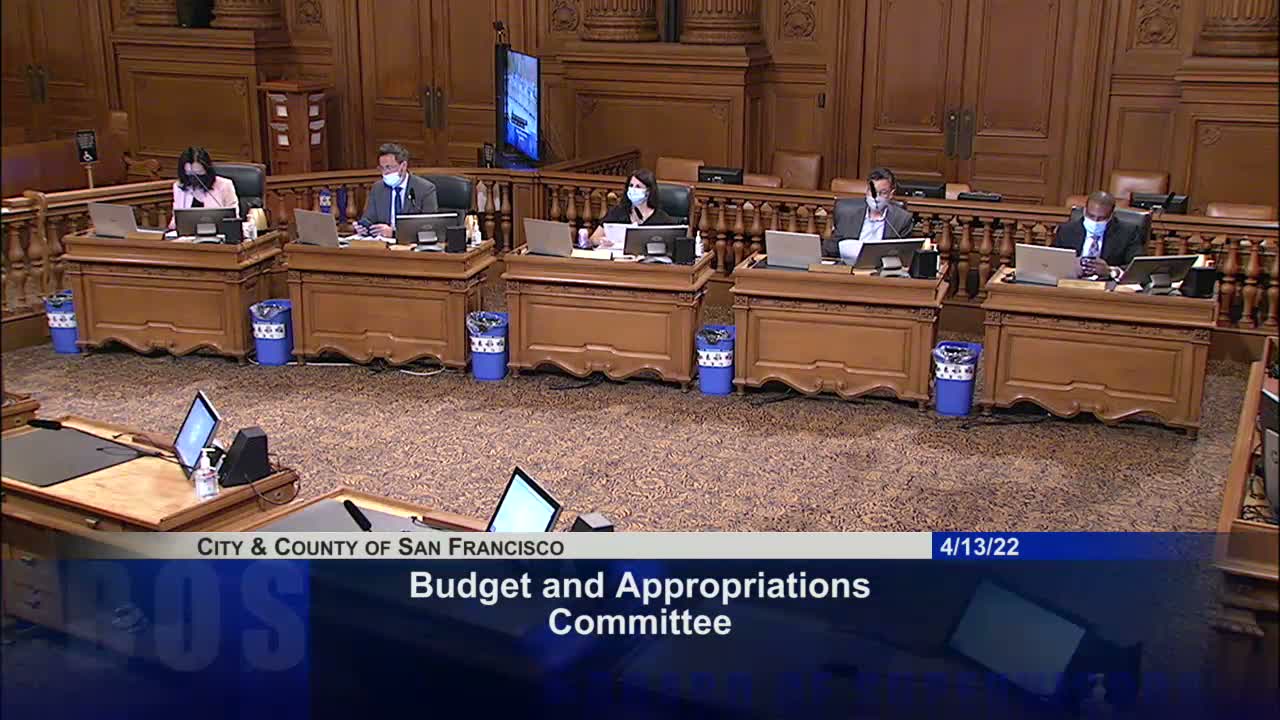
The San Francisco Budget and Appropriations Committee heard a March update to the city's five-year financial plan on April 13, during which the mayor's budget office said a previously projected $108,000,000 surplus for the upcoming budget years is now "slightly less now at about 75,000,000." Ashley Grafenberger, the mayor's budget director, presented the update alongside staff from the controller's office and the budget and legislative analyst.
Grafenberger told the committee the plan uses a "base case" that rolls forward adopted policy choices and current assumptions. She said expenditure changes were the primary driver of the downward revision, pointing to a higher-than-expected employer contribution for pensions (about one percentage point above January assumptions), increased workers' compensation and modest health-care cost changes. She said the forecast assumes labor settlements at roughly the consumer price index and warned that each 1 percentage-point increase above assumptions adds about $25,000,000 in general fund cost.
Cara Lou, the controller's citywide revenue manager, detailed revenue assumptions behind the forecast, including a stronger-than-expected property tax outlook but weaker business and hotel taxes. Lou said the office "increased our telecommuting assumption from 15% to 33% beginning in 22-23," a change that reduces the portion of some businesses' gross receipts apportioned to San Francisco and therefore depresses business tax receipts. She said hotel-tax revenue is expected to recover to pre-pandemic levels by calendar year 2026 and that transfer-tax receipts remain muted because of fewer large commercial transactions.
The March update also incorporated an expected net increase of approximately $45,900,000 in FEMA reimbursements tied to an extension of eligible COVID-response costs. Grafenberger and controller staff cautioned, however, that FEMA timing is uncertain: some claims require additional information from the city, and obligations above $20,000,000 require congressional approval, which can delay cash receipts.
Committee members questioned reserve balances and long-term risks. Committee members were told the city closed 2021 with about $78,000,000 in the general reserve, used $37,600,000 in supplementals, and is projecting a year-end general reserve balance of about $44,000,000 with an assumed deposit of $48,000,000 in 2022-23 that would raise the projected balance in later years. Staff also described a fiscal cliff reserve (about $230,000,000) and other policy reserves. Grafenberger said the fiscal cliff reserve and related policy choices will be features of the mayor's proposed budget and that committee members will get more detail with the mayor's June 1 proposals.
Supervisors pressed staff on structural risk. Grafenberger identified a roughly $150,000,000 shortfall in the final year of the forecast as the structural gap and said the city's conservative approach during the pandemic limited the addition of ongoing costs, keeping the structural deficit lower than in prior years. Supervisor questions also highlighted how state-level school-funding changes (referenced from the governor's January budget and tied to ERAF/LCFF adjustments) reduce excess ERAF returned to the city.
A public commenter, David Pilpel, urged the committee to replenish reserves rather than spend one-time surplus funds and recommended cautious nonprofit COLAs and realistic position counts.
The presentation closed with staff reiterating multiple uncertainties — labor negotiations, pension investment returns, FEMA timing and broader macroeconomic risk — that could materially change the forecast. The committee filed the March update and will consider the mayor's full budget proposal when it is released.
Grafenberger told the committee the plan uses a "base case" that rolls forward adopted policy choices and current assumptions. She said expenditure changes were the primary driver of the downward revision, pointing to a higher-than-expected employer contribution for pensions (about one percentage point above January assumptions), increased workers' compensation and modest health-care cost changes. She said the forecast assumes labor settlements at roughly the consumer price index and warned that each 1 percentage-point increase above assumptions adds about $25,000,000 in general fund cost.
Cara Lou, the controller's citywide revenue manager, detailed revenue assumptions behind the forecast, including a stronger-than-expected property tax outlook but weaker business and hotel taxes. Lou said the office "increased our telecommuting assumption from 15% to 33% beginning in 22-23," a change that reduces the portion of some businesses' gross receipts apportioned to San Francisco and therefore depresses business tax receipts. She said hotel-tax revenue is expected to recover to pre-pandemic levels by calendar year 2026 and that transfer-tax receipts remain muted because of fewer large commercial transactions.
The March update also incorporated an expected net increase of approximately $45,900,000 in FEMA reimbursements tied to an extension of eligible COVID-response costs. Grafenberger and controller staff cautioned, however, that FEMA timing is uncertain: some claims require additional information from the city, and obligations above $20,000,000 require congressional approval, which can delay cash receipts.
Committee members questioned reserve balances and long-term risks. Committee members were told the city closed 2021 with about $78,000,000 in the general reserve, used $37,600,000 in supplementals, and is projecting a year-end general reserve balance of about $44,000,000 with an assumed deposit of $48,000,000 in 2022-23 that would raise the projected balance in later years. Staff also described a fiscal cliff reserve (about $230,000,000) and other policy reserves. Grafenberger said the fiscal cliff reserve and related policy choices will be features of the mayor's proposed budget and that committee members will get more detail with the mayor's June 1 proposals.
Supervisors pressed staff on structural risk. Grafenberger identified a roughly $150,000,000 shortfall in the final year of the forecast as the structural gap and said the city's conservative approach during the pandemic limited the addition of ongoing costs, keeping the structural deficit lower than in prior years. Supervisor questions also highlighted how state-level school-funding changes (referenced from the governor's January budget and tied to ERAF/LCFF adjustments) reduce excess ERAF returned to the city.
A public commenter, David Pilpel, urged the committee to replenish reserves rather than spend one-time surplus funds and recommended cautious nonprofit COLAs and realistic position counts.
The presentation closed with staff reiterating multiple uncertainties — labor negotiations, pension investment returns, FEMA timing and broader macroeconomic risk — that could materially change the forecast. The committee filed the March update and will consider the mayor's full budget proposal when it is released.
Don't Miss a Word: See the Full Meeting!
Go beyond summaries. Unlock every video, transcript, and key insight with a Founder Membership.
✓
Get instant access to full meeting videos
✓
Search and clip any phrase from complete transcripts
✓
Receive AI-powered summaries & custom alerts
✓
Enjoy lifetime, unrestricted access to government data
30-day money-back guarantee
