San Francisco committee reviews Prop B split, staffing shortfalls and budget implications for new Sanitation & Streets department
April 27, 2022 | San Francisco County, California
This article was created by AI summarizing key points discussed. AI makes mistakes, so for full details and context, please refer to the video of the full meeting. Please report any errors so we can fix them. Report an error »
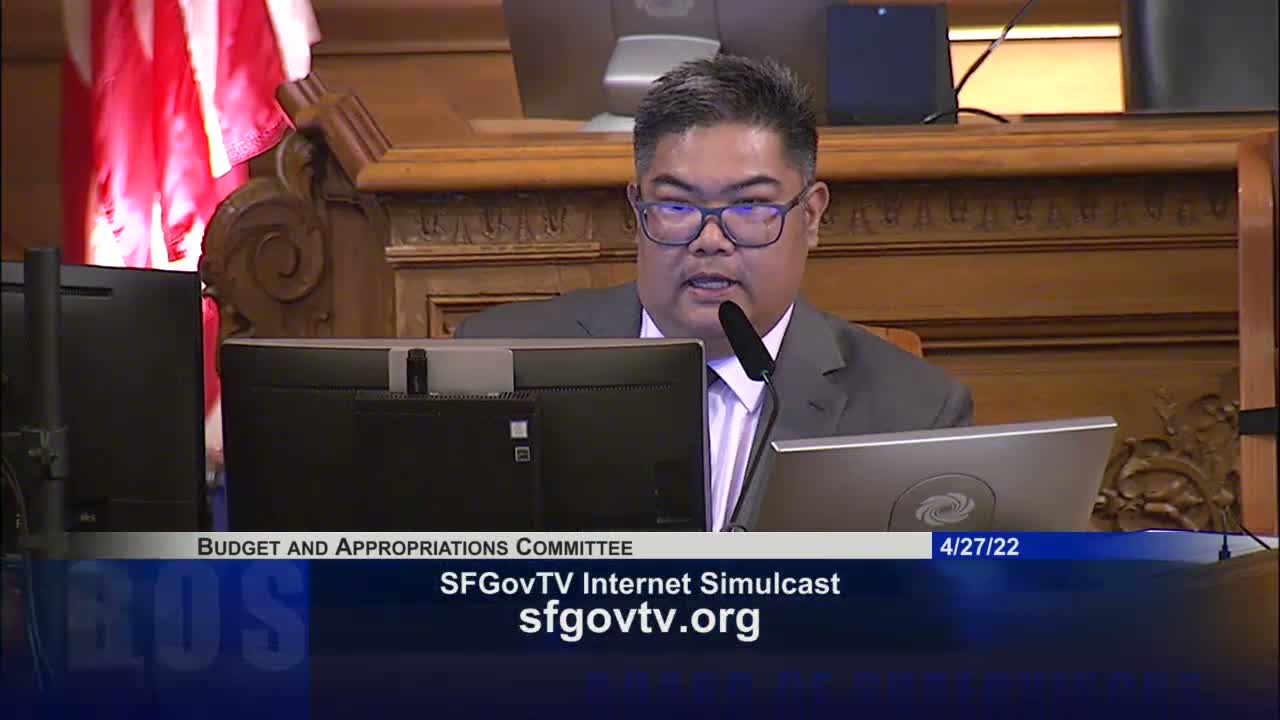
San Francisco’s Budget and Appropriations Committee on April 27 reviewed plans to implement Proposition B, which splits the city’s Department of Public Works into a smaller Public Works focused on capital projects and a new Sanitation & Streets (SAS) department focused on street cleaning, enforcement and urban forestry. Chair Hillary Ronan convened the hearing to probe how the split will affect conditions on city streets, how SAS will be funded and what staffing resources will be needed.
City Administrator Carmen Chu and Rachel Alonzo, the city’s Prop B project director, told the committee the implementation team has established governance structures, working groups and a recommended set of approximately 20 performance measures for each commission created by the charter amendment. Alonzo said SAS would report monthly on cleanliness metrics while Public Works would report quarterly on capital-delivery metrics, and that initial commission onboarding is scheduled this summer with Public Works’ commission powers taking effect Sept. 1 and SAS’ powers Oct. 1.
Bruce Robertson, Public Works’ finance lead, walked supervisors through organizational charts showing operations (street cleaning, environmental services and urban forestry) moving to the new SAS department and other bureaus remaining with Public Works. Robertson said the controller’s costing letter, issued when Prop B went to voters, identified “up to 6,000,000 in potential additional administrative costs” tied to creating commissions, commission staffing and duplicative back-office functions.
Supervisors pressed officials on staffing shortfalls and hiring timelines. Interim Public Works Director Carla Short said the department proposed a sidewalk-cleaning initiative that would add 31 positions at an estimated nearly $10,000,000 in first-year labor and nonlabor costs. Deputy Director of Operations Dejada Durden said operations currently has 43 unfilled general-labor positions and estimated a roughly 25% daily absenteeism rate, warning that filling vacancies alone would not eliminate gaps caused by chronic absenteeism.
Officials said the long-standing vacancy rate in Public Works has been high — previously reported near 30% but more recently in the upper 20s — and that some budgeted positions are ID-funded or project-based and therefore cannot be filled unless program funding materializes. Rachel Alonzo and Robertson described a phased approach to shifting HR and administrative functions into Public Works (as required by the charter) and noted Prop B prevents SAS from establishing its own full administrative services until two years after formation; in the interim some administrative functions will be shared to provide continuity.
Mayor’s Budget Director Ashley Grafenberger said the administration recognizes street cleanliness and enforcement are priorities but will weigh the department’s requests against other citywide needs when preparing the mayor’s budget, and that fully funding the level requested by Public Works will be difficult.
During public comment, David Pilpel said he opposed Proposition B in 2020 and cautioned that the split could raise costs and slow project approvals. Supervisors urged staff to provide additional follow-up information — for example, whether the city’s contract with Recology allows changing pickup frequency for overflowing street cans — and asked staff to return with precise vacancy counts and funding breakdowns as the mayor’s budget is finalized.
The committee recorded routine procedural votes at the end of the hearing: members excused Supervisor Chan and then voted 4–0 to file the hearing.
The committee requested follow-up materials including a detailed list of funded-but-unfilled positions, exact proposed FTE increases for the sidewalk-cleaning initiative and clarification on which enforcement functions will remain within the Bureau of Street Use & Mapping versus be operationally integrated with SAS. The mayor’s proposed budget will determine how many of the positions discussed are funded this fiscal year.
City Administrator Carmen Chu and Rachel Alonzo, the city’s Prop B project director, told the committee the implementation team has established governance structures, working groups and a recommended set of approximately 20 performance measures for each commission created by the charter amendment. Alonzo said SAS would report monthly on cleanliness metrics while Public Works would report quarterly on capital-delivery metrics, and that initial commission onboarding is scheduled this summer with Public Works’ commission powers taking effect Sept. 1 and SAS’ powers Oct. 1.
Bruce Robertson, Public Works’ finance lead, walked supervisors through organizational charts showing operations (street cleaning, environmental services and urban forestry) moving to the new SAS department and other bureaus remaining with Public Works. Robertson said the controller’s costing letter, issued when Prop B went to voters, identified “up to 6,000,000 in potential additional administrative costs” tied to creating commissions, commission staffing and duplicative back-office functions.
Supervisors pressed officials on staffing shortfalls and hiring timelines. Interim Public Works Director Carla Short said the department proposed a sidewalk-cleaning initiative that would add 31 positions at an estimated nearly $10,000,000 in first-year labor and nonlabor costs. Deputy Director of Operations Dejada Durden said operations currently has 43 unfilled general-labor positions and estimated a roughly 25% daily absenteeism rate, warning that filling vacancies alone would not eliminate gaps caused by chronic absenteeism.
Officials said the long-standing vacancy rate in Public Works has been high — previously reported near 30% but more recently in the upper 20s — and that some budgeted positions are ID-funded or project-based and therefore cannot be filled unless program funding materializes. Rachel Alonzo and Robertson described a phased approach to shifting HR and administrative functions into Public Works (as required by the charter) and noted Prop B prevents SAS from establishing its own full administrative services until two years after formation; in the interim some administrative functions will be shared to provide continuity.
Mayor’s Budget Director Ashley Grafenberger said the administration recognizes street cleanliness and enforcement are priorities but will weigh the department’s requests against other citywide needs when preparing the mayor’s budget, and that fully funding the level requested by Public Works will be difficult.
During public comment, David Pilpel said he opposed Proposition B in 2020 and cautioned that the split could raise costs and slow project approvals. Supervisors urged staff to provide additional follow-up information — for example, whether the city’s contract with Recology allows changing pickup frequency for overflowing street cans — and asked staff to return with precise vacancy counts and funding breakdowns as the mayor’s budget is finalized.
The committee recorded routine procedural votes at the end of the hearing: members excused Supervisor Chan and then voted 4–0 to file the hearing.
The committee requested follow-up materials including a detailed list of funded-but-unfilled positions, exact proposed FTE increases for the sidewalk-cleaning initiative and clarification on which enforcement functions will remain within the Bureau of Street Use & Mapping versus be operationally integrated with SAS. The mayor’s proposed budget will determine how many of the positions discussed are funded this fiscal year.
View the Full Meeting & All Its Details
This article offers just a summary. Unlock complete video, transcripts, and insights as a Founder Member.
✓
Watch full, unedited meeting videos
✓
Search every word spoken in unlimited transcripts
✓
AI summaries & real-time alerts (all government levels)
✓
Permanent access to expanding government content
30-day money-back guarantee
