Supervisors press DPH for faster progress on Mental Health SF bed expansion as judges report months-long jail waits
March 02, 2022 | San Francisco County, California
This article was created by AI summarizing key points discussed. AI makes mistakes, so for full details and context, please refer to the video of the full meeting. Please report any errors so we can fix them. Report an error »
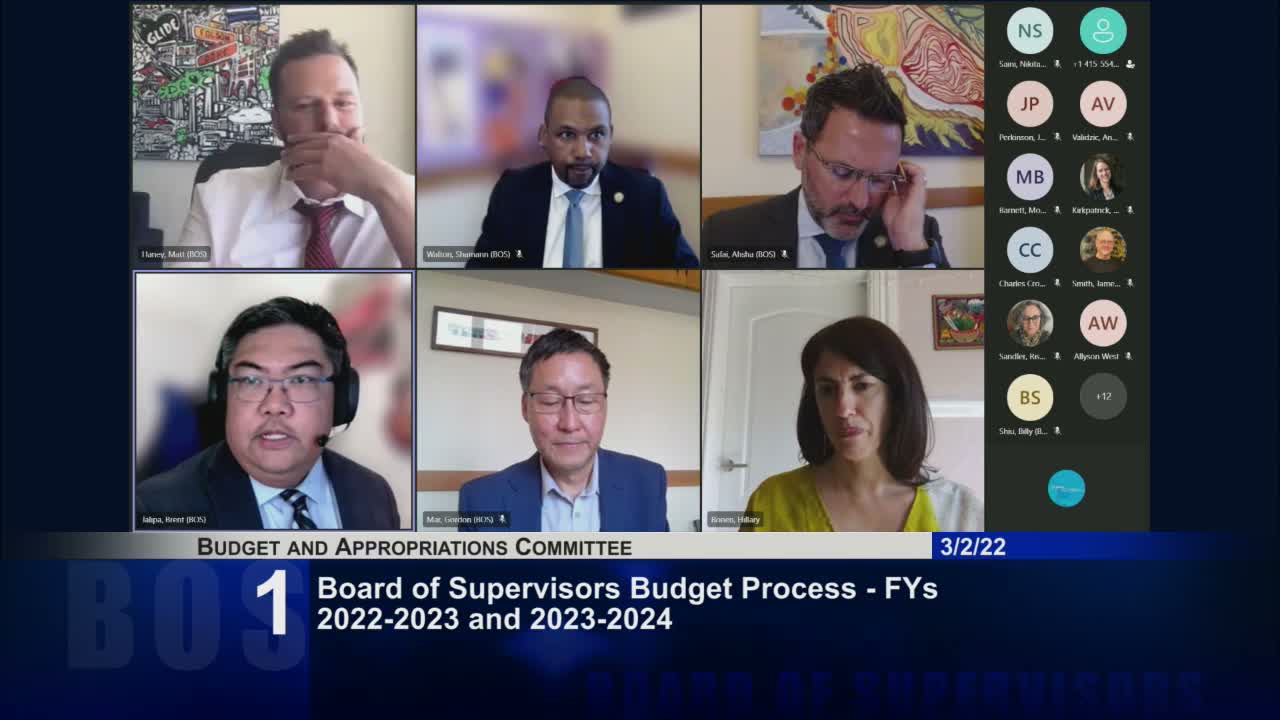
Supervisors, judges and Department of Public Health officials traded sharp questions and data at a March 2 hearing on the city's progress expanding behavioral-health beds under Mental Health SF. Judge testimony described long jail waits for appropriate placements; DPH outlined funding and near-term procurement steps but acknowledged work remains to meet the 400-bed goal.
Supervisor Ronan framed the hearing by citing the bed-optimization report and its estimate that roughly 408 additional beds would be needed to address system flow. Judges who work in collaborative courts told the committee that defendants with dual diagnoses frequently wait months before programs can even interview them and then wait additional months for a bed. "If you look at those numbers, you've got at line e, you've got 79 days before somebody even talks to them about whether you're appropriate for the program... then after that... there are numbers that are almost 7 months or exceeding 8 months," Judge Michael Burgert said, describing case-chart examples.
Department of Public Health officials said progress has been made but is slower than advocates and judges want. David Pating, co-lead for Mental Health SF new beds and facilities, summarized the department's approach (purchasing and rehabbing facilities and contracting with in- and out-of-county providers) and said DPH is updating the bed-optimization work with a new report due by December 2022.
Kelly Kirkpatrick, DPH deputy administrator for operations, said the department has opened approximately 89 of the 400 new-bed goal and noted that the city received its full allocation of Prop C ($93,000,000), of which about $30,000,000 is allocated this fiscal year for residential care and treatment beds. Kirkpatrick said DPH plans to issue an RFP that month to expand contracted bed types (including dual-diagnosis) and that property acquisition and renovations typically take 1.5'2 to 3 years, including due diligence, community process and licensing assessments.
Supervisors pressed DPH for concrete, trackable metrics and clearer budget requests. Supervisor Rafael Mandelmann and others said prior appropriations and past targets have not produced the expected capacity, cited examples of stalled projects, and demanded that DPH produce staffing and funding needs the committee can consider during the budget cycle. Dr. Hilary Conant, DPH director of behavioral health services, acknowledged the urgency and said DPH is prioritizing referrals from jails and hospital discharges and is working to streamline screening tools and pathways with jail health, pretrial, and provider partners.
After extended questioning and the department's commitments to pursue acquisitions, contracting and data improvements, the committee voted to file the hearing for follow-up (motion to file carried by roll call; 4 ayes with Chair Haney absent). Supervisors directed DPH to return with clearer staffing requests, progress metrics and time-bound milestones as part of the upcoming budget process.
Supervisor Ronan framed the hearing by citing the bed-optimization report and its estimate that roughly 408 additional beds would be needed to address system flow. Judges who work in collaborative courts told the committee that defendants with dual diagnoses frequently wait months before programs can even interview them and then wait additional months for a bed. "If you look at those numbers, you've got at line e, you've got 79 days before somebody even talks to them about whether you're appropriate for the program... then after that... there are numbers that are almost 7 months or exceeding 8 months," Judge Michael Burgert said, describing case-chart examples.
Department of Public Health officials said progress has been made but is slower than advocates and judges want. David Pating, co-lead for Mental Health SF new beds and facilities, summarized the department's approach (purchasing and rehabbing facilities and contracting with in- and out-of-county providers) and said DPH is updating the bed-optimization work with a new report due by December 2022.
Kelly Kirkpatrick, DPH deputy administrator for operations, said the department has opened approximately 89 of the 400 new-bed goal and noted that the city received its full allocation of Prop C ($93,000,000), of which about $30,000,000 is allocated this fiscal year for residential care and treatment beds. Kirkpatrick said DPH plans to issue an RFP that month to expand contracted bed types (including dual-diagnosis) and that property acquisition and renovations typically take 1.5'2 to 3 years, including due diligence, community process and licensing assessments.
Supervisors pressed DPH for concrete, trackable metrics and clearer budget requests. Supervisor Rafael Mandelmann and others said prior appropriations and past targets have not produced the expected capacity, cited examples of stalled projects, and demanded that DPH produce staffing and funding needs the committee can consider during the budget cycle. Dr. Hilary Conant, DPH director of behavioral health services, acknowledged the urgency and said DPH is prioritizing referrals from jails and hospital discharges and is working to streamline screening tools and pathways with jail health, pretrial, and provider partners.
After extended questioning and the department's commitments to pursue acquisitions, contracting and data improvements, the committee voted to file the hearing for follow-up (motion to file carried by roll call; 4 ayes with Chair Haney absent). Supervisors directed DPH to return with clearer staffing requests, progress metrics and time-bound milestones as part of the upcoming budget process.
Don't Miss a Word: See the Full Meeting!
Go beyond summaries. Unlock every video, transcript, and key insight with a Founder Membership.
✓
Get instant access to full meeting videos
✓
Search and clip any phrase from complete transcripts
✓
Receive AI-powered summaries & custom alerts
✓
Enjoy lifetime, unrestricted access to government data
30-day money-back guarantee
