Supervisors press DEM on $5.5M Drug Market coordination plan as BLA urges reserves
June 23, 2023 | San Francisco County, California
This article was created by AI summarizing key points discussed. AI makes mistakes, so for full details and context, please refer to the video of the full meeting. Please report any errors so we can fix them. Report an error »
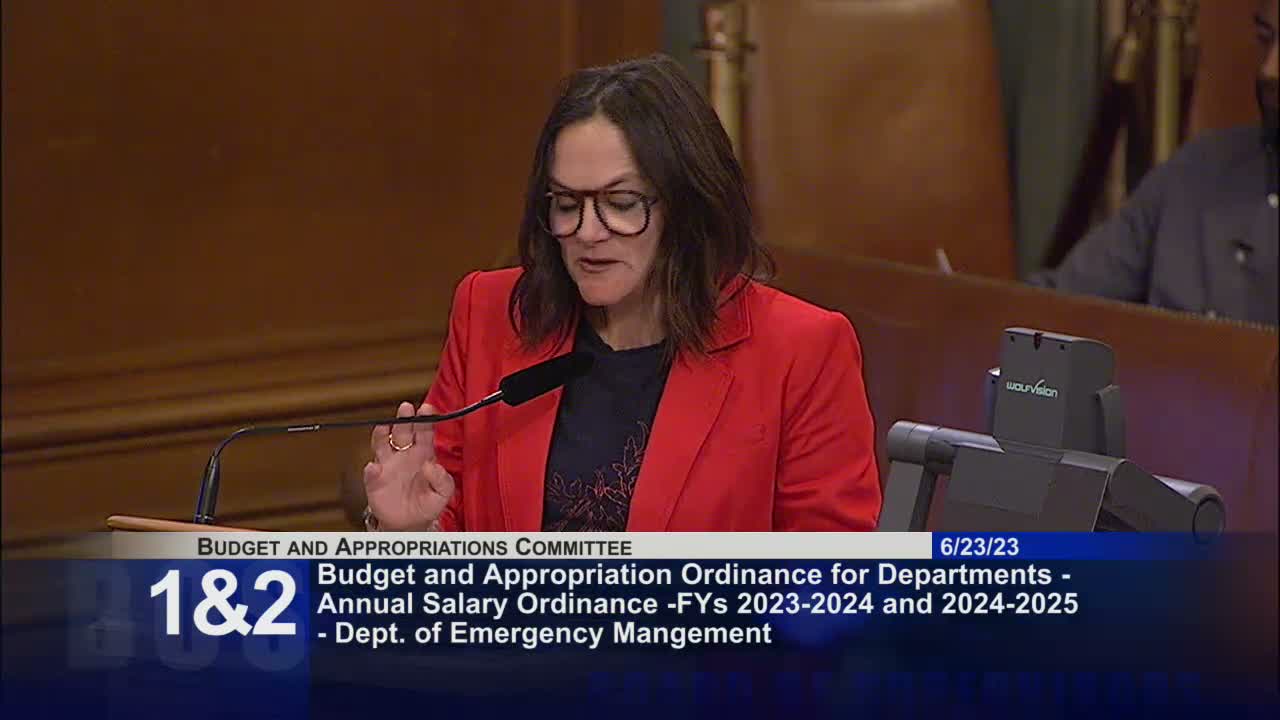
San FranciscoBudget and Appropriation Committee members spent more than an hour Wednesday interrogating the Department of Emergency Managementabout a newly launched Drug Market Agency Coordination Center, known as DMACC, and whether the department should be the long-term home for what supervisors described as a cross-agency public-safety operation.
Mary Ellen Carroll, DEMexecutive director, told the committee that the mayorand DEM have reposed a $5.5 million initiative to stand up the DMACC. Of that total, Carroll said, roughly $1.277 million is the operational portion that would cover leasing 1155 Market Street, technology and temporary staff; the remainderabout $4 millionis proposed as a one-time reserve for work orders to other departments that would support the centerwork. "We activated this less than two weeks ago," Carroll said, adding DEM expects to provide more operational details by the committees next meeting.
The Budget and Legislative Analyst, represented at the hearing by Linden Berry and other analysts, recommended placing the $4 million reserve on hold until DMACC work orders and interdepartmental costs are more fully defined. Berry said the operating funds of about $1.2 million are a policy decision for the board and that the work orderswhich will fund infrastructure and services from other city departmentsremain unfinished.
Supervisors were split on whether the DMACC belongs in DEM and on how quickly the city should commit funds. Vice Chair Rafael Mendelmann and other supervisors said the center addresses urgent street-safety problems that require rapid, multiagency coordination and that DEM has the convening capacity to lead that work. "I cannot imagine who else would take this on in our city bureaucracy and get the work done," Mendelmann said.
Supervisor Hillary Ronan pressed Carroll on long-term effectiveness, arguing the city lacks the treatment beds, step-down housing and coordinated mental-health infrastructure needed to make a supply-side enforcement strategy durable. "We're dealing with the emergency of poverty," Ronan said, warning that short-term operations without investments in housing and treatment will repeat past cycles of temporary gains followed by renewed street activity.
Carroll acknowledged those structural constraints and said DMACC is designed as a coordination table with public-safety, public-health and housing partners, not as a sole solution. Carroll also said DEMwhich has taken on street-crisis work during the pandemicis balancing its traditional emergency responsibilities with new crisis-response roles.
The committee requested a follow-up from DEM that details: the number of FTEs assigned to each coordinated street-response program; the operating and capital budgets associated with the departmentincluding ongoing and vacancy-driven salary savings; and the status of capital improvements at DEMnotably infrastructure at 1011 Turk Street. Carroll agreed to provide the requested FTE and budget breakdowns and noted that the BLA and DEM had agreed to place some funds on reserve while final plans are completed.
The committee did not take a formal vote on DMACC funding on Wednesday. Members signaled support for reserving the larger, interdepartmental work-order sum until partners return with finalized scopes and costs, while also urging DEM to move quickly on operational details.
Whathappens next: DEM will deliver a detailed staffing and budget breakdown to the Budget and Appropriation Committee by the committees next recessed meeting, and supervisors may consider whether to approve the $1.277 million in operations and the $4 million reserve once those details are available.
Mary Ellen Carroll, DEMexecutive director, told the committee that the mayorand DEM have reposed a $5.5 million initiative to stand up the DMACC. Of that total, Carroll said, roughly $1.277 million is the operational portion that would cover leasing 1155 Market Street, technology and temporary staff; the remainderabout $4 millionis proposed as a one-time reserve for work orders to other departments that would support the centerwork. "We activated this less than two weeks ago," Carroll said, adding DEM expects to provide more operational details by the committees next meeting.
The Budget and Legislative Analyst, represented at the hearing by Linden Berry and other analysts, recommended placing the $4 million reserve on hold until DMACC work orders and interdepartmental costs are more fully defined. Berry said the operating funds of about $1.2 million are a policy decision for the board and that the work orderswhich will fund infrastructure and services from other city departmentsremain unfinished.
Supervisors were split on whether the DMACC belongs in DEM and on how quickly the city should commit funds. Vice Chair Rafael Mendelmann and other supervisors said the center addresses urgent street-safety problems that require rapid, multiagency coordination and that DEM has the convening capacity to lead that work. "I cannot imagine who else would take this on in our city bureaucracy and get the work done," Mendelmann said.
Supervisor Hillary Ronan pressed Carroll on long-term effectiveness, arguing the city lacks the treatment beds, step-down housing and coordinated mental-health infrastructure needed to make a supply-side enforcement strategy durable. "We're dealing with the emergency of poverty," Ronan said, warning that short-term operations without investments in housing and treatment will repeat past cycles of temporary gains followed by renewed street activity.
Carroll acknowledged those structural constraints and said DMACC is designed as a coordination table with public-safety, public-health and housing partners, not as a sole solution. Carroll also said DEMwhich has taken on street-crisis work during the pandemicis balancing its traditional emergency responsibilities with new crisis-response roles.
The committee requested a follow-up from DEM that details: the number of FTEs assigned to each coordinated street-response program; the operating and capital budgets associated with the departmentincluding ongoing and vacancy-driven salary savings; and the status of capital improvements at DEMnotably infrastructure at 1011 Turk Street. Carroll agreed to provide the requested FTE and budget breakdowns and noted that the BLA and DEM had agreed to place some funds on reserve while final plans are completed.
The committee did not take a formal vote on DMACC funding on Wednesday. Members signaled support for reserving the larger, interdepartmental work-order sum until partners return with finalized scopes and costs, while also urging DEM to move quickly on operational details.
Whathappens next: DEM will deliver a detailed staffing and budget breakdown to the Budget and Appropriation Committee by the committees next recessed meeting, and supervisors may consider whether to approve the $1.277 million in operations and the $4 million reserve once those details are available.
View the Full Meeting & All Its Details
This article offers just a summary. Unlock complete video, transcripts, and insights as a Founder Member.
✓
Watch full, unedited meeting videos
✓
Search every word spoken in unlimited transcripts
✓
AI summaries & real-time alerts (all government levels)
✓
Permanent access to expanding government content
30-day money-back guarantee
