Supervisors debate $50 million supplemental to establish Office of Reparations; item continued to June 28
June 09, 2023 | San Francisco County, California
This article was created by AI summarizing key points discussed. AI makes mistakes, so for full details and context, please refer to the video of the full meeting. Please report any errors so we can fix them. Report an error »
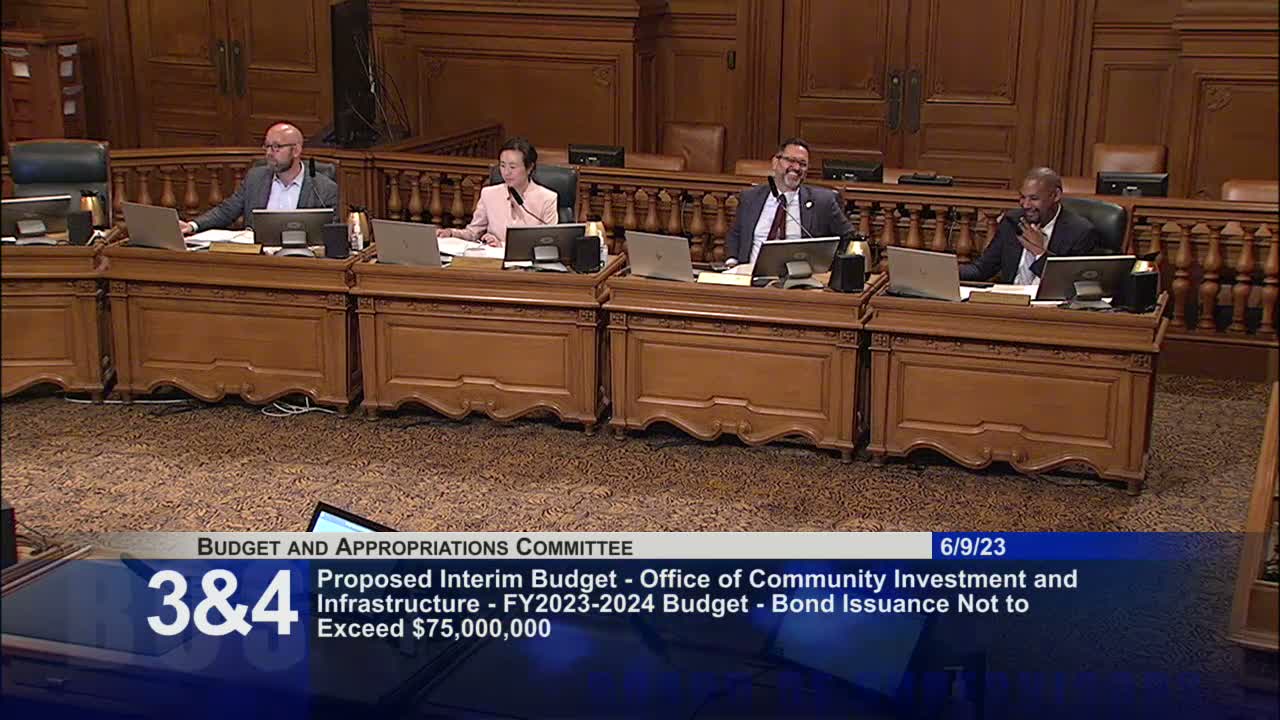
Supervisor Shamann Walton introduced an ordinance (item 5) to appropriate $50,000,000 from general reserves to the Human Rights Commission to establish an Office of Reparations and begin implementation of the African American Reparations Advisory Committee (ARAC) recommendations.
Walton framed the supplemental as a way to "put our money where our mouth is" following unanimous March board statements supporting reparations. Eric McDonald, chair of the ARAC, described the committee's mission to chronicle harms and recommend an eligibility and implementation plan. McDonald said an Office of Reparations is essential to operationalizing the committee's recommendations.
Dan Gonchar of the Budget and Legislative Analyst's Office presented cost estimates: staffing and operational support for the office at the levels necessary to implement ARAC recommendations, with staff and professional services estimates and a two-year cost profile. Gonchar said the BLA estimates roughly $1,600,000 to staff the office (city staff costs prorated) with approximately $48.4 million of the proposed appropriation remaining for programming; he noted the $50,000,000 would not be sufficient to implement all recommendations but could pilot programming.
Public comment was overwhelmingly supportive: dozens of callers and in-person speakers urged the Board to fund the office, begin outreach and eligibility work, and sustain implementation beyond an initial pilot. Jafriya Morris said the committee had "done an amazing job" and urged the Board to act. Several speakers warned that symbolic statements without funding would undermine community trust.
Mayor's budget staff Anna Dunning and Human Rights Commission Director Cheryl Davis clarified distinctions between the Dreamkeeper initiative (which Dunning said is funded at about $60,000,000 in the proposed budget) and a dedicated Office of Reparations. Dunning said the mayor's proposed budget did not include funding specifically earmarked for a new Office of Reparations. Director Davis recommended more operational staffing and outreach funding than the BLA minimum to ensure meaningful progress, suggesting an operational baseline closer to $3,000,000 and additional dollars to support tangible initiatives.
Supervisors debated whether to reduce the supplemental (Walton proposed changing $50,000,000 to $10,000,000; the motion lacked a second and failed). After discussion the committee voted to continue the ordinance to a date-certain (June 28) for ongoing budget negotiation, with a roll call of Mandelmann (aye), Safai (aye), Walton (no) and Chan (aye); the motion carried 3–1.
Walton framed the supplemental as a way to "put our money where our mouth is" following unanimous March board statements supporting reparations. Eric McDonald, chair of the ARAC, described the committee's mission to chronicle harms and recommend an eligibility and implementation plan. McDonald said an Office of Reparations is essential to operationalizing the committee's recommendations.
Dan Gonchar of the Budget and Legislative Analyst's Office presented cost estimates: staffing and operational support for the office at the levels necessary to implement ARAC recommendations, with staff and professional services estimates and a two-year cost profile. Gonchar said the BLA estimates roughly $1,600,000 to staff the office (city staff costs prorated) with approximately $48.4 million of the proposed appropriation remaining for programming; he noted the $50,000,000 would not be sufficient to implement all recommendations but could pilot programming.
Public comment was overwhelmingly supportive: dozens of callers and in-person speakers urged the Board to fund the office, begin outreach and eligibility work, and sustain implementation beyond an initial pilot. Jafriya Morris said the committee had "done an amazing job" and urged the Board to act. Several speakers warned that symbolic statements without funding would undermine community trust.
Mayor's budget staff Anna Dunning and Human Rights Commission Director Cheryl Davis clarified distinctions between the Dreamkeeper initiative (which Dunning said is funded at about $60,000,000 in the proposed budget) and a dedicated Office of Reparations. Dunning said the mayor's proposed budget did not include funding specifically earmarked for a new Office of Reparations. Director Davis recommended more operational staffing and outreach funding than the BLA minimum to ensure meaningful progress, suggesting an operational baseline closer to $3,000,000 and additional dollars to support tangible initiatives.
Supervisors debated whether to reduce the supplemental (Walton proposed changing $50,000,000 to $10,000,000; the motion lacked a second and failed). After discussion the committee voted to continue the ordinance to a date-certain (June 28) for ongoing budget negotiation, with a roll call of Mandelmann (aye), Safai (aye), Walton (no) and Chan (aye); the motion carried 3–1.
Don't Miss a Word: See the Full Meeting!
Go beyond summaries. Unlock every video, transcript, and key insight with a Founder Membership.
✓
Get instant access to full meeting videos
✓
Search and clip any phrase from complete transcripts
✓
Receive AI-powered summaries & custom alerts
✓
Enjoy lifetime, unrestricted access to government data
30-day money-back guarantee
