San Francisco budget hearing draws hours of public comment urging protect childcare, homeless and neighborhood programs
June 26, 2023 | San Francisco County, California
This article was created by AI summarizing key points discussed. AI makes mistakes, so for full details and context, please refer to the video of the full meeting. Please report any errors so we can fix them. Report an error »
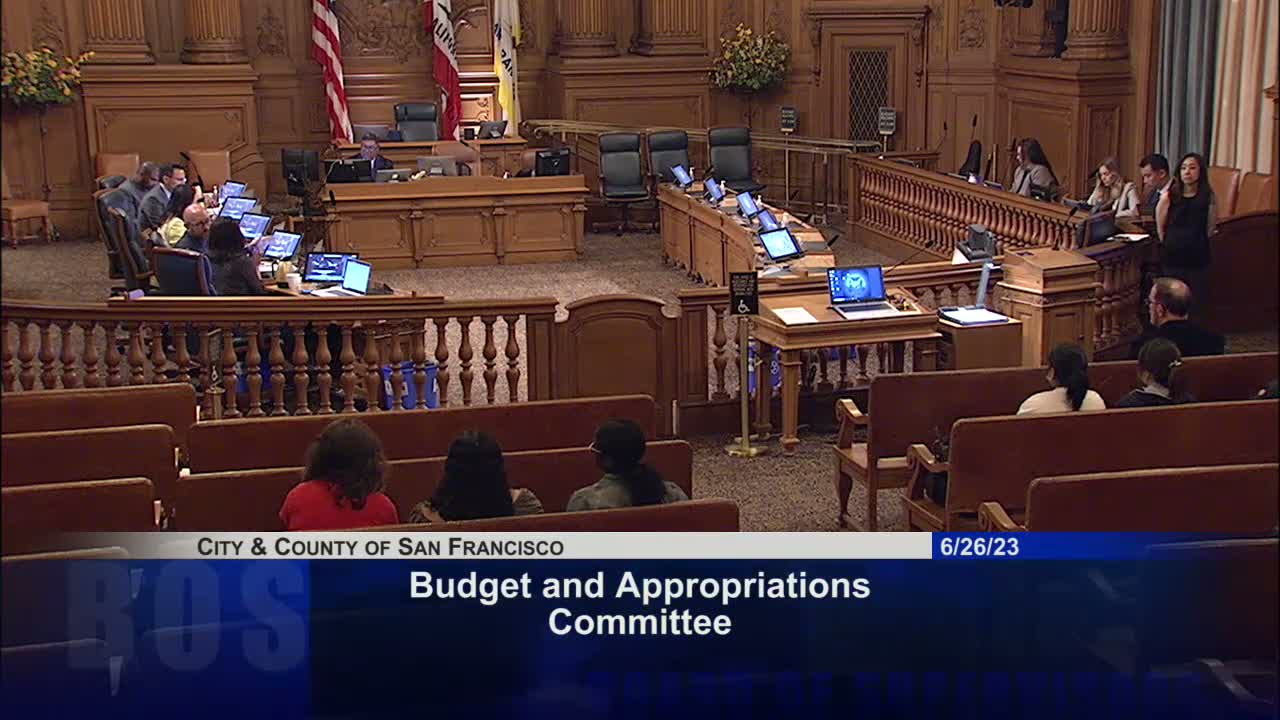
The San Francisco Board of Supervisors' Budget & Appropriations Committee spent a special June session hearing more than six hours of public comment on the mayor's proposed budget, with repeated appeals from residents and service providers to preserve funding for childcare, homeless and neighborhood programs.
Chair Connie Chan opened the meeting with a reminder of the committee's process and the day's purpose: "I am supervisor Connie Chan, chair of the committee," and then explained the public-comment rules and schedule. Brent Halipa, the committee clerk, walked through hybrid meeting logistics and interpretation services before the committee called agenda items 1 and 2: the annual budget appropriation ordinance and the salary/position ordinance for fiscal years ending June 30, 2024 and 2025.
Speakers who filled the chamber and remote queue stressed a small set of recurring priorities. Childcare advocates asked supervisors to leave intact the voter-approved Baby (Prop) C baseline and not to use it to plug budget gaps; family childcare providers and parents described the program as essential to working families and urged continued funding for infants, toddlers and preschoolers as well as investments in providers' pay. One child-care provider told the committee that staff paid at dignified wages allow parents to work and that cuts would force providers and families to make untenable choices.
Service providers and residents also pushed back on proposed cuts to programs that serve people experiencing homelessness, especially transitional-age youth (TAY) and families. A broad coalition of homeless and youth-service organizations argued that reallocating set-aside funds would reduce housing and prevention across the system. The Homeless Prenatal Program, Larkin Street Youth Services and others warned that removing or redirecting Prop C sets back multi-year efforts to place families and youth into permanent housing.
Tenants and organizers from Single Room Occupancy (SRO) communities testified about dangerous building conditions and the role of SRO tenant collaboratives and code-enforcement outreach in resolving habitability issues. Multiple SRO residents said organizers provide translation and tenant-counseling that city systems alone do not deliver and asked the committee to restore roughly $5.2 million proposed for SRO/collaborative programs.
Neighborhood food programs and the San Francisco-Marin Food Bank cautioned that proposed reductions to food-security funding would worsen hunger and increase waitlists for the city's pop-up pantry network. Cultural and arts institutions, including speakers representing the GLBT Historical Society and the Chinese Culture Center's 41 Ross residency program, asked supervisors to restore cuts to core operating support that keep museums, archives and arts education running.
Community green-space defenders urged restoration of funding for Hummingbird Farm and Sisterhood Garden, describing paid youth apprenticeships, native-plant restoration and cultural programming that the projects deliver for southeast neighborhoods.
Throughout the afternoon, many speakers linked the proposed cuts to a broader concern: that the mayor's budget priorities emphasize law enforcement and one-time expenditures, while reducing long-running community services that keep residents housed, fed and supported. Though commenters held a range of policy views, the testimony frequently urged that public safety investments should be balanced with housing, treatment, and community-based alternatives. One public speaker said directly: "We should fund services, not surveillance."
After public comment, the committee approved a motion to continue remaining agenda items to a follow-up meeting on Wednesday, June 28 (roll call: Mendelmann yes; Safai absent; Ronan yes; Walton yes; Chan yes) and recessed to reconvene at 10:00 a.m. on June 28. The roll-call votes were recorded on the record and reflected the committee's decision to gather more information and consider add-back requests at the continuation session.
Next steps: the committee will reconvene on June 28 to consider add-back requests and follow up on items raised during public comment. Many community organizations said they will continue meeting with supervisors and staff ahead of that session to supply budget details, impact projections and program-level requests.
Chair Connie Chan opened the meeting with a reminder of the committee's process and the day's purpose: "I am supervisor Connie Chan, chair of the committee," and then explained the public-comment rules and schedule. Brent Halipa, the committee clerk, walked through hybrid meeting logistics and interpretation services before the committee called agenda items 1 and 2: the annual budget appropriation ordinance and the salary/position ordinance for fiscal years ending June 30, 2024 and 2025.
Speakers who filled the chamber and remote queue stressed a small set of recurring priorities. Childcare advocates asked supervisors to leave intact the voter-approved Baby (Prop) C baseline and not to use it to plug budget gaps; family childcare providers and parents described the program as essential to working families and urged continued funding for infants, toddlers and preschoolers as well as investments in providers' pay. One child-care provider told the committee that staff paid at dignified wages allow parents to work and that cuts would force providers and families to make untenable choices.
Service providers and residents also pushed back on proposed cuts to programs that serve people experiencing homelessness, especially transitional-age youth (TAY) and families. A broad coalition of homeless and youth-service organizations argued that reallocating set-aside funds would reduce housing and prevention across the system. The Homeless Prenatal Program, Larkin Street Youth Services and others warned that removing or redirecting Prop C sets back multi-year efforts to place families and youth into permanent housing.
Tenants and organizers from Single Room Occupancy (SRO) communities testified about dangerous building conditions and the role of SRO tenant collaboratives and code-enforcement outreach in resolving habitability issues. Multiple SRO residents said organizers provide translation and tenant-counseling that city systems alone do not deliver and asked the committee to restore roughly $5.2 million proposed for SRO/collaborative programs.
Neighborhood food programs and the San Francisco-Marin Food Bank cautioned that proposed reductions to food-security funding would worsen hunger and increase waitlists for the city's pop-up pantry network. Cultural and arts institutions, including speakers representing the GLBT Historical Society and the Chinese Culture Center's 41 Ross residency program, asked supervisors to restore cuts to core operating support that keep museums, archives and arts education running.
Community green-space defenders urged restoration of funding for Hummingbird Farm and Sisterhood Garden, describing paid youth apprenticeships, native-plant restoration and cultural programming that the projects deliver for southeast neighborhoods.
Throughout the afternoon, many speakers linked the proposed cuts to a broader concern: that the mayor's budget priorities emphasize law enforcement and one-time expenditures, while reducing long-running community services that keep residents housed, fed and supported. Though commenters held a range of policy views, the testimony frequently urged that public safety investments should be balanced with housing, treatment, and community-based alternatives. One public speaker said directly: "We should fund services, not surveillance."
After public comment, the committee approved a motion to continue remaining agenda items to a follow-up meeting on Wednesday, June 28 (roll call: Mendelmann yes; Safai absent; Ronan yes; Walton yes; Chan yes) and recessed to reconvene at 10:00 a.m. on June 28. The roll-call votes were recorded on the record and reflected the committee's decision to gather more information and consider add-back requests at the continuation session.
Next steps: the committee will reconvene on June 28 to consider add-back requests and follow up on items raised during public comment. Many community organizations said they will continue meeting with supervisors and staff ahead of that session to supply budget details, impact projections and program-level requests.
Don't Miss a Word: See the Full Meeting!
Go beyond summaries. Unlock every video, transcript, and key insight with a Founder Membership.
✓
Get instant access to full meeting videos
✓
Search and clip any phrase from complete transcripts
✓
Receive AI-powered summaries & custom alerts
✓
Enjoy lifetime, unrestricted access to government data
30-day money-back guarantee
