San Francisco proposes $2.8 billion DPH budget with expanded behavioral‑health funding
June 16, 2021 | San Francisco County, California
This article was created by AI summarizing key points discussed. AI makes mistakes, so for full details and context, please refer to the video of the full meeting. Please report any errors so we can fix them. Report an error »
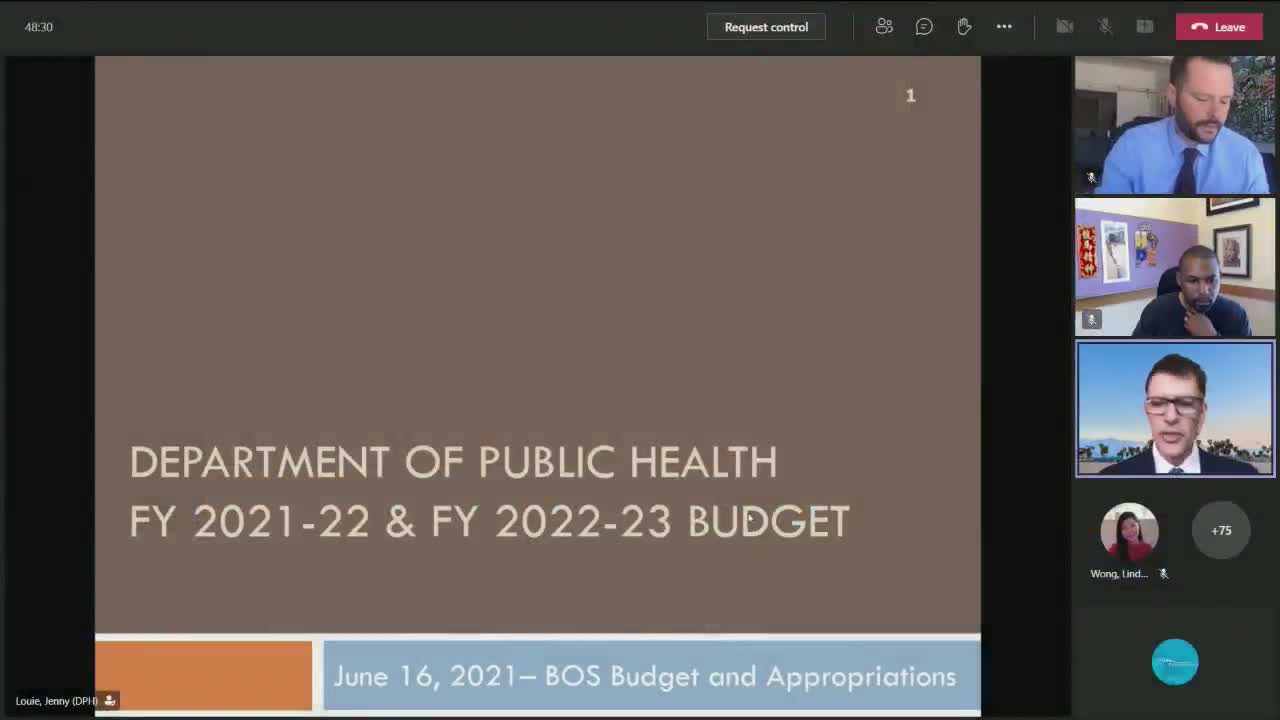
Grant Colfax, director of the San Francisco Department of Public Health, told the Budget & Appropriations Committee that the department’s proposed $2,800,000,000 budget would preserve core pandemic response and carry forward key behavioral‑health investments. “This is our $2,800,000,000 budget,” Colfax said in his five‑minute overview, adding it supports more than 7,300 full‑time equivalents and funds hospital and long‑term care operations.
Colfax emphasized the budget’s focus on Mental Health SF: new non‑police crisis response capacity, increased operating support for the behavioral health pharmacy and the drug sobering center, and work toward filling planned treatment beds. Chief Financial Officer Jenny Louie told supervisors the budget assumes operating costs for about 196 additional treatment beds in the near term, supplementing roughly 147 beds previously budgeted. “We are in the process of looking… for facilities where we can increase capacity,” Louie said.
Why it matters: The city is trying to turn large‑scale investments passed in prior ballot measures into expanded services on the ground — a mix of short‑term contracted beds and permanent sites — while also funding outreach, overdose prevention and a non‑law‑enforcement model for many crisis responses. Supervisor Matt Haney and others pressed DPH for timelines and implementation detail, including how many beds would be contracted and how many would be permanent acquisitions.
Key program components and points of debate:
- Street crisis response teams and diversion: Supervisors asked whether seven crisis response teams would be sufficient to cover priority calls. DPH staff said they currently operate four to five teams, expect overnight coverage soon and target roughly 10,000 diverted 911 calls when fully implemented. Dr. Hillary Conners described the teams carrying naloxone, initiating buprenorphine and providing assertive follow‑up after nonfatal overdoses to link people to treatment.
- Treatment bed capacity: Supervisors sought a year‑by‑year breakdown of which beds will come online and when. DPH promised to provide more precise counts and site acquisition details as contracts are finalized.
- Overdose prevention and safe‑consumption preparedness: Colfax and Conners said the budget funds street overdose response teams that carry naloxone and medications and provide follow‑up; Colfax also said the department is prepared to implement supervised consumption sites if and when state and federal permissions allow.
- Security and non‑police response in clinical settings: DPH described a mixed approach to healthcare security that limits sheriff presence while expanding behavioral response teams and psychiatric‑nursing de‑escalation staff to reduce the need for armed deputies in routine care settings.
What’s next: DPH will provide supervisors with more granular bed counts, identification of facilities and timelines, and follow up on a range of staffing and procurement questions raised during the hearing. The budget item for DPH will move forward to the full Board with the committee’s recommendation.
Colfax emphasized the budget’s focus on Mental Health SF: new non‑police crisis response capacity, increased operating support for the behavioral health pharmacy and the drug sobering center, and work toward filling planned treatment beds. Chief Financial Officer Jenny Louie told supervisors the budget assumes operating costs for about 196 additional treatment beds in the near term, supplementing roughly 147 beds previously budgeted. “We are in the process of looking… for facilities where we can increase capacity,” Louie said.
Why it matters: The city is trying to turn large‑scale investments passed in prior ballot measures into expanded services on the ground — a mix of short‑term contracted beds and permanent sites — while also funding outreach, overdose prevention and a non‑law‑enforcement model for many crisis responses. Supervisor Matt Haney and others pressed DPH for timelines and implementation detail, including how many beds would be contracted and how many would be permanent acquisitions.
Key program components and points of debate:
- Street crisis response teams and diversion: Supervisors asked whether seven crisis response teams would be sufficient to cover priority calls. DPH staff said they currently operate four to five teams, expect overnight coverage soon and target roughly 10,000 diverted 911 calls when fully implemented. Dr. Hillary Conners described the teams carrying naloxone, initiating buprenorphine and providing assertive follow‑up after nonfatal overdoses to link people to treatment.
- Treatment bed capacity: Supervisors sought a year‑by‑year breakdown of which beds will come online and when. DPH promised to provide more precise counts and site acquisition details as contracts are finalized.
- Overdose prevention and safe‑consumption preparedness: Colfax and Conners said the budget funds street overdose response teams that carry naloxone and medications and provide follow‑up; Colfax also said the department is prepared to implement supervised consumption sites if and when state and federal permissions allow.
- Security and non‑police response in clinical settings: DPH described a mixed approach to healthcare security that limits sheriff presence while expanding behavioral response teams and psychiatric‑nursing de‑escalation staff to reduce the need for armed deputies in routine care settings.
What’s next: DPH will provide supervisors with more granular bed counts, identification of facilities and timelines, and follow up on a range of staffing and procurement questions raised during the hearing. The budget item for DPH will move forward to the full Board with the committee’s recommendation.
View the Full Meeting & All Its Details
This article offers just a summary. Unlock complete video, transcripts, and insights as a Founder Member.
✓
Watch full, unedited meeting videos
✓
Search every word spoken in unlimited transcripts
✓
AI summaries & real-time alerts (all government levels)
✓
Permanent access to expanding government content
30-day money-back guarantee
