Supervisors Hear Warnings From Providers as Departments Outline Cuts and One‑time Funding Gaps
April 17, 2024 | San Francisco County, California
This article was created by AI summarizing key points discussed. AI makes mistakes, so for full details and context, please refer to the video of the full meeting. Please report any errors so we can fix them. Report an error »
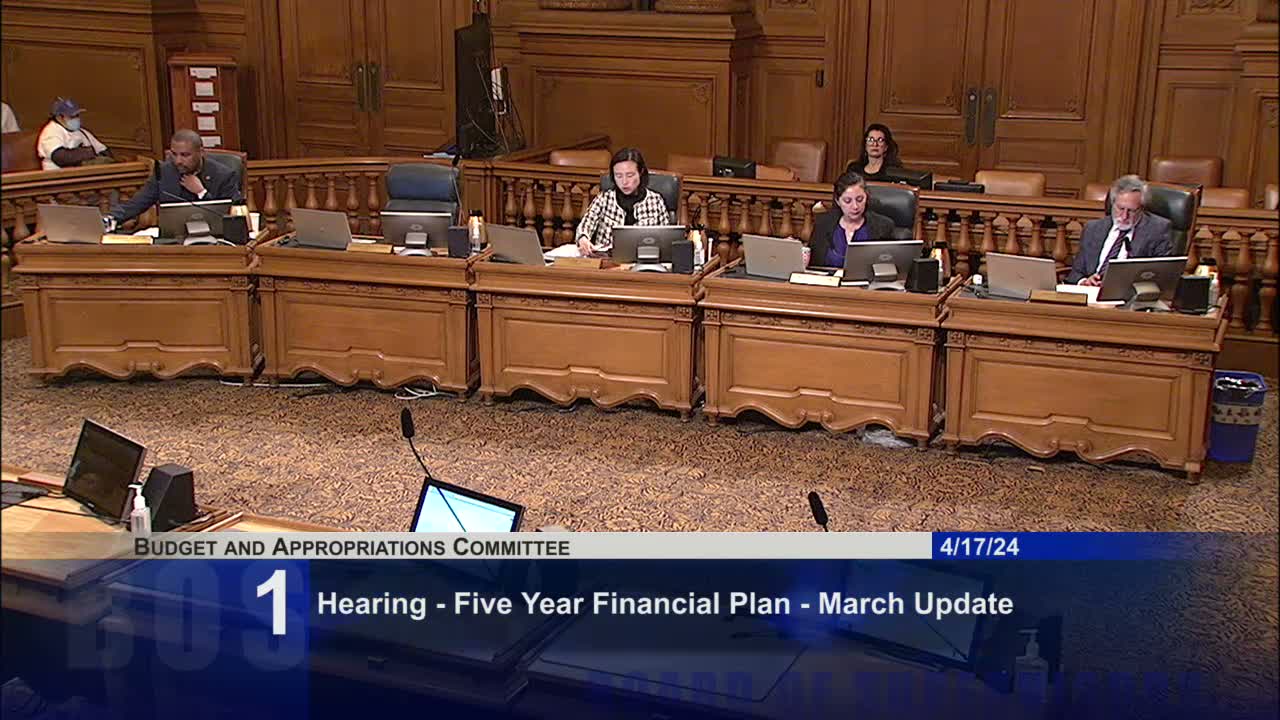
San Francisco — City officials and service providers traded questions and warnings April 17 as the Budget and Appropriations Committee took an early look at how mayoral budget guidance could affect homelessness response, shelter services and tenant-protection programs.
Chair Connie Chan opened the hearing by telling colleagues the committee wanted to “get a head start’’ on the budget process before the mayor delivers a full proposal May 30. She noted the city faces an approximate $800,000,000 budget gap and said the panel would use the session to probe department plans and hear community concerns.
The Department of Homelessness and Supportive Housing (HSH) presented its two‑year proposal and a five‑year strategic framework called Home by the Bay, which the department said guides investments in prevention, shelter, and permanent supportive housing. “In the past 2 years alone, we’ve helped over 6,700 people move out of homelessness,” HSH Executive Director Shereen McSpadden told the committee and summarized ongoing capital work: “we have, or are in the process of deploying over $26,000,000 in funding to address capital improvement needs.”
Gigi Whitley, HSH’s chief of administration and finance, said the department’s proposed budget shows a modest overall decline (about 7% over two years) largely because one‑time state funds and other temporary sources are ending. Whitley said HSH was asked to identify a 10% ongoing general‑fund reduction target (about $27,000,000) and a 5% contingency (roughly $13,000,000) and described strategies to protect services by capturing underspending, realigning contracts and leveraging state grants.
The mayor’s Office of Housing and Community Development (MOHCD) outlined tenant-protection programs the city funds or supports, naming eviction legal defense, the Emergency Rental Assistance Program (ERAP), tenant education and mediation among the core tools. MOHCD staff gave a program-level snapshot that totals about $66,600,000 in current grant spending: roughly $17,800,000 for eviction legal defense, $43,500,000 for ERAP, $3,300,000 for tenant-rights education, and $2,000,000 for mediation. Brian Chi, MOHCD director of community development, described ERAP’s funding mix as three parts: a one‑time Prop I allocation ($10,500,000), a one‑time mayoral enhancement ($32,000,000), and an ongoing work order from HSH (a little over $12,000,000). He warned that the expiration of one‑time enhancements will reduce the program’s annual capacity next fiscal year.
The Department of Building Inspection (DBI) told the committee it operates on a cost‑recovery model and that most of its budget is fee‑funded. Assistant Director Christine Gasparek said DBI currently supports about $5,000,000 a year in community‑based grants that help tenants with code‑enforcement outreach and SRO habitability. DBI staff described a recently completed fee study recommending an average fee increase of about 40% phased over three years and warned reserves could fall below $10,000,000 in the near term if revenues remain weak.
Across the room, a coalition of labor and community providers urged the board not to balance the budget on the backs of vulnerable San Franciscans. “We will not balance the budget on the backs of poor and working class San Franciscans,” Jennifer Friedenbach of the Coalition on Homelessness said during her presentation, which cited waitlists and an estimated 442 families currently waiting for shelter. Supportive‑housing providers said operating pressures — rising vacancies, unpaid rent and higher insurance and maintenance costs — are straining non‑profit partners; Tabitha Allen of Tenderloin Housing Clinic said providers face more than $8,000,000 in losses from rental arrears and estimated $27,000,000 would be needed to address habitability and accessibility improvements in older buildings.
More than a hundred members of the public and representatives of tenant‑advocacy organizations, legal services and shelter providers took one‑minute turns during a lengthy public‑comment period. Speakers repeatedly flagged the eviction‑defense system’s effectiveness, citing a roughly 92% success rate when tenants receive full‑scope legal representation, and warned that steep reductions to ERAP or CBO grants could force thousands into homelessness. Several speakers asked that unspent one‑time funds be rolled into next year to blunt immediate cuts and urged the committee to prioritize prevention and legal assistance over program eliminations.
Supervisors pressed department staff on specifics. Committee members asked whether one‑time mayoral and state funds could be carried forward or reallocated and pressed HSH and MOHCD for clarifications of contingency lists and where reductions would begin if further cuts are required. MOHCD staff described options they had submitted to the mayor’s budget office, including identifying one‑time rollovers and reassigning non‑direct‑service capital dollars to preserve grants through the next fiscal year.
The committee also recorded two formal motions. Early in the meeting the board voted to continue Item 1 — the March financial‑plan update — to the call of the chair. At the end of the hearing Chair Chan moved to file the item; the committee approved the motion by roll call (three ayes, two members absent) and adjourned.
What’s next: Chair Chan framed this as the first of three hearings in the board’s budget review process. Departments will continue to refine budget proposals before the mayor’s May 30 submission, and the board will revisit allocations and potential reductions during the formal June budget hearings.
Reporting note: Quotes and program figures in this story come from departmental presentations and public commenters during the April 17 Budget & Appropriations Committee hearing; vote tallies are drawn from the meeting roll calls recorded on the public record.
Chair Connie Chan opened the hearing by telling colleagues the committee wanted to “get a head start’’ on the budget process before the mayor delivers a full proposal May 30. She noted the city faces an approximate $800,000,000 budget gap and said the panel would use the session to probe department plans and hear community concerns.
The Department of Homelessness and Supportive Housing (HSH) presented its two‑year proposal and a five‑year strategic framework called Home by the Bay, which the department said guides investments in prevention, shelter, and permanent supportive housing. “In the past 2 years alone, we’ve helped over 6,700 people move out of homelessness,” HSH Executive Director Shereen McSpadden told the committee and summarized ongoing capital work: “we have, or are in the process of deploying over $26,000,000 in funding to address capital improvement needs.”
Gigi Whitley, HSH’s chief of administration and finance, said the department’s proposed budget shows a modest overall decline (about 7% over two years) largely because one‑time state funds and other temporary sources are ending. Whitley said HSH was asked to identify a 10% ongoing general‑fund reduction target (about $27,000,000) and a 5% contingency (roughly $13,000,000) and described strategies to protect services by capturing underspending, realigning contracts and leveraging state grants.
The mayor’s Office of Housing and Community Development (MOHCD) outlined tenant-protection programs the city funds or supports, naming eviction legal defense, the Emergency Rental Assistance Program (ERAP), tenant education and mediation among the core tools. MOHCD staff gave a program-level snapshot that totals about $66,600,000 in current grant spending: roughly $17,800,000 for eviction legal defense, $43,500,000 for ERAP, $3,300,000 for tenant-rights education, and $2,000,000 for mediation. Brian Chi, MOHCD director of community development, described ERAP’s funding mix as three parts: a one‑time Prop I allocation ($10,500,000), a one‑time mayoral enhancement ($32,000,000), and an ongoing work order from HSH (a little over $12,000,000). He warned that the expiration of one‑time enhancements will reduce the program’s annual capacity next fiscal year.
The Department of Building Inspection (DBI) told the committee it operates on a cost‑recovery model and that most of its budget is fee‑funded. Assistant Director Christine Gasparek said DBI currently supports about $5,000,000 a year in community‑based grants that help tenants with code‑enforcement outreach and SRO habitability. DBI staff described a recently completed fee study recommending an average fee increase of about 40% phased over three years and warned reserves could fall below $10,000,000 in the near term if revenues remain weak.
Across the room, a coalition of labor and community providers urged the board not to balance the budget on the backs of vulnerable San Franciscans. “We will not balance the budget on the backs of poor and working class San Franciscans,” Jennifer Friedenbach of the Coalition on Homelessness said during her presentation, which cited waitlists and an estimated 442 families currently waiting for shelter. Supportive‑housing providers said operating pressures — rising vacancies, unpaid rent and higher insurance and maintenance costs — are straining non‑profit partners; Tabitha Allen of Tenderloin Housing Clinic said providers face more than $8,000,000 in losses from rental arrears and estimated $27,000,000 would be needed to address habitability and accessibility improvements in older buildings.
More than a hundred members of the public and representatives of tenant‑advocacy organizations, legal services and shelter providers took one‑minute turns during a lengthy public‑comment period. Speakers repeatedly flagged the eviction‑defense system’s effectiveness, citing a roughly 92% success rate when tenants receive full‑scope legal representation, and warned that steep reductions to ERAP or CBO grants could force thousands into homelessness. Several speakers asked that unspent one‑time funds be rolled into next year to blunt immediate cuts and urged the committee to prioritize prevention and legal assistance over program eliminations.
Supervisors pressed department staff on specifics. Committee members asked whether one‑time mayoral and state funds could be carried forward or reallocated and pressed HSH and MOHCD for clarifications of contingency lists and where reductions would begin if further cuts are required. MOHCD staff described options they had submitted to the mayor’s budget office, including identifying one‑time rollovers and reassigning non‑direct‑service capital dollars to preserve grants through the next fiscal year.
The committee also recorded two formal motions. Early in the meeting the board voted to continue Item 1 — the March financial‑plan update — to the call of the chair. At the end of the hearing Chair Chan moved to file the item; the committee approved the motion by roll call (three ayes, two members absent) and adjourned.
What’s next: Chair Chan framed this as the first of three hearings in the board’s budget review process. Departments will continue to refine budget proposals before the mayor’s May 30 submission, and the board will revisit allocations and potential reductions during the formal June budget hearings.
Reporting note: Quotes and program figures in this story come from departmental presentations and public commenters during the April 17 Budget & Appropriations Committee hearing; vote tallies are drawn from the meeting roll calls recorded on the public record.
View the Full Meeting & All Its Details
This article offers just a summary. Unlock complete video, transcripts, and insights as a Founder Member.
✓
Watch full, unedited meeting videos
✓
Search every word spoken in unlimited transcripts
✓
AI summaries & real-time alerts (all government levels)
✓
Permanent access to expanding government content
30-day money-back guarantee
