Officials warn of roughly $800 million shortfall; March update trims projections by about $10 million
May 01, 2024 | San Francisco County, California
This article was created by AI summarizing key points discussed. AI makes mistakes, so for full details and context, please refer to the video of the full meeting. Please report any errors so we can fix them. Report an error »
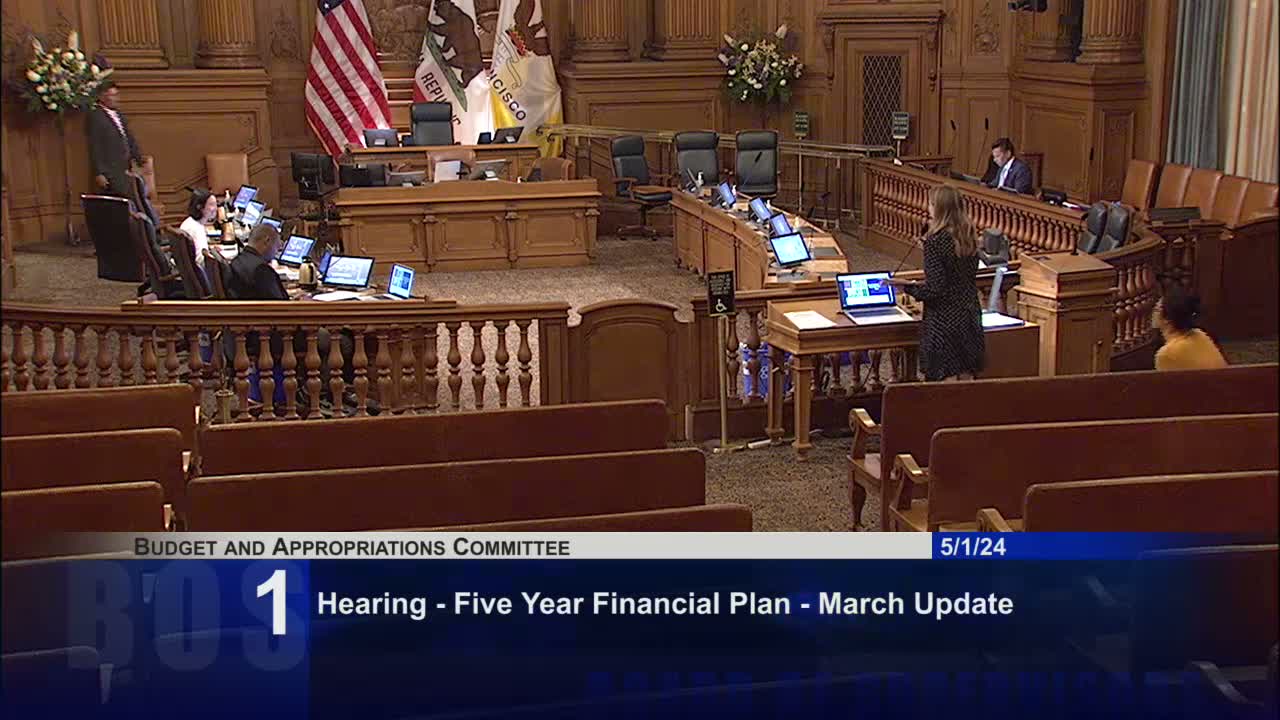
San Francisco budget officials told the County’s Budget and Appropriation Committee on May 1 that, if the city makes no new policy changes, it faces an estimated $800 million shortfall over the next two years, though the March update to the five‑year financial plan reduced prior projections by about $10 million.
Anna Dunion of the Mayor’s Budget Office said the March update is a modest revision to the December report and “we're looking at a change of about $10,000,000 from our prior projections.” She framed the estimate as a status‑quo projection—an accounting of the gap that would exist without new policy actions.
The report layers a mix of modest revenue improvements with higher cost assumptions. Carol Lou of the Controller’s Office said property tax forecasts were lowered because of increased assessment appeals that reduce assessed values and the amount of excess ERAF available to the city. Business tax cash receipts were higher in the current year but were largely offset by known refund claims and litigation, leaving that stream effectively flat in the out years. Transfer tax was held at prior levels, and staff said conversions tied to Proposition C are unlikely to occur within the plan period.
On other revenues, the report assumes $21,800,000 in additional FEMA reimbursements related to winter storms and includes the six‑month report’s additional fund balance of $34,400,000. Carol Lou told the committee staff are forecasting $123,000,000 in FEMA reimbursements for the current year and “we already have $80,000,000 in hand.”
On the expenditure side, presenters said wage and benefit costs rose because of updated health and retirement assumptions; they did not change base wage‑rate assumptions beyond building in CPI. Anna Dunion said the retirement system’s assumed investment return is 7.2 percent and cautioned that lower returns would raise employer contribution rates. Carol Lou reported the retirement system’s year‑to‑date returns through Feb. 29, 2024, were 5.7 percent.
Health benefits also drove pressure on the forecast. Officials said negotiated health rates for calendar year 2024 were unusually high, and the report models increases in the 7–9 percent range after prior annual projections of roughly 4–5 percent. Presenters confirmed that last year’s health costs exceeded projection by about $18,000,000.
The update lists the primary risks the city continues to monitor: ongoing labor negotiations (the forecast uses a CPI assumption of about 2.5 percent), the restatement of historical employment numbers by the state Employment Development Department which showed net job losses, the sensitivity of retirement contribution rates to investment returns, potential reductions in excess ERAF under proposals at the state level, and uncertainty around FEMA reimbursements.
On the ERAF issue, presenters said they had not built a state proposal into the March forecast but warned it could reduce the city’s excess ERAF by roughly $40,000,000 annually if enacted. "Our estimate is that that would result in a loss of around $40,000,000 annually to the city," Dunion said.
Supervisors pressed staff on several items. Chair Connie Chan asked for the range of retirement returns and health‑cost assumptions; staff said monthly investment reports fluctuate and the retirement system publishes monthly performance updates. Supervisor Myrna Malgar asked whether the city is coordinating with other municipalities on FEMA reimbursement advocacy; officials said such coordination is underway.
No members of the public spoke on the item. Chair Chan moved to file the hearing as heard; Supervisor Shimon Walton seconded the motion. The committee took a roll call and the motion passed with four yes votes and President Aaron Peskin absent.
The presenters told the committee they will continue following state budget developments and labor negotiations that could materially change the projections. The committee took no further action on budget policy at the May 1 hearing and filed the March update as heard.
Anna Dunion of the Mayor’s Budget Office said the March update is a modest revision to the December report and “we're looking at a change of about $10,000,000 from our prior projections.” She framed the estimate as a status‑quo projection—an accounting of the gap that would exist without new policy actions.
The report layers a mix of modest revenue improvements with higher cost assumptions. Carol Lou of the Controller’s Office said property tax forecasts were lowered because of increased assessment appeals that reduce assessed values and the amount of excess ERAF available to the city. Business tax cash receipts were higher in the current year but were largely offset by known refund claims and litigation, leaving that stream effectively flat in the out years. Transfer tax was held at prior levels, and staff said conversions tied to Proposition C are unlikely to occur within the plan period.
On other revenues, the report assumes $21,800,000 in additional FEMA reimbursements related to winter storms and includes the six‑month report’s additional fund balance of $34,400,000. Carol Lou told the committee staff are forecasting $123,000,000 in FEMA reimbursements for the current year and “we already have $80,000,000 in hand.”
On the expenditure side, presenters said wage and benefit costs rose because of updated health and retirement assumptions; they did not change base wage‑rate assumptions beyond building in CPI. Anna Dunion said the retirement system’s assumed investment return is 7.2 percent and cautioned that lower returns would raise employer contribution rates. Carol Lou reported the retirement system’s year‑to‑date returns through Feb. 29, 2024, were 5.7 percent.
Health benefits also drove pressure on the forecast. Officials said negotiated health rates for calendar year 2024 were unusually high, and the report models increases in the 7–9 percent range after prior annual projections of roughly 4–5 percent. Presenters confirmed that last year’s health costs exceeded projection by about $18,000,000.
The update lists the primary risks the city continues to monitor: ongoing labor negotiations (the forecast uses a CPI assumption of about 2.5 percent), the restatement of historical employment numbers by the state Employment Development Department which showed net job losses, the sensitivity of retirement contribution rates to investment returns, potential reductions in excess ERAF under proposals at the state level, and uncertainty around FEMA reimbursements.
On the ERAF issue, presenters said they had not built a state proposal into the March forecast but warned it could reduce the city’s excess ERAF by roughly $40,000,000 annually if enacted. "Our estimate is that that would result in a loss of around $40,000,000 annually to the city," Dunion said.
Supervisors pressed staff on several items. Chair Connie Chan asked for the range of retirement returns and health‑cost assumptions; staff said monthly investment reports fluctuate and the retirement system publishes monthly performance updates. Supervisor Myrna Malgar asked whether the city is coordinating with other municipalities on FEMA reimbursement advocacy; officials said such coordination is underway.
No members of the public spoke on the item. Chair Chan moved to file the hearing as heard; Supervisor Shimon Walton seconded the motion. The committee took a roll call and the motion passed with four yes votes and President Aaron Peskin absent.
The presenters told the committee they will continue following state budget developments and labor negotiations that could materially change the projections. The committee took no further action on budget policy at the May 1 hearing and filed the March update as heard.
Don't Miss a Word: See the Full Meeting!
Go beyond summaries. Unlock every video, transcript, and key insight with a Founder Membership.
✓
Get instant access to full meeting videos
✓
Search and clip any phrase from complete transcripts
✓
Receive AI-powered summaries & custom alerts
✓
Enjoy lifetime, unrestricted access to government data
30-day money-back guarantee
