Planning Commission approves 100 Broadway cannabis store with on-site consumption lounge, adds air, visibility and outreach conditions
March 09, 2023 | San Francisco City, San Francisco County, California
This article was created by AI summarizing key points discussed. AI makes mistakes, so for full details and context, please refer to the video of the full meeting. Please report any errors so we can fix them. Report an error »
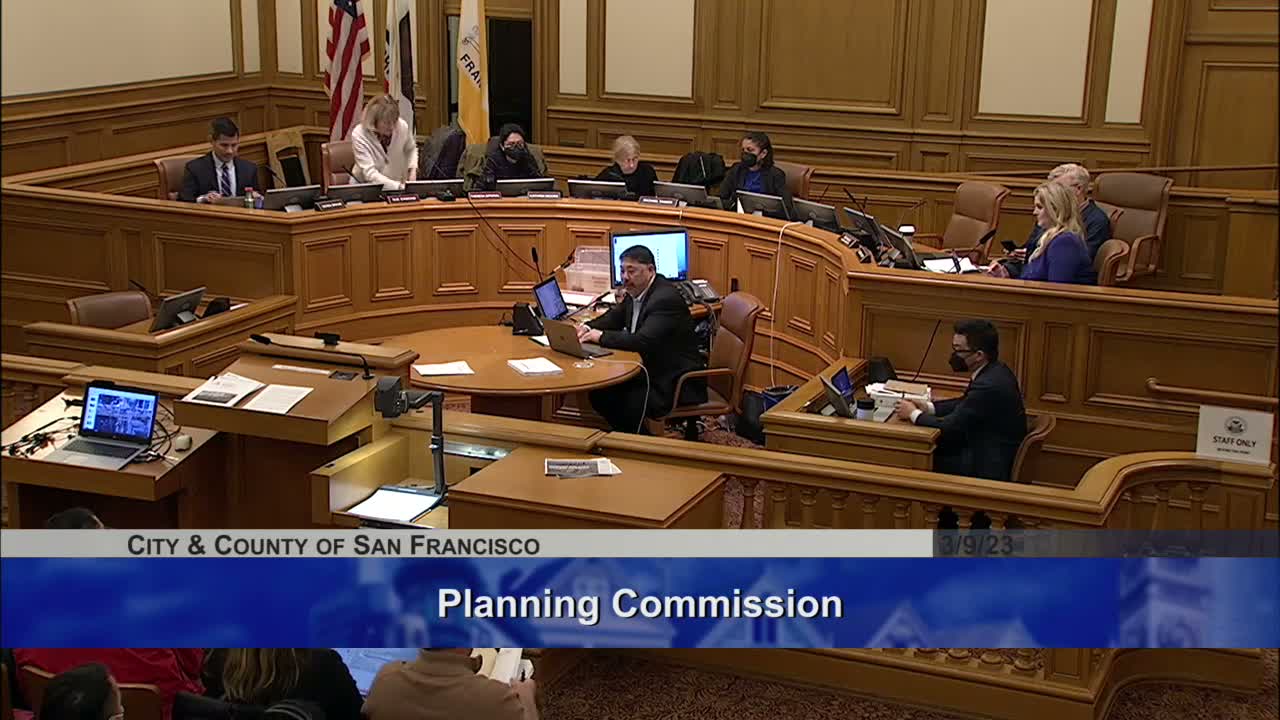
The San Francisco Planning Commission voted unanimously on March 9 to approve a discretionary review for a cannabis retail store with an on-site consumption lounge at 100 Broadway, adopting a set of conditions intended to reduce potential impacts on nearby childcare centers and residents.
Planning staff described the proposal as a conversion of about 6,700 square feet of ground-floor retail to cannabis retail with a consumption lounge and 2,800 square feet of accessory/storage in the basement. Nick Foster of the planning department recommended taking discretionary review with modifications and approving the project with conditions; he told commissioners the site meets code location requirements and that Department of Public Health (DPH) technical standards apply to consumption lounges.
The application drew lengthy public comment, much of it from Chinatown-area residents, childcare operators and senior groups. Andy Chu, executive director of the Chinatown YMCA (which operates a nearby preschool), said the center’s outdoor play area lies close to the site and that "customers who may leave the store might walk by and might light up," a concern echoed by other childcare operators. Protesters argued that preschool and daycare locations should be included in the city’s 600-foot buffer used for K–12 schools.
Project sponsor Lawrence Michaelson said the proposal includes a hermetically sealed smoking and vaping room designed to DPH standards and an exhaust system with filtration so that no marijuana smoke would be emitted outside the building. Michaelson said the consumption lounge is a neighborhood amenity and that "no money is to be made on the lounge," adding that the lounge aims to provide a safe indoor space for medical and social consumption for residents who cannot consume at home.
Commissioners pressed staff and the sponsor for technical clarity on ventilation and for enforceable community protections. Foster said DPH reviews HVAC and mitigation at the building-permit stage and can require monitoring or enforcement after construction. Several commissioners urged explicit, enforceable conditions rather than relying solely on post‑permit complaint procedures.
To address community concerns, the commission approved a motion to take discretionary review and to impose staff-proposed conditions plus additional requirements. Those added by the commission include: (1) DPH testing of odor and smoke mitigation at six months and one year after opening; (2) a requirement that the consumption-lounge exhaust not discharge into the adjacent courtyard or any preschool play area; (3) exit signage reminding patrons not to smoke or consume on public streets; (4) moving display cases/backing or otherwise creating a 2–3 foot buffer so products are not visible from the public realm while preserving storefront activation; and (5) a community outreach program that provides translation and interpretation services and an on-call community liaison.
Commission President Tanner framed the decision as balancing compliance with state and city law, neighborhood concerns, and the need to find safe indoor consumption options for residents: "This is a code-compliant location in a green zone," he said, while acknowledging the sensitivity of preschools nearby. The motion passed 5–0.
Next steps: the sponsor must incorporate the conditions into building-permit documents and obtain DPH and DBI approvals for the lounge’s HVAC and operational plans. Staff said DPH will conduct technical review and inspections at permitting and may conduct additional checks if complaints arise.
Community reaction was sharply divided: supporters said the lounge would provide safe access for patients and bring foot traffic and jobs downtown; opponents, particularly many Chinatown residents and childcare providers, urged larger buffers around early-childhood facilities and stronger enforcement guarantees. The commission directed staff to note community concerns for future policy work on buffers and outreach.
Planning staff described the proposal as a conversion of about 6,700 square feet of ground-floor retail to cannabis retail with a consumption lounge and 2,800 square feet of accessory/storage in the basement. Nick Foster of the planning department recommended taking discretionary review with modifications and approving the project with conditions; he told commissioners the site meets code location requirements and that Department of Public Health (DPH) technical standards apply to consumption lounges.
The application drew lengthy public comment, much of it from Chinatown-area residents, childcare operators and senior groups. Andy Chu, executive director of the Chinatown YMCA (which operates a nearby preschool), said the center’s outdoor play area lies close to the site and that "customers who may leave the store might walk by and might light up," a concern echoed by other childcare operators. Protesters argued that preschool and daycare locations should be included in the city’s 600-foot buffer used for K–12 schools.
Project sponsor Lawrence Michaelson said the proposal includes a hermetically sealed smoking and vaping room designed to DPH standards and an exhaust system with filtration so that no marijuana smoke would be emitted outside the building. Michaelson said the consumption lounge is a neighborhood amenity and that "no money is to be made on the lounge," adding that the lounge aims to provide a safe indoor space for medical and social consumption for residents who cannot consume at home.
Commissioners pressed staff and the sponsor for technical clarity on ventilation and for enforceable community protections. Foster said DPH reviews HVAC and mitigation at the building-permit stage and can require monitoring or enforcement after construction. Several commissioners urged explicit, enforceable conditions rather than relying solely on post‑permit complaint procedures.
To address community concerns, the commission approved a motion to take discretionary review and to impose staff-proposed conditions plus additional requirements. Those added by the commission include: (1) DPH testing of odor and smoke mitigation at six months and one year after opening; (2) a requirement that the consumption-lounge exhaust not discharge into the adjacent courtyard or any preschool play area; (3) exit signage reminding patrons not to smoke or consume on public streets; (4) moving display cases/backing or otherwise creating a 2–3 foot buffer so products are not visible from the public realm while preserving storefront activation; and (5) a community outreach program that provides translation and interpretation services and an on-call community liaison.
Commission President Tanner framed the decision as balancing compliance with state and city law, neighborhood concerns, and the need to find safe indoor consumption options for residents: "This is a code-compliant location in a green zone," he said, while acknowledging the sensitivity of preschools nearby. The motion passed 5–0.
Next steps: the sponsor must incorporate the conditions into building-permit documents and obtain DPH and DBI approvals for the lounge’s HVAC and operational plans. Staff said DPH will conduct technical review and inspections at permitting and may conduct additional checks if complaints arise.
Community reaction was sharply divided: supporters said the lounge would provide safe access for patients and bring foot traffic and jobs downtown; opponents, particularly many Chinatown residents and childcare providers, urged larger buffers around early-childhood facilities and stronger enforcement guarantees. The commission directed staff to note community concerns for future policy work on buffers and outreach.
View the Full Meeting & All Its Details
This article offers just a summary. Unlock complete video, transcripts, and insights as a Founder Member.
✓
Watch full, unedited meeting videos
✓
Search every word spoken in unlimited transcripts
✓
AI summaries & real-time alerts (all government levels)
✓
Permanent access to expanding government content
30-day money-back guarantee
