Planning Commission hears multi-agency downtown recovery road map, staff says it will take years
February 23, 2023 | San Francisco City, San Francisco County, California
This article was created by AI summarizing key points discussed. AI makes mistakes, so for full details and context, please refer to the video of the full meeting. Please report any errors so we can fix them. Report an error »
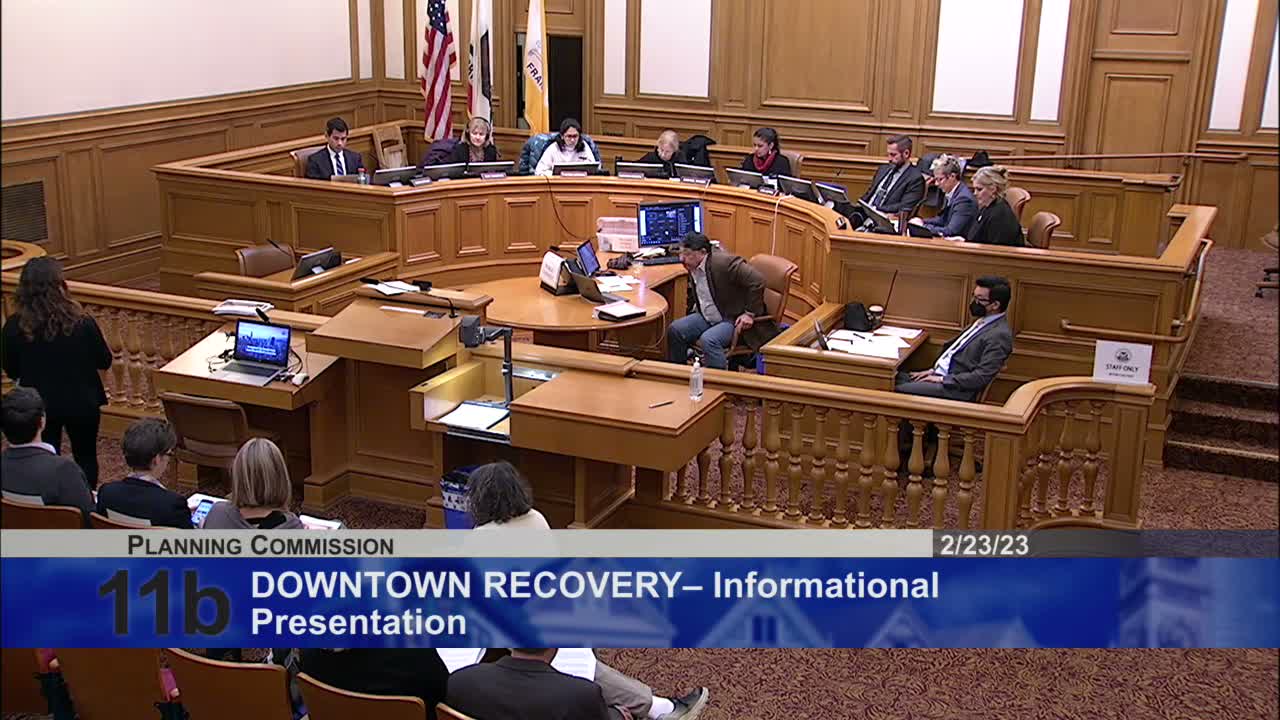
San Francisco planning staff and the Office of Economic and Workforce Development (OEWD) on Feb. 23 outlined a multi-year downtown recovery "road map" aimed at restoring foot traffic and economic activity in the city's commercial core.
Anne Marie Rogers, the Planning Department's director of citywide policy, framed the discussion as a two-part briefing: an overview of the road map and a status update on office projects. Kate Sophos, OEWD executive director, told the Planning Commission the downtown at large remains a critical engine for the city and said the effort will require dozens of coordinated actions. "There is no silver bullet," Sophos said, calling the initiative "the beginning of the journey" rather than a finished plan.
OEWD's Jacob Bentliff said the administration's work is organized around nine strategies and about 50 initiatives. Those include a public-safety package that blends additional police staffing with non-police outreach teams; a competitive-industries assessment to identify sectors the city should pursue; and a Vacant-to-Vibrant program to match entrepreneurs with vacant storefronts. Bentliff also cited tax incentives the mayor proposed to attract office-based companies, including a limited credit of up to $2 million per company through 2028.
Planning staff described four buckets of work: (1) the future of office, including a KPMG study led by OEWD to identify target industries; (2) expanding housing downtown and exploring office-to-residential conversions; (3) public-life and retail activation, including permitting and zoning changes to encourage active ground-floor uses; and (4) Union Square-specific code changes to diversify uses there. Corey Teague of the Planning Department said the city is tracking roughly 5.9 million square feet of allocated but not-yet-constructed office space.
Commissioners pressed staff on several implementation questions. Commissioner Moore asked for analysis of the revenue implications from delayed projects and whether any impact fees are being collected; Teague explained impact fees are assessed at permit issuance and not collected until construction permits are filed. Commissioner Diamond pressed staff on the practical constraints to office-to-residential conversions, including building and fire-code barriers and whether fee deferrals or forgiveness might be needed to make conversions financially viable.
Staff said multiple studies and analytical efforts are underway: OEWD and KPMG are surveying employers and Bay Area residents to understand why and when people come downtown; the Planning Department is collaborating with SPUR and Gensler on conversion feasibility; and a ULI technical assistance panel is planned for May. Kat Daniel, director of economic recovery initiatives, said dashboard metrics are public and tracked regularly (migration, office attendance, hotel occupancy, employment and vacancy rates); staff projected a realistic five-year horizon for a significant recovery given current vacancy levels.
Public commenters urged the planning team to center recovery efforts on low-income and immigrant residents and to produce a monitoring report for Central SoMa that the department had been required to issue. Several commissioners urged staff to return with more concrete numbers on fee revenue, shovel-ready incentives, and an implementation timeline.
The commission received the presentations and staff answered questions; staff committed to returning with follow-up data on impact fees, monitoring reports, and more-detailed elements of the conversion feasibility work. The department said the road map will remain iterative and tied to a public dashboard that will track key indicators as studies and pilot programs proceed.
Anne Marie Rogers, the Planning Department's director of citywide policy, framed the discussion as a two-part briefing: an overview of the road map and a status update on office projects. Kate Sophos, OEWD executive director, told the Planning Commission the downtown at large remains a critical engine for the city and said the effort will require dozens of coordinated actions. "There is no silver bullet," Sophos said, calling the initiative "the beginning of the journey" rather than a finished plan.
OEWD's Jacob Bentliff said the administration's work is organized around nine strategies and about 50 initiatives. Those include a public-safety package that blends additional police staffing with non-police outreach teams; a competitive-industries assessment to identify sectors the city should pursue; and a Vacant-to-Vibrant program to match entrepreneurs with vacant storefronts. Bentliff also cited tax incentives the mayor proposed to attract office-based companies, including a limited credit of up to $2 million per company through 2028.
Planning staff described four buckets of work: (1) the future of office, including a KPMG study led by OEWD to identify target industries; (2) expanding housing downtown and exploring office-to-residential conversions; (3) public-life and retail activation, including permitting and zoning changes to encourage active ground-floor uses; and (4) Union Square-specific code changes to diversify uses there. Corey Teague of the Planning Department said the city is tracking roughly 5.9 million square feet of allocated but not-yet-constructed office space.
Commissioners pressed staff on several implementation questions. Commissioner Moore asked for analysis of the revenue implications from delayed projects and whether any impact fees are being collected; Teague explained impact fees are assessed at permit issuance and not collected until construction permits are filed. Commissioner Diamond pressed staff on the practical constraints to office-to-residential conversions, including building and fire-code barriers and whether fee deferrals or forgiveness might be needed to make conversions financially viable.
Staff said multiple studies and analytical efforts are underway: OEWD and KPMG are surveying employers and Bay Area residents to understand why and when people come downtown; the Planning Department is collaborating with SPUR and Gensler on conversion feasibility; and a ULI technical assistance panel is planned for May. Kat Daniel, director of economic recovery initiatives, said dashboard metrics are public and tracked regularly (migration, office attendance, hotel occupancy, employment and vacancy rates); staff projected a realistic five-year horizon for a significant recovery given current vacancy levels.
Public commenters urged the planning team to center recovery efforts on low-income and immigrant residents and to produce a monitoring report for Central SoMa that the department had been required to issue. Several commissioners urged staff to return with more concrete numbers on fee revenue, shovel-ready incentives, and an implementation timeline.
The commission received the presentations and staff answered questions; staff committed to returning with follow-up data on impact fees, monitoring reports, and more-detailed elements of the conversion feasibility work. The department said the road map will remain iterative and tied to a public dashboard that will track key indicators as studies and pilot programs proceed.
View the Full Meeting & All Its Details
This article offers just a summary. Unlock complete video, transcripts, and insights as a Founder Member.
✓
Watch full, unedited meeting videos
✓
Search every word spoken in unlimited transcripts
✓
AI summaries & real-time alerts (all government levels)
✓
Permanent access to expanding government content
30-day money-back guarantee
