Board of Appeals denies rehearing requests in two taxi medallion revocation cases
March 30, 2022 | San Francisco City, San Francisco County, California
This article was created by AI summarizing key points discussed. AI makes mistakes, so for full details and context, please refer to the video of the full meeting. Please report any errors so we can fix them. Report an error »
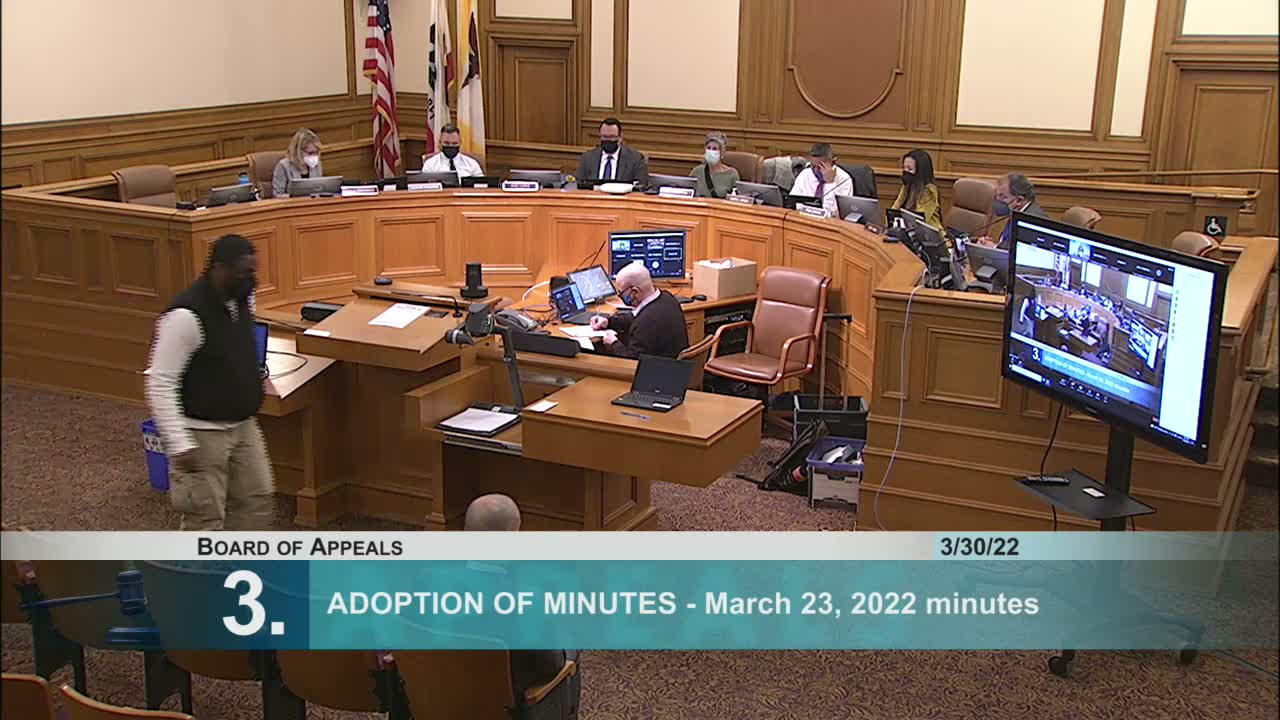
The San Francisco Board of Appeals on March 23 considered rehearing requests for two taxi medallion nonrenewals and, after debate and public comment, denied both requests, leaving the underlying determinations intact.
Appellant counsel Heidi Machen argued the board should grant rehearings "on the basis that extraordinary circumstances exist and a rehearing is needed to prevent manifest injustice," saying the board's rules (including rule 9B) do not distinguish between "substantive" and "nonsubstantive" motions and that Commissioner Lopez's absence at the original March 2 hearings deprived appellants of a full panel. "We brought this request for a rehearing on the basis that extraordinary circumstances exist and a rehearing is needed to prevent manifest injustice," Machen said during her allotted time.
Philip Grama, identified in the record as SFMTA's Enforcement and Legal Affairs Manager for Taxis and Accessible Services, told the board the written rehearing requests "did not state any new facts" and did not identify witnesses or documents required by the rehearing rule. "The appellant has not raised any new facts, let alone material facts that would or could impact the outcome of the original hearing," he said.
Multiple members of the taxi industry and medallion holders told the board they considered the agency's enforcement and the city's response to TNCs to have decimated medallion values and disproportionately harmed disabled medallion holders. Charles Rathbone described the situation as a "systemic purging of disabled people from the permit system," and Marcello Fonseca and Evelyn Pouques urged the board to grant rehearing so cases could be reconsidered with a full panel. Dan Hines, president of National Cab Company, said the city's earlier decision to allow ride-hailing companies to operate without sufficient regulation "crippled the taxi industry and destroyed medallion value."
Commissioners debated the legal standard for rehearing, including whether the absence of one commissioner at the prior hearing could, by itself, create "manifest injustice." Some commissioners said they were sympathetic to appellants but would not find the rehearing criteria were met. Motions to grant rehearing failed to receive the votes required; after subsequent motions and votes the board concluded the underlying determinations were upheld by operation of law and the rehearing requests were denied.
The SFMTA noted related hearings cited by appellants are now calendared, and the board did not grant new evidentiary hearings based on the arguments presented that night. The meeting concluded with public comment and adjournment.
The board took formal action on the minutes for a prior meeting, adopting them by vote earlier in the session.
Appellant counsel Heidi Machen argued the board should grant rehearings "on the basis that extraordinary circumstances exist and a rehearing is needed to prevent manifest injustice," saying the board's rules (including rule 9B) do not distinguish between "substantive" and "nonsubstantive" motions and that Commissioner Lopez's absence at the original March 2 hearings deprived appellants of a full panel. "We brought this request for a rehearing on the basis that extraordinary circumstances exist and a rehearing is needed to prevent manifest injustice," Machen said during her allotted time.
Philip Grama, identified in the record as SFMTA's Enforcement and Legal Affairs Manager for Taxis and Accessible Services, told the board the written rehearing requests "did not state any new facts" and did not identify witnesses or documents required by the rehearing rule. "The appellant has not raised any new facts, let alone material facts that would or could impact the outcome of the original hearing," he said.
Multiple members of the taxi industry and medallion holders told the board they considered the agency's enforcement and the city's response to TNCs to have decimated medallion values and disproportionately harmed disabled medallion holders. Charles Rathbone described the situation as a "systemic purging of disabled people from the permit system," and Marcello Fonseca and Evelyn Pouques urged the board to grant rehearing so cases could be reconsidered with a full panel. Dan Hines, president of National Cab Company, said the city's earlier decision to allow ride-hailing companies to operate without sufficient regulation "crippled the taxi industry and destroyed medallion value."
Commissioners debated the legal standard for rehearing, including whether the absence of one commissioner at the prior hearing could, by itself, create "manifest injustice." Some commissioners said they were sympathetic to appellants but would not find the rehearing criteria were met. Motions to grant rehearing failed to receive the votes required; after subsequent motions and votes the board concluded the underlying determinations were upheld by operation of law and the rehearing requests were denied.
The SFMTA noted related hearings cited by appellants are now calendared, and the board did not grant new evidentiary hearings based on the arguments presented that night. The meeting concluded with public comment and adjournment.
The board took formal action on the minutes for a prior meeting, adopting them by vote earlier in the session.
View the Full Meeting & All Its Details
This article offers just a summary. Unlock complete video, transcripts, and insights as a Founder Member.
✓
Watch full, unedited meeting videos
✓
Search every word spoken in unlimited transcripts
✓
AI summaries & real-time alerts (all government levels)
✓
Permanent access to expanding government content
30-day money-back guarantee
