Board of Appeals denies tree-appeal; urges signatories to pursue MOU funding
June 01, 2022 | San Francisco City, San Francisco County, California
This article was created by AI summarizing key points discussed. AI makes mistakes, so for full details and context, please refer to the video of the full meeting. Please report any errors so we can fix them. Report an error »
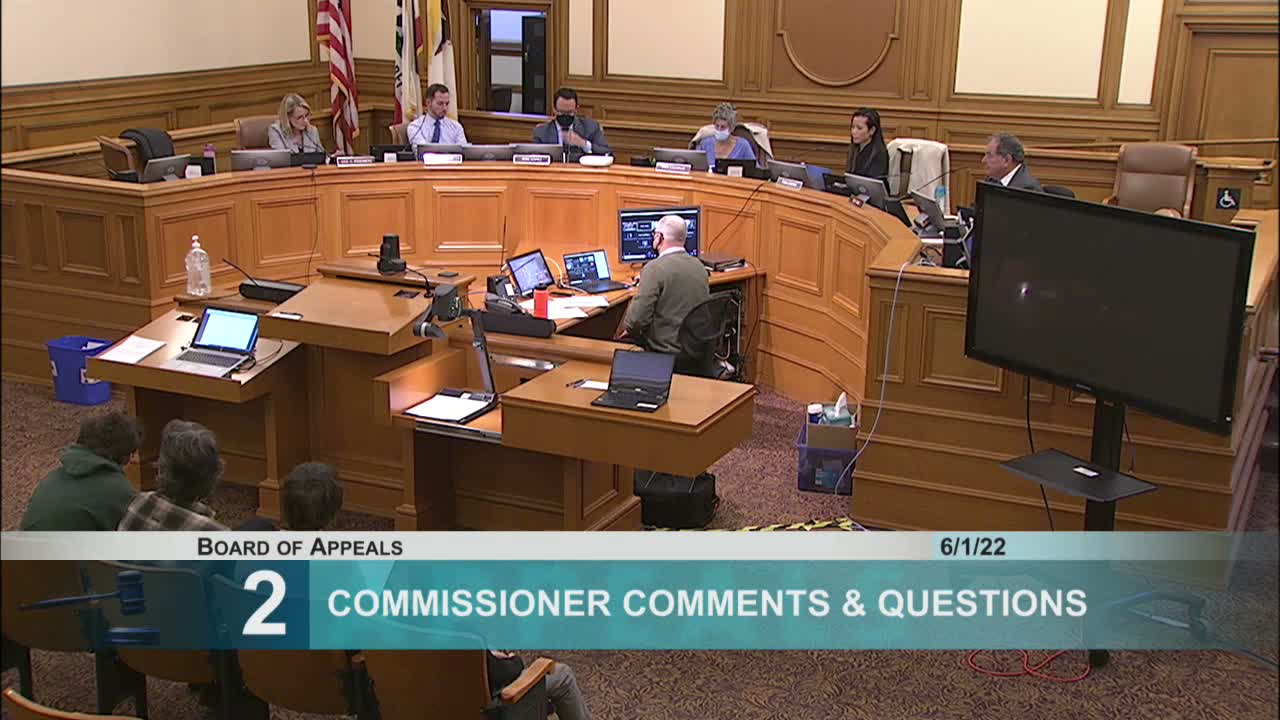
The San Francisco Board of Appeals on June 1 denied an appeal by community members who sought to block a Public Works order to remove two street trees to allow building foundation work and new utility vaults.
Appellant Joshua Klipp described a multi-year community effort to save and steward trees along the 20th/4th Street corridor and presented an agreement — a memorandum of understanding (MOU) — among Planning, Public Works and community representatives to use Eastern Neighborhoods Impact (NCAC) funds to plant and water replacement trees. Klipp asked the board to either record the MOU in the case or make the project sponsor commit to funding the replacement plan should NCAC not allocate funds; he said planting 30 trees via the proposed plan would cost about $60,000.
The project's representative, Lev Weisbach, said the site is unusually constrained by utility boxes and roots that extend into the lot and that replacement tree locations were coordinated with site utilities. He said the sponsor had already paid entitlements and fees and could not guarantee an additional developer-funded backstop. Nicholas Crawford, acting superintendent of the Bureau of Urban Forestry, said the MOU would let the bureau plant and establish trees if NCAC allocates the funds, but NCAC allocations are discretionary.
Deputy City Attorney Brad Resty advised commissioners that the board lacks authority to force a developer to pay amounts beyond what code requires; the board can only note voluntary settlement terms. Commissioners expressed sympathy for the community’s efforts to care for trees but agreed they could not legally impose a developer-funded remedy beyond code. Vice President Anne Lazarus moved to deny the appeal and to encourage the parties to follow the MOU and pursue funding; Commissioners Lopez, Chang and President Swig voted aye and the motion carried 4–0.
The decision leaves the Public Works order in place and the project proceeding with the permit conditions in the Public Works order, while the MOU remains a voluntary path for planting should NCAC funds be allocated or parties secure a voluntary sponsor commitment.
The board’s action was procedural: it upheld the department’s order as properly issued, noted the MOU’s benefits, and encouraged — but did not require — the parties to secure funding for community planting if NCAC does not provide it.
Appellant Joshua Klipp described a multi-year community effort to save and steward trees along the 20th/4th Street corridor and presented an agreement — a memorandum of understanding (MOU) — among Planning, Public Works and community representatives to use Eastern Neighborhoods Impact (NCAC) funds to plant and water replacement trees. Klipp asked the board to either record the MOU in the case or make the project sponsor commit to funding the replacement plan should NCAC not allocate funds; he said planting 30 trees via the proposed plan would cost about $60,000.
The project's representative, Lev Weisbach, said the site is unusually constrained by utility boxes and roots that extend into the lot and that replacement tree locations were coordinated with site utilities. He said the sponsor had already paid entitlements and fees and could not guarantee an additional developer-funded backstop. Nicholas Crawford, acting superintendent of the Bureau of Urban Forestry, said the MOU would let the bureau plant and establish trees if NCAC allocates the funds, but NCAC allocations are discretionary.
Deputy City Attorney Brad Resty advised commissioners that the board lacks authority to force a developer to pay amounts beyond what code requires; the board can only note voluntary settlement terms. Commissioners expressed sympathy for the community’s efforts to care for trees but agreed they could not legally impose a developer-funded remedy beyond code. Vice President Anne Lazarus moved to deny the appeal and to encourage the parties to follow the MOU and pursue funding; Commissioners Lopez, Chang and President Swig voted aye and the motion carried 4–0.
The decision leaves the Public Works order in place and the project proceeding with the permit conditions in the Public Works order, while the MOU remains a voluntary path for planting should NCAC funds be allocated or parties secure a voluntary sponsor commitment.
The board’s action was procedural: it upheld the department’s order as properly issued, noted the MOU’s benefits, and encouraged — but did not require — the parties to secure funding for community planting if NCAC does not provide it.
View the Full Meeting & All Its Details
This article offers just a summary. Unlock complete video, transcripts, and insights as a Founder Member.
✓
Watch full, unedited meeting videos
✓
Search every word spoken in unlimited transcripts
✓
AI summaries & real-time alerts (all government levels)
✓
Permanent access to expanding government content
30-day money-back guarantee
