Planning Department briefs Board of Appeals on what can be appealed and how 'BBN' notifications work
October 12, 2022 | San Francisco City, San Francisco County, California
This article was created by AI summarizing key points discussed. AI makes mistakes, so for full details and context, please refer to the video of the full meeting. Please report any errors so we can fix them. Report an error »
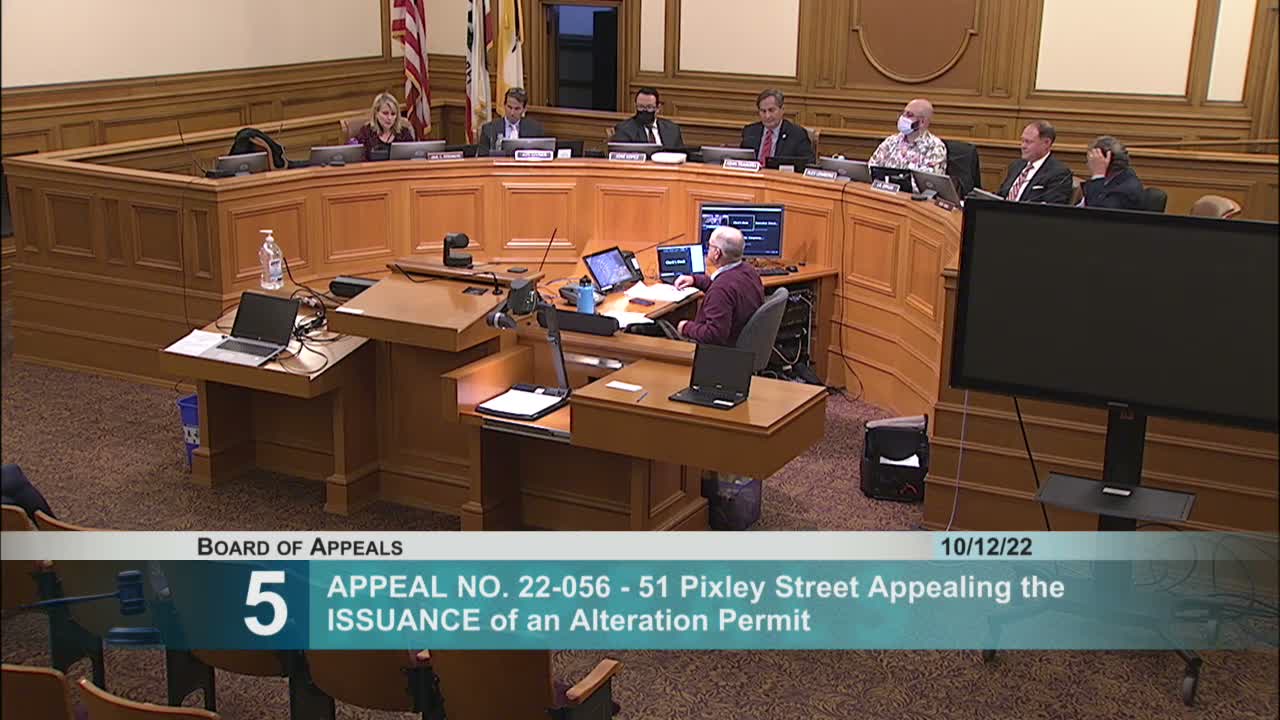
Corey Teague, the Planning Department’s zoning administrator, gave an informational presentation to the San Francisco Board of Appeals on Oct. 12 covering which planning actions are appealable to the board and how notice and enforcement processes function.
Teague outlined categories that commonly come to the Board of Appeals — building permits, variances, letters of determination, notices of violation — and said some actions (for example, certain conditional use authorizations and CEQA determinations) are appealed to other bodies such as the Planning Commission or Board of Supervisors depending on code and charter provisions. He explained that building permits often have layers of review (DBI, Planning, public‑notice triggers), and that some administrative modifications may be processed as part of a permit and later be the subject of a permit appeal.
Teague described the department’s notice tools: section 3.11 (30‑day notice to owners/residents within a 150‑foot radius for many residential projects) and the voluntary block‑book notation (BBN), a departmental option by which an interested party can pay to receive electronic notice of applications for a given parcel for a year. He said BBN is a planning‑department policy option (not a codified requirement) intended to increase public awareness; the department will email BBN registrants when a qualifying application is filed and provide a short window for discretionary review requests.
On enforcement, Teague reviewed the department’s layered approach (initial outreach, notice of complaint, notice of enforcement, notice of violation) and said an NOV is the formal, appealable enforcement notice. He also noted that coastal‑zone appeals can follow distinct paths depending on geography and California Coastal Commission jurisdiction, and that other entitlements such as downtown authorizations and large project authorizations allow policy‑based exceptions similar to variances but are processed in different forums.
Robert Fruchtman, a public commenter, urged commissioners to consider the broader cost of frequent appeals; he quoted a 2017 UC Berkeley Turner Center roundtable finding that frequent appeals increase entitlement time and cost and urged reforms contemplated in the city's housing element update.
Commissioners asked for a glossary of frequently used acronyms (Teague said the department already maintains one and will update and circulate it) and requested further informational sessions. The presentation was framed as a training for newer commissioners and a refresher for returning members.
Takeaway: The session clarified which decisions come to the Board of Appeals, explained optional notice tools such as the BBN, and flagged that the variance path is a high‑bar discretionary process often used to address legacy, substandard lot conditions.
Teague outlined categories that commonly come to the Board of Appeals — building permits, variances, letters of determination, notices of violation — and said some actions (for example, certain conditional use authorizations and CEQA determinations) are appealed to other bodies such as the Planning Commission or Board of Supervisors depending on code and charter provisions. He explained that building permits often have layers of review (DBI, Planning, public‑notice triggers), and that some administrative modifications may be processed as part of a permit and later be the subject of a permit appeal.
Teague described the department’s notice tools: section 3.11 (30‑day notice to owners/residents within a 150‑foot radius for many residential projects) and the voluntary block‑book notation (BBN), a departmental option by which an interested party can pay to receive electronic notice of applications for a given parcel for a year. He said BBN is a planning‑department policy option (not a codified requirement) intended to increase public awareness; the department will email BBN registrants when a qualifying application is filed and provide a short window for discretionary review requests.
On enforcement, Teague reviewed the department’s layered approach (initial outreach, notice of complaint, notice of enforcement, notice of violation) and said an NOV is the formal, appealable enforcement notice. He also noted that coastal‑zone appeals can follow distinct paths depending on geography and California Coastal Commission jurisdiction, and that other entitlements such as downtown authorizations and large project authorizations allow policy‑based exceptions similar to variances but are processed in different forums.
Robert Fruchtman, a public commenter, urged commissioners to consider the broader cost of frequent appeals; he quoted a 2017 UC Berkeley Turner Center roundtable finding that frequent appeals increase entitlement time and cost and urged reforms contemplated in the city's housing element update.
Commissioners asked for a glossary of frequently used acronyms (Teague said the department already maintains one and will update and circulate it) and requested further informational sessions. The presentation was framed as a training for newer commissioners and a refresher for returning members.
Takeaway: The session clarified which decisions come to the Board of Appeals, explained optional notice tools such as the BBN, and flagged that the variance path is a high‑bar discretionary process often used to address legacy, substandard lot conditions.
Don't Miss a Word: See the Full Meeting!
Go beyond summaries. Unlock every video, transcript, and key insight with a Founder Membership.
✓
Get instant access to full meeting videos
✓
Search and clip any phrase from complete transcripts
✓
Receive AI-powered summaries & custom alerts
✓
Enjoy lifetime, unrestricted access to government data
30-day money-back guarantee
