Board of Appeals overturns three medallion revocations, cites equity and procedural errors
November 16, 2022 | San Francisco City, San Francisco County, California
This article was created by AI summarizing key points discussed. AI makes mistakes, so for full details and context, please refer to the video of the full meeting. Please report any errors so we can fix them. Report an error »
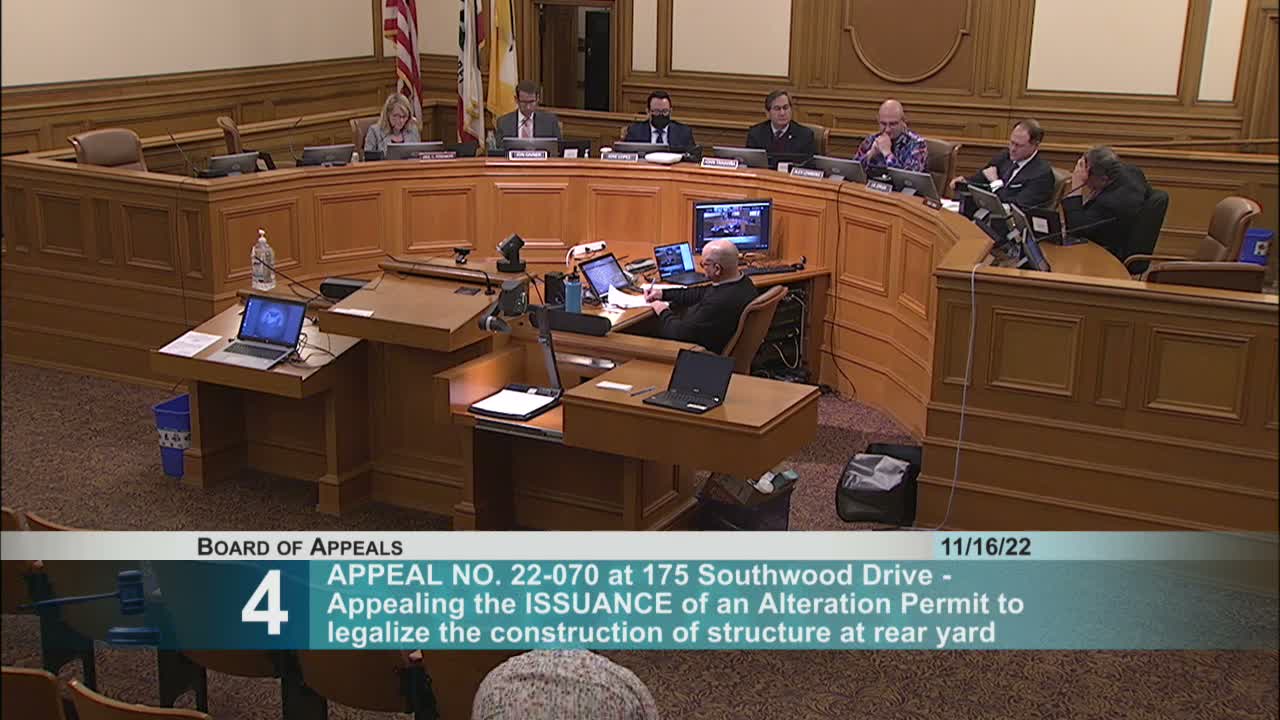
The San Francisco Board of Appeals on Nov. 16 overturned SFMTA revocations for three taxi medallion holders, finding that appellants reasonably relied on prior statements from agency staff and that procedural errors affected adjudications in two cases.
The three appeals — involving medallion holders Robert Scribe (medallion 878), George Horrible (1303) and James Cortezos (753) — were each the subject of multiple prior administrative proceedings. In each case SFMTA had issued a notice of nonrenewal because the permit holder lacked an active California driver’s license and the associated “A‑card” required for post‑Proposition K medallions; the Transportation Code conditions continued possession on meeting the full‑time driving / A‑card requirement.
SFMTA representatives told the Board that the transportation code requires post‑K medallion holders to maintain an active A‑card and that the agency’s position was to uphold nonrenewal when the A‑card is not active. Philip Grama, SFMTA enforcement and legal affairs manager, said the agency asked the board to uphold the hearing officers’ reconsidered decisions.
Appellants’ attorneys and public commenters urged a different outcome. Heidi Machen, attorney for Robert Scribe, said the appellant relied on advice from SFMTA staff over many years that he did not have to renew his A‑card while disabled and that revocation would cause a “grave injustice.” "This is a man who has been a part of the industry for decades, and he was disabled," Machen told the board, urging equitable relief so the appellants may “see if, in fact, their medallion does provide them with some sort of retirement benefit.”
Numerous taxi drivers and advocates testified in support of the appellants, describing a steep decline in medallion market value after the arrival of ride‑hail companies and urging compassion for aging and disabled medallion holders who had relied on past staff guidance. Appellants and supporters said the medallion sales program has been frozen since values fell and that lease income is currently one of the few remaining ways for an inactive medallion to produce income.
Several commissioners said the equitable‑estoppel elements were met: (1) a representation by the agency, (2) reasonable reliance by the appellant, (3) detrimental reliance, and (4) a showing that applying estoppel would not defeat a strong public policy. Commissioners also raised concerns about the procedural path in two cases where a hearing officer issued an earlier decision and then issued a reconsidered decision after a city attorney or agency request; some members viewed that reconsideration process as procedurally problematic.
The Board voted to grant each appeal. For Robert Scribe the board granted the appeal on equitable‑estoppel grounds by a 5–0 roll call. For George Horrible and James Cortezos the board granted appeals on dual grounds — that the hearing officer’s reconsideration was procedurally flawed and that equitable estoppel applied — and reversed the reconsidered determinations (each vote 5–0).
What this means: The board returned the medallions to the appellants rather than allowing automatic revocation for lack of an A‑card, on an evidentiary record that the appellants reasonably relied on prior SFMTA statements. The decisions do not delete the underlying code that requires an active A‑card for post‑K medallions; rather, the board used equitable relief in these particular factual circumstances. SFMTA said it will continue to pursue policy and enforcement for medallion compliance; commissioners urged the agency to consider longer‑term policy fixes for permanently disabled holders.
Quotations from the record: Philip Grama (SFMTA) summarized the agency’s position: “The transportation code requires that post‑K medallion holders… must maintain a driver permit, which we call an A‑card.” Attorney Heidi Machen argued the board should prevent a “grave injustice” where, she said, appellants relied on staff assurances and forfeited sale opportunities years earlier.
Next steps: The decisions resolve the three appeals before the board but do not eliminate the underlying code obligations. Commissioners signaled interest in a separate, broader discussion with SFMTA about permanent accommodations for disabled medallion holders and about the agency’s interpretation and enforcement process.
The three appeals — involving medallion holders Robert Scribe (medallion 878), George Horrible (1303) and James Cortezos (753) — were each the subject of multiple prior administrative proceedings. In each case SFMTA had issued a notice of nonrenewal because the permit holder lacked an active California driver’s license and the associated “A‑card” required for post‑Proposition K medallions; the Transportation Code conditions continued possession on meeting the full‑time driving / A‑card requirement.
SFMTA representatives told the Board that the transportation code requires post‑K medallion holders to maintain an active A‑card and that the agency’s position was to uphold nonrenewal when the A‑card is not active. Philip Grama, SFMTA enforcement and legal affairs manager, said the agency asked the board to uphold the hearing officers’ reconsidered decisions.
Appellants’ attorneys and public commenters urged a different outcome. Heidi Machen, attorney for Robert Scribe, said the appellant relied on advice from SFMTA staff over many years that he did not have to renew his A‑card while disabled and that revocation would cause a “grave injustice.” "This is a man who has been a part of the industry for decades, and he was disabled," Machen told the board, urging equitable relief so the appellants may “see if, in fact, their medallion does provide them with some sort of retirement benefit.”
Numerous taxi drivers and advocates testified in support of the appellants, describing a steep decline in medallion market value after the arrival of ride‑hail companies and urging compassion for aging and disabled medallion holders who had relied on past staff guidance. Appellants and supporters said the medallion sales program has been frozen since values fell and that lease income is currently one of the few remaining ways for an inactive medallion to produce income.
Several commissioners said the equitable‑estoppel elements were met: (1) a representation by the agency, (2) reasonable reliance by the appellant, (3) detrimental reliance, and (4) a showing that applying estoppel would not defeat a strong public policy. Commissioners also raised concerns about the procedural path in two cases where a hearing officer issued an earlier decision and then issued a reconsidered decision after a city attorney or agency request; some members viewed that reconsideration process as procedurally problematic.
The Board voted to grant each appeal. For Robert Scribe the board granted the appeal on equitable‑estoppel grounds by a 5–0 roll call. For George Horrible and James Cortezos the board granted appeals on dual grounds — that the hearing officer’s reconsideration was procedurally flawed and that equitable estoppel applied — and reversed the reconsidered determinations (each vote 5–0).
What this means: The board returned the medallions to the appellants rather than allowing automatic revocation for lack of an A‑card, on an evidentiary record that the appellants reasonably relied on prior SFMTA statements. The decisions do not delete the underlying code that requires an active A‑card for post‑K medallions; rather, the board used equitable relief in these particular factual circumstances. SFMTA said it will continue to pursue policy and enforcement for medallion compliance; commissioners urged the agency to consider longer‑term policy fixes for permanently disabled holders.
Quotations from the record: Philip Grama (SFMTA) summarized the agency’s position: “The transportation code requires that post‑K medallion holders… must maintain a driver permit, which we call an A‑card.” Attorney Heidi Machen argued the board should prevent a “grave injustice” where, she said, appellants relied on staff assurances and forfeited sale opportunities years earlier.
Next steps: The decisions resolve the three appeals before the board but do not eliminate the underlying code obligations. Commissioners signaled interest in a separate, broader discussion with SFMTA about permanent accommodations for disabled medallion holders and about the agency’s interpretation and enforcement process.
Don't Miss a Word: See the Full Meeting!
Go beyond summaries. Unlock every video, transcript, and key insight with a Founder Membership.
✓
Get instant access to full meeting videos
✓
Search and clip any phrase from complete transcripts
✓
Receive AI-powered summaries & custom alerts
✓
Enjoy lifetime, unrestricted access to government data
30-day money-back guarantee
