San Francisco Board of Appeals upholds DBI permit for antenna work at 1431 San Bruno Avenue
November 30, 2022 | San Francisco City, San Francisco County, California
This article was created by AI summarizing key points discussed. AI makes mistakes, so for full details and context, please refer to the video of the full meeting. Please report any errors so we can fix them. Report an error »
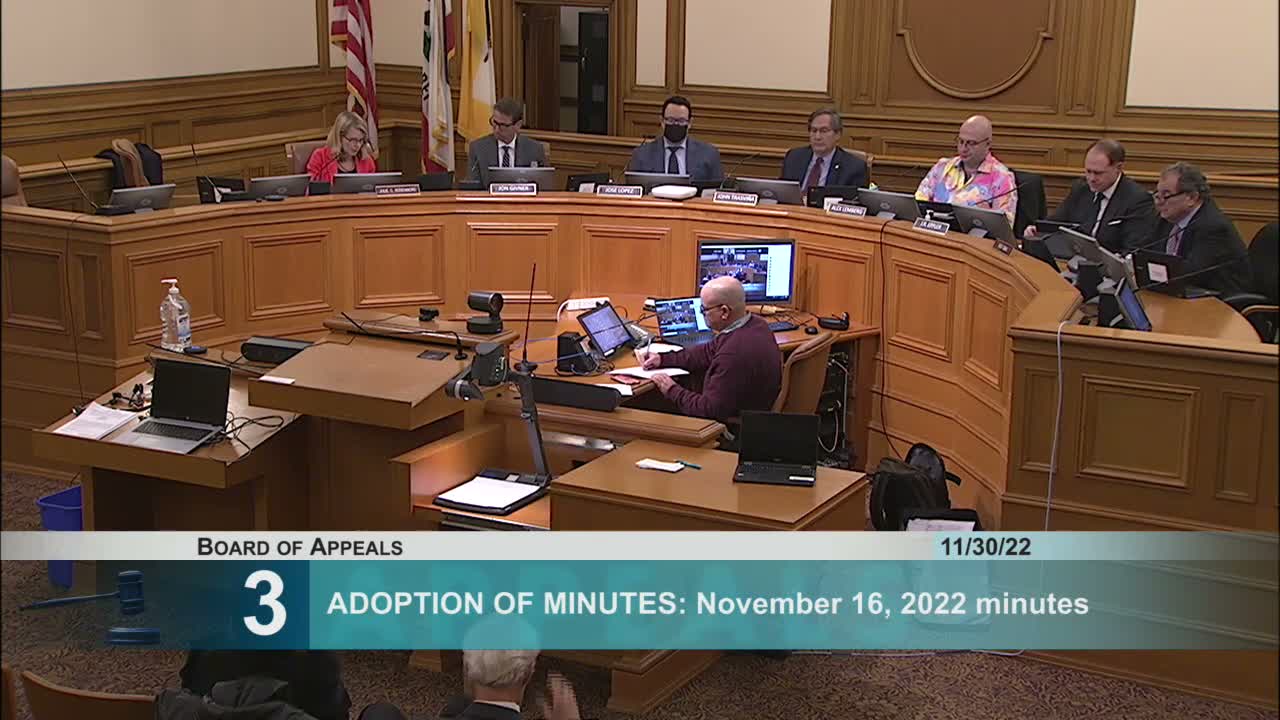
The San Francisco Board of Appeals voted 5–0 on Nov. 30 to deny Appeal 22‑071 and uphold a permit (DBI #202202288869) that authorizes Verizon and Crown Castle to replace antennas and equipment at a monopole at 1431 San Bruno Avenue. President Rick Swig moved to deny the appeal; Vice President Jose Lopez and Commissioners Alex Lundberg, John Transvinha and JR Epler voted in favor.
The appeal, filed by a neighborhood group represented at the hearing by Mr. Lee, argued the permit should be denied because Verizon lacks a conditional use authorization (CUA) for the wireless transmission site, Planning had rescinded approval, the site violates conditions of approval (visual treatment, community liaison, multilingual signage) and the parcel shows unresolved enforcement issues including sidewalk disrepair and blight. Lee urged the board to treat the matter as a vehicle to require property maintenance and to write to the city attorney and mayor defending appellants’ review rights.
Verizon’s outside counsel, Paul Albritton, and RF experts told the board the application is an eligible facilities request under federal law (Middle Class Tax Relief and Job Creation Act of 2012, commonly referred to at hearing as section 6409 of the Spectrum Act) and therefore subject to a ministerial review limited to whether the change ‘‘substantially changes the physical dimensions’’ of an existing facility. Albritton said the proposed change would increase antenna height by about 3 inches and extend panels a couple of inches outward; the firm’s plans replace existing mounts and result effectively in 12 antennas (from 9) by adding smaller elements, but the overall profile remains within the FCC’s substantial‑change thresholds. "The federal law says we can go up 20 feet," Albritton said, and the proposed changes, he added, fall well below that benchmark.
Planning Department staff (Deputy Zoning Administrator Tina Tam) presented permit records showing a monopole first erected in 1995 with GTE antennas, a 1997 planning commission action that authorized additional Sprint antennas (case 97.043c, motion 14,328), and documentation the project meets the FCC’s eligible facilities criteria and does not create a substantial change. Planning reported the monopole is roughly 55 feet tall and that permit records support up to 13 antennas for the site. The Department of Public Health and DBI submitted technical reviews showing RF emissions well below FCC thresholds; DBI’s representative (Matthew Green) told the board he found no record that the prior approval was rescinded and reported no active DBI complaints for the parcel.
Commissioners pressed both sides on factual discrepancies in the record: the appellant cited a DPH reference he read as stating there are as many as 20–31 antennas on or around the property, while Planning said permit records document 9 GTE antennas plus 4 Sprint antennas (13 total) for the monopole and that other antennas on an adjacent billboard are on a separate parcel. The appellant also raised site‑condition complaints — graffiti, illegal dumping and a damaged sidewalk — and asked the board to condition permit approval on remediation; the board was advised by staff and the city attorney that it lacked authority to add cleanup conditions to a ministerial eligible‑facilities approval, but DBI agreed to follow up with the Department of Public Works about the sidewalk complaint.
After asking Planning and DBI to clarify where enforcement complaints should be directed and confirming the federal preemption framework limits local discretion on eligible facilities requests, the board concluded the record did not show a clear CUA violation that would defeat the eligible‑facilities finding. President Swig moved to deny the appeal on the basis that the permit was properly issued; the motion carried 5–0 and the board adjourned the hearing.
The next procedural steps noted at the hearing: DBI said it would contact DPW about the sidewalk complaint and Planning said its enforcement team can investigate alleged noncompliance with CUA conditions if new, verifiable information is presented. The permit remains in effect pending any separate enforcement action or legal challenge.
The appeal, filed by a neighborhood group represented at the hearing by Mr. Lee, argued the permit should be denied because Verizon lacks a conditional use authorization (CUA) for the wireless transmission site, Planning had rescinded approval, the site violates conditions of approval (visual treatment, community liaison, multilingual signage) and the parcel shows unresolved enforcement issues including sidewalk disrepair and blight. Lee urged the board to treat the matter as a vehicle to require property maintenance and to write to the city attorney and mayor defending appellants’ review rights.
Verizon’s outside counsel, Paul Albritton, and RF experts told the board the application is an eligible facilities request under federal law (Middle Class Tax Relief and Job Creation Act of 2012, commonly referred to at hearing as section 6409 of the Spectrum Act) and therefore subject to a ministerial review limited to whether the change ‘‘substantially changes the physical dimensions’’ of an existing facility. Albritton said the proposed change would increase antenna height by about 3 inches and extend panels a couple of inches outward; the firm’s plans replace existing mounts and result effectively in 12 antennas (from 9) by adding smaller elements, but the overall profile remains within the FCC’s substantial‑change thresholds. "The federal law says we can go up 20 feet," Albritton said, and the proposed changes, he added, fall well below that benchmark.
Planning Department staff (Deputy Zoning Administrator Tina Tam) presented permit records showing a monopole first erected in 1995 with GTE antennas, a 1997 planning commission action that authorized additional Sprint antennas (case 97.043c, motion 14,328), and documentation the project meets the FCC’s eligible facilities criteria and does not create a substantial change. Planning reported the monopole is roughly 55 feet tall and that permit records support up to 13 antennas for the site. The Department of Public Health and DBI submitted technical reviews showing RF emissions well below FCC thresholds; DBI’s representative (Matthew Green) told the board he found no record that the prior approval was rescinded and reported no active DBI complaints for the parcel.
Commissioners pressed both sides on factual discrepancies in the record: the appellant cited a DPH reference he read as stating there are as many as 20–31 antennas on or around the property, while Planning said permit records document 9 GTE antennas plus 4 Sprint antennas (13 total) for the monopole and that other antennas on an adjacent billboard are on a separate parcel. The appellant also raised site‑condition complaints — graffiti, illegal dumping and a damaged sidewalk — and asked the board to condition permit approval on remediation; the board was advised by staff and the city attorney that it lacked authority to add cleanup conditions to a ministerial eligible‑facilities approval, but DBI agreed to follow up with the Department of Public Works about the sidewalk complaint.
After asking Planning and DBI to clarify where enforcement complaints should be directed and confirming the federal preemption framework limits local discretion on eligible facilities requests, the board concluded the record did not show a clear CUA violation that would defeat the eligible‑facilities finding. President Swig moved to deny the appeal on the basis that the permit was properly issued; the motion carried 5–0 and the board adjourned the hearing.
The next procedural steps noted at the hearing: DBI said it would contact DPW about the sidewalk complaint and Planning said its enforcement team can investigate alleged noncompliance with CUA conditions if new, verifiable information is presented. The permit remains in effect pending any separate enforcement action or legal challenge.
View the Full Meeting & All Its Details
This article offers just a summary. Unlock complete video, transcripts, and insights as a Founder Member.
✓
Watch full, unedited meeting videos
✓
Search every word spoken in unlimited transcripts
✓
AI summaries & real-time alerts (all government levels)
✓
Permanent access to expanding government content
30-day money-back guarantee
