Neighbors press state and city on PCE risks as Board of Appeals upholds site permit for 2550 Irving Street
August 16, 2023 | San Francisco City, San Francisco County, California
This article was created by AI summarizing key points discussed. AI makes mistakes, so for full details and context, please refer to the video of the full meeting. Please report any errors so we can fix them. Report an error »
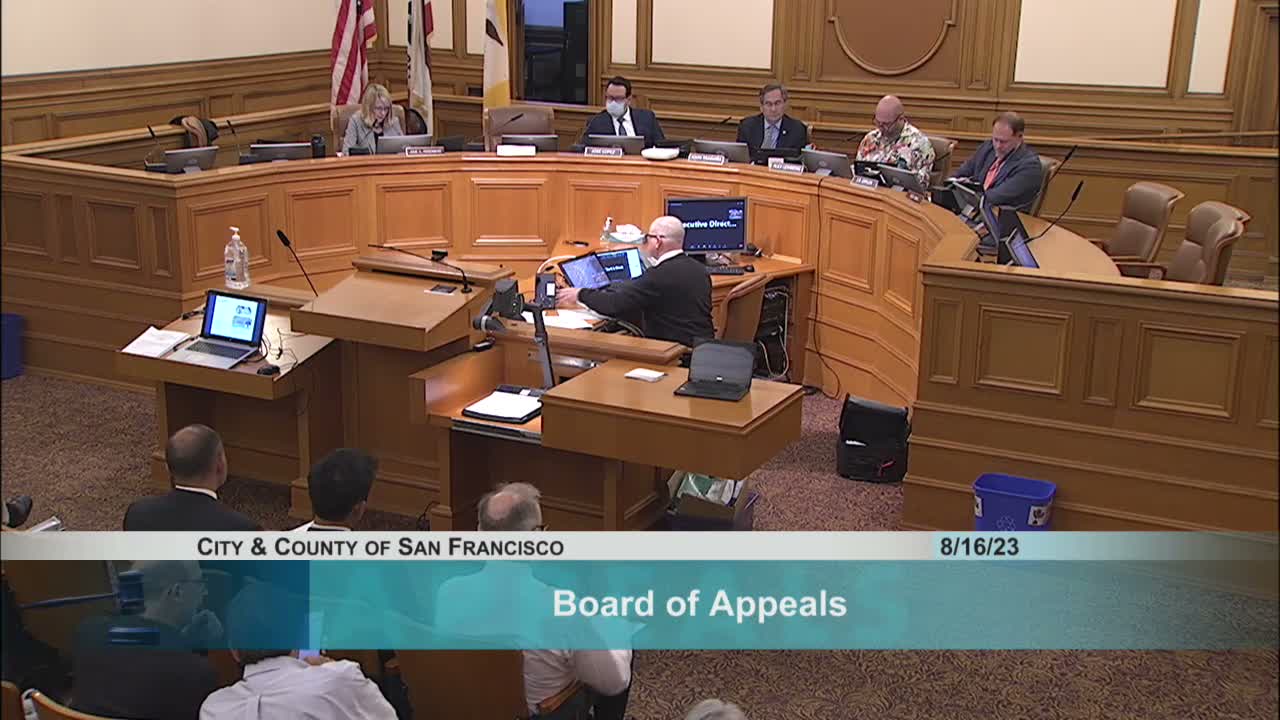
The San Francisco Board of Appeals heard hours of technical testimony, public comment and legal briefing on Aug. 16 over whether the city should withhold a site permit for 2550 Irving Street — a proposed seven-story, 90-unit affordable housing project — until more aggressive remediation of tetrachloroethylene (PCE) soil vapor is performed.
Mid-Sunset Neighborhood Association (MSNA), represented by Enoch Wong, presented expert testimony from UCSF toxicologist Tamer Durani and remediation engineer Dan Grasmick. Dr. Durani emphasized the health risks associated with PCE, saying long-term exposure is "recognized to cause cancer" and noting children and people of child-bearing age are especially vulnerable. Grasmick testified active soil-vapor-extraction (SVE) could reduce subsurface vapor concentrations rapidly and that a short pilot would help design a system that minimizes off-site draw.
The permit holder and environmental consultants disputed the need for immediate SVE at the parcel. David Gruna, a licensed hydrogeologist working with the sponsor, described multiple rounds of subsurface investigation he said found no PCE source zone within the historic building footprint and presented soil and groundwater sample results. TNDC counsel CJ Higley and Path Forward Partners argued the site is not a primary source and that DTSC-approved vapor-intrusion mitigation measures and the site management plan (SMP) will protect future residents; Higley said the project qualifies for ministerial approval under Senate Bill 35 (SB 35) and asked the board to deny the appeal on legal grounds.
The state Department of Toxic Substances Control (DTSC) summarized a high-resolution characterization program it directed: membrane interface probe (MIP) probes and targeted follow-up sampling produced thousands of measurements across several boreholes and, DTSC testified, found no evidence of a persistent source zone under the TNDC parcel while confirming soil vapor in the neighborhood. DTSC said its modified SMP and Construction Air Monitoring complied during demolition and that neighborhood-scale characterization and off-site source investigation are ongoing. The Department of Public Health (DPH) and DBI told the board they are satisfied that the approved mitigation will protect on-site workers and future occupants.
Public comment ran long and sharply divided nearby residents and advocates: dozens urged denial and immediate cleanup citing long-term neighborhood exposures and health concerns; dozens more urged the board to deny the appeal and allow 90 affordable units to proceed, noting the project’s SB 35 eligibility and the city’s housing needs.
In deliberations, commissioners split. Some said the record and DTSC/DPH findings supported allowing the site permit to stand and that the SB 35 ministerial path limits discretionary conditions. Others said the neighborhood’s specific requests for additional soil-vapor testing and a pilot SVE study were not adequately addressed and that the city should press for remediation that protects current neighbors as well as future occupants.
The board did not reach a four-vote majority to remand or impose additional conditions. One motion to deny the appeal (i.e., to uphold the department’s permit decision) failed on a 2–2 vote; a motion to continue the matter so the absent president could participate also failed. Under applicable board rules the unresolved appeal was therefore treated as denied by operation of law and the site permit remains effective. Commissioners and staff recorded a need for continued DTSC/DPH neighborhood-scale work and for better community engagement going forward.
Next steps: DTSC and DPH said they will continue off-site investigations and community outreach; the permit holder will proceed under the approved SMP and construction schedule, including the approved vapor-intrusion mitigation measures. MSNA and others said they will press regulators and pursue other legal and administrative options to seek additional neighborhood remediation.
Quote: "PCE exposure is recognized to cause cancer," UCSF toxicologist Tamer Durani told the board; DTSC said its characterization found "no evidence of a PCE source zone on-site" but acknowledged soil vapor contamination at neighborhood scale.
The dispute highlights a recurring municipal tension: city and state regulators’ technical findings and mitigation plans versus neighborhood demands for immediate, site-specific remediation — and the constraints SB 35 places on local discretionary review of qualifying affordable housing projects.
Mid-Sunset Neighborhood Association (MSNA), represented by Enoch Wong, presented expert testimony from UCSF toxicologist Tamer Durani and remediation engineer Dan Grasmick. Dr. Durani emphasized the health risks associated with PCE, saying long-term exposure is "recognized to cause cancer" and noting children and people of child-bearing age are especially vulnerable. Grasmick testified active soil-vapor-extraction (SVE) could reduce subsurface vapor concentrations rapidly and that a short pilot would help design a system that minimizes off-site draw.
The permit holder and environmental consultants disputed the need for immediate SVE at the parcel. David Gruna, a licensed hydrogeologist working with the sponsor, described multiple rounds of subsurface investigation he said found no PCE source zone within the historic building footprint and presented soil and groundwater sample results. TNDC counsel CJ Higley and Path Forward Partners argued the site is not a primary source and that DTSC-approved vapor-intrusion mitigation measures and the site management plan (SMP) will protect future residents; Higley said the project qualifies for ministerial approval under Senate Bill 35 (SB 35) and asked the board to deny the appeal on legal grounds.
The state Department of Toxic Substances Control (DTSC) summarized a high-resolution characterization program it directed: membrane interface probe (MIP) probes and targeted follow-up sampling produced thousands of measurements across several boreholes and, DTSC testified, found no evidence of a persistent source zone under the TNDC parcel while confirming soil vapor in the neighborhood. DTSC said its modified SMP and Construction Air Monitoring complied during demolition and that neighborhood-scale characterization and off-site source investigation are ongoing. The Department of Public Health (DPH) and DBI told the board they are satisfied that the approved mitigation will protect on-site workers and future occupants.
Public comment ran long and sharply divided nearby residents and advocates: dozens urged denial and immediate cleanup citing long-term neighborhood exposures and health concerns; dozens more urged the board to deny the appeal and allow 90 affordable units to proceed, noting the project’s SB 35 eligibility and the city’s housing needs.
In deliberations, commissioners split. Some said the record and DTSC/DPH findings supported allowing the site permit to stand and that the SB 35 ministerial path limits discretionary conditions. Others said the neighborhood’s specific requests for additional soil-vapor testing and a pilot SVE study were not adequately addressed and that the city should press for remediation that protects current neighbors as well as future occupants.
The board did not reach a four-vote majority to remand or impose additional conditions. One motion to deny the appeal (i.e., to uphold the department’s permit decision) failed on a 2–2 vote; a motion to continue the matter so the absent president could participate also failed. Under applicable board rules the unresolved appeal was therefore treated as denied by operation of law and the site permit remains effective. Commissioners and staff recorded a need for continued DTSC/DPH neighborhood-scale work and for better community engagement going forward.
Next steps: DTSC and DPH said they will continue off-site investigations and community outreach; the permit holder will proceed under the approved SMP and construction schedule, including the approved vapor-intrusion mitigation measures. MSNA and others said they will press regulators and pursue other legal and administrative options to seek additional neighborhood remediation.
Quote: "PCE exposure is recognized to cause cancer," UCSF toxicologist Tamer Durani told the board; DTSC said its characterization found "no evidence of a PCE source zone on-site" but acknowledged soil vapor contamination at neighborhood scale.
The dispute highlights a recurring municipal tension: city and state regulators’ technical findings and mitigation plans versus neighborhood demands for immediate, site-specific remediation — and the constraints SB 35 places on local discretionary review of qualifying affordable housing projects.
View the Full Meeting & All Its Details
This article offers just a summary. Unlock complete video, transcripts, and insights as a Founder Member.
✓
Watch full, unedited meeting videos
✓
Search every word spoken in unlimited transcripts
✓
AI summaries & real-time alerts (all government levels)
✓
Permanent access to expanding government content
30-day money-back guarantee
