Board of Appeals continues Metz reasonable-modification appeal to Jan. 10 with intent to grant
December 13, 2023 | San Francisco City, San Francisco County, California
This article was created by AI summarizing key points discussed. AI makes mistakes, so for full details and context, please refer to the video of the full meeting. Please report any errors so we can fix them. Report an error »
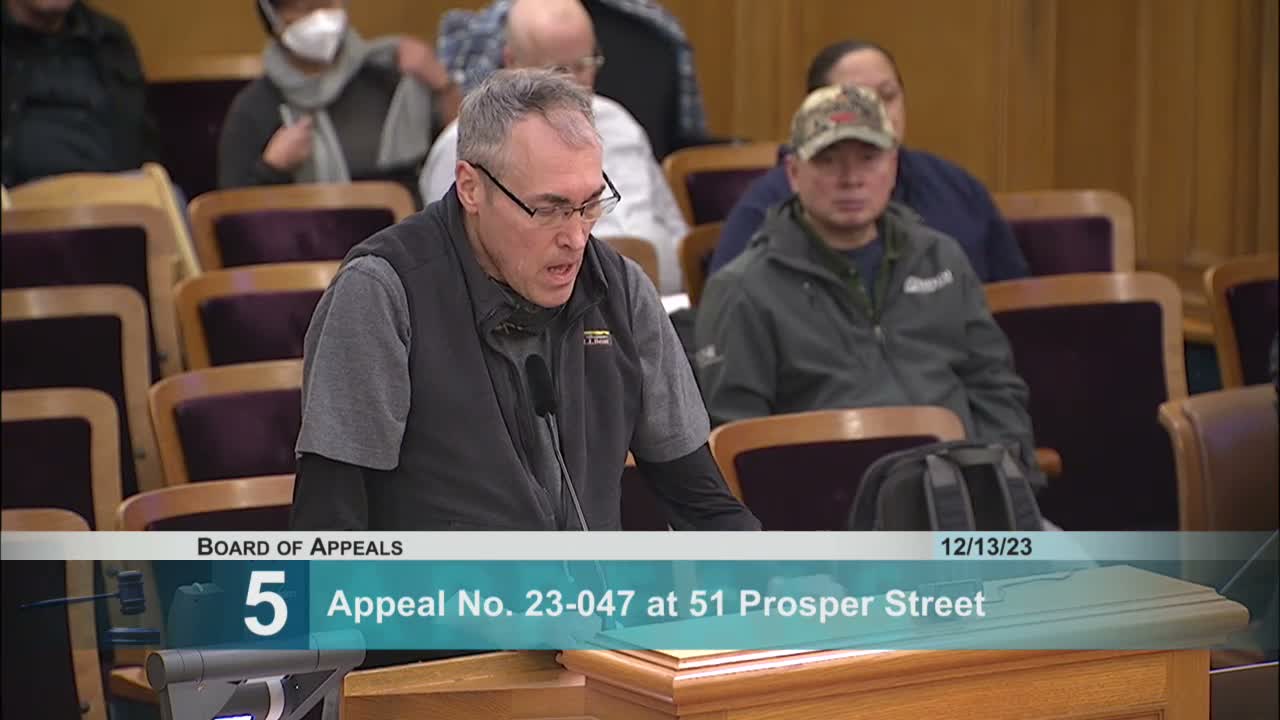
Tom Metz, a San Francisco property owner who said he needs a live-in caregiver because of a progressive motor-neuron disease, asked the San Francisco Board of Appeals on Dec. 13 to permit merging two dwelling units at 51 Prosper St. Metz told the board the merger — which would remove one kitchen and create contiguous living space — is necessary for his safety and to preserve the building's long-term viability as rent-controlled housing.
Metz told commissioners his plan would let him keep a live-in assistant and avoid institutional care, and that the planned reconfiguration would create larger bedrooms and additional habitable space. He argued the city's recent interpretation of state housing law and Planning Department guidance should not bar his requested accommodation. "If you approve my appeal, it will permit me to continue to live independently," Metz said.
The Planning Department's Corey Teague acknowledged the tension between accommodating disabilities and preserving the city's housing stock. Teague described the department's decision to issue a reasonable modification that permits an interior connection between units but to require the existing kitchens remain and require removal of the connection once it is no longer needed. He said the department briefed the Mayor's Office on Disability and that the modification attempt tried to balance both policy goals.
Commissioners debated the appropriate legal path, with several noting federal and state disability rules and the city's reasonable-modification code (Planning Code 305.1) give the board scope to consider disability accommodations. Commissioner Alex Lundberg moved to continue the item to the Jan. 10 calendar with the board's intent to grant the modification; the motion directs Planning staff to draft revised decision language that addresses the code criteria explicitly so future cases can rely on a clear precedent. The motion passed 4'to'0.
The board asked that Planning circulate the revised findings before Jan. 10 and that any material changes be flagged so the public may comment. The board's action leaves open the option for the applicant to pursue a conditional-use authorization at the Planning Commission if the applicant prefers a full legal merger under the city's updated interpretation of state housing law.
Metz told commissioners his plan would let him keep a live-in assistant and avoid institutional care, and that the planned reconfiguration would create larger bedrooms and additional habitable space. He argued the city's recent interpretation of state housing law and Planning Department guidance should not bar his requested accommodation. "If you approve my appeal, it will permit me to continue to live independently," Metz said.
The Planning Department's Corey Teague acknowledged the tension between accommodating disabilities and preserving the city's housing stock. Teague described the department's decision to issue a reasonable modification that permits an interior connection between units but to require the existing kitchens remain and require removal of the connection once it is no longer needed. He said the department briefed the Mayor's Office on Disability and that the modification attempt tried to balance both policy goals.
Commissioners debated the appropriate legal path, with several noting federal and state disability rules and the city's reasonable-modification code (Planning Code 305.1) give the board scope to consider disability accommodations. Commissioner Alex Lundberg moved to continue the item to the Jan. 10 calendar with the board's intent to grant the modification; the motion directs Planning staff to draft revised decision language that addresses the code criteria explicitly so future cases can rely on a clear precedent. The motion passed 4'to'0.
The board asked that Planning circulate the revised findings before Jan. 10 and that any material changes be flagged so the public may comment. The board's action leaves open the option for the applicant to pursue a conditional-use authorization at the Planning Commission if the applicant prefers a full legal merger under the city's updated interpretation of state housing law.
View the Full Meeting & All Its Details
This article offers just a summary. Unlock complete video, transcripts, and insights as a Founder Member.
✓
Watch full, unedited meeting videos
✓
Search every word spoken in unlimited transcripts
✓
AI summaries & real-time alerts (all government levels)
✓
Permanent access to expanding government content
30-day money-back guarantee
