Board revokes permit for staircase repairs at 1331–1333 Church, orders two‑permit finding
January 10, 2024 | San Francisco City, San Francisco County, California
This article was created by AI summarizing key points discussed. AI makes mistakes, so for full details and context, please refer to the video of the full meeting. Please report any errors so we can fix them. Report an error »
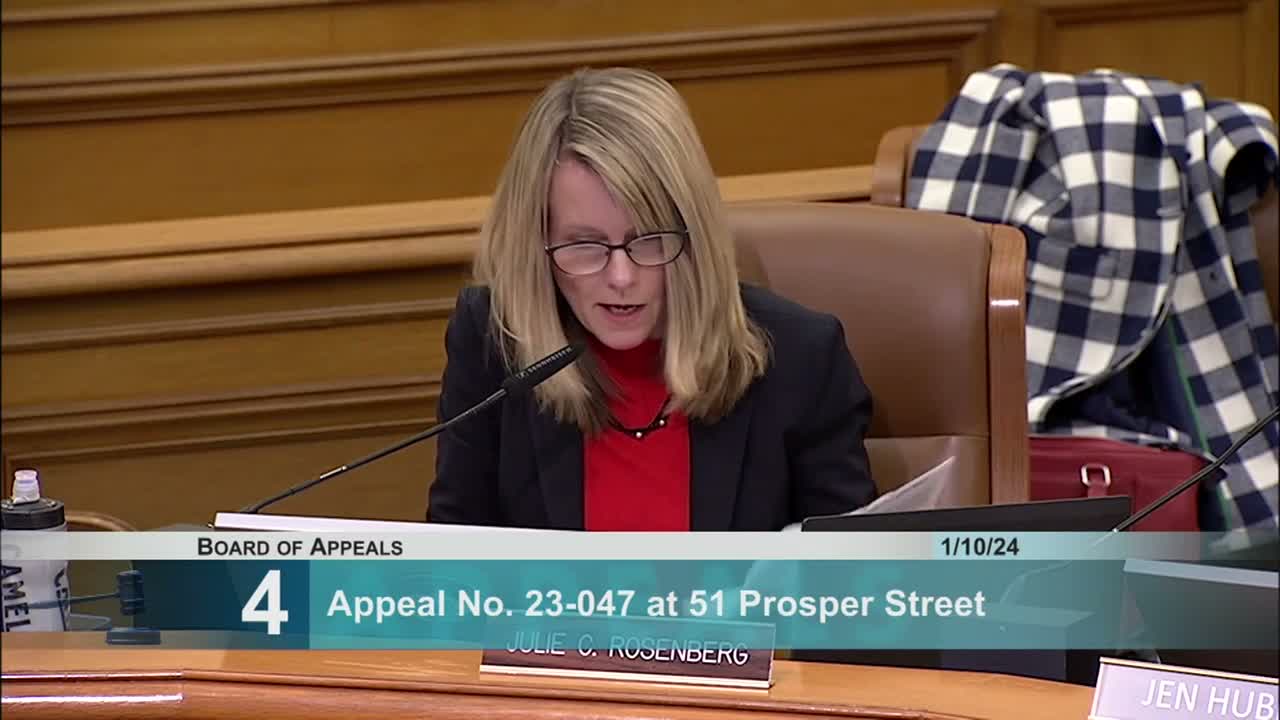
The Board of Appeals voted 4–1 on Jan. 10 to grant an appeal from the owners of 1331–1333 Church Street and revoke a building permit for repair work on a staircase that neighbors say is illegally fastened to their wall. Commissioners concluded the single permitted application did not sufficiently account for the neighboring property’s rights and stated the board’s view that two permits — one per affected property — are required when an improvement touches an adjacent building.
Appellant representatives told the board they had exchanged more than 50 emails, made four settlement offers (including contributing to repainting and paying toward repairs) and repeatedly asked the permit holder for access to coordinate work; they alleged the permit holder declined to cooperate and that substantial dry rot and holes remain on their wall. "We do not deny Mr. Chin the right to fix his staircase," the appellant’s representative said, "but we do need to make sure our wall does not suffer further damages." (appellant representative)
Matthew Green of the Department of Building Inspection explained DBI’s earlier guidance and offered to secure a written interpretation from the chief building official. He acknowledged the plans contain elements (handrail fasteners) that appear to cross property lines and recommended a special condition requiring self‑supporting handrails. Commissioners debated whether the case fit prior examples where one permit sufficed; some commissioners emphasized the plain language of the code requiring separate permits for each building or structure affected.
After a lengthy exchange about the practical consequences of requiring two permits, Commissioner John Trezyna moved to grant the appeal on the basis that the single permit failed to account for the appellants’ interests and that two permits are required; the motion carried 4–1 (Vice President Jose Lopez opposed). The board instructed DBI and the parties that revoking the permit would require the permit holder and any other necessary owners to submit separate permit applications to address the work cooperatively.
DBI and planning staff noted that civil remedies remain available to resolve cost and access disputes between neighbors — the board’s action affects permit issuance, not civil liability. The board also invited DBI to pursue clearer departmental policy or an official code interpretation to reduce future ambiguity.
Next steps: the revoked permit prevents immediate construction under the previously issued number; DBI said the easiest path forward would be a coordinated submittal with two linked permit applications and mutually agreed plans, or litigation between neighbors to resolve access and payment issues.
Appellant representatives told the board they had exchanged more than 50 emails, made four settlement offers (including contributing to repainting and paying toward repairs) and repeatedly asked the permit holder for access to coordinate work; they alleged the permit holder declined to cooperate and that substantial dry rot and holes remain on their wall. "We do not deny Mr. Chin the right to fix his staircase," the appellant’s representative said, "but we do need to make sure our wall does not suffer further damages." (appellant representative)
Matthew Green of the Department of Building Inspection explained DBI’s earlier guidance and offered to secure a written interpretation from the chief building official. He acknowledged the plans contain elements (handrail fasteners) that appear to cross property lines and recommended a special condition requiring self‑supporting handrails. Commissioners debated whether the case fit prior examples where one permit sufficed; some commissioners emphasized the plain language of the code requiring separate permits for each building or structure affected.
After a lengthy exchange about the practical consequences of requiring two permits, Commissioner John Trezyna moved to grant the appeal on the basis that the single permit failed to account for the appellants’ interests and that two permits are required; the motion carried 4–1 (Vice President Jose Lopez opposed). The board instructed DBI and the parties that revoking the permit would require the permit holder and any other necessary owners to submit separate permit applications to address the work cooperatively.
DBI and planning staff noted that civil remedies remain available to resolve cost and access disputes between neighbors — the board’s action affects permit issuance, not civil liability. The board also invited DBI to pursue clearer departmental policy or an official code interpretation to reduce future ambiguity.
Next steps: the revoked permit prevents immediate construction under the previously issued number; DBI said the easiest path forward would be a coordinated submittal with two linked permit applications and mutually agreed plans, or litigation between neighbors to resolve access and payment issues.
View the Full Meeting & All Its Details
This article offers just a summary. Unlock complete video, transcripts, and insights as a Founder Member.
✓
Watch full, unedited meeting videos
✓
Search every word spoken in unlimited transcripts
✓
AI summaries & real-time alerts (all government levels)
✓
Permanent access to expanding government content
30-day money-back guarantee
