Planning Commission backs group-housing definition changes, sends revised ordinances to Board with exceptions
February 10, 2022 | San Francisco City, San Francisco County, California
This article was created by AI summarizing key points discussed. AI makes mistakes, so for full details and context, please refer to the video of the full meeting. Please report any errors so we can fix them. Report an error »
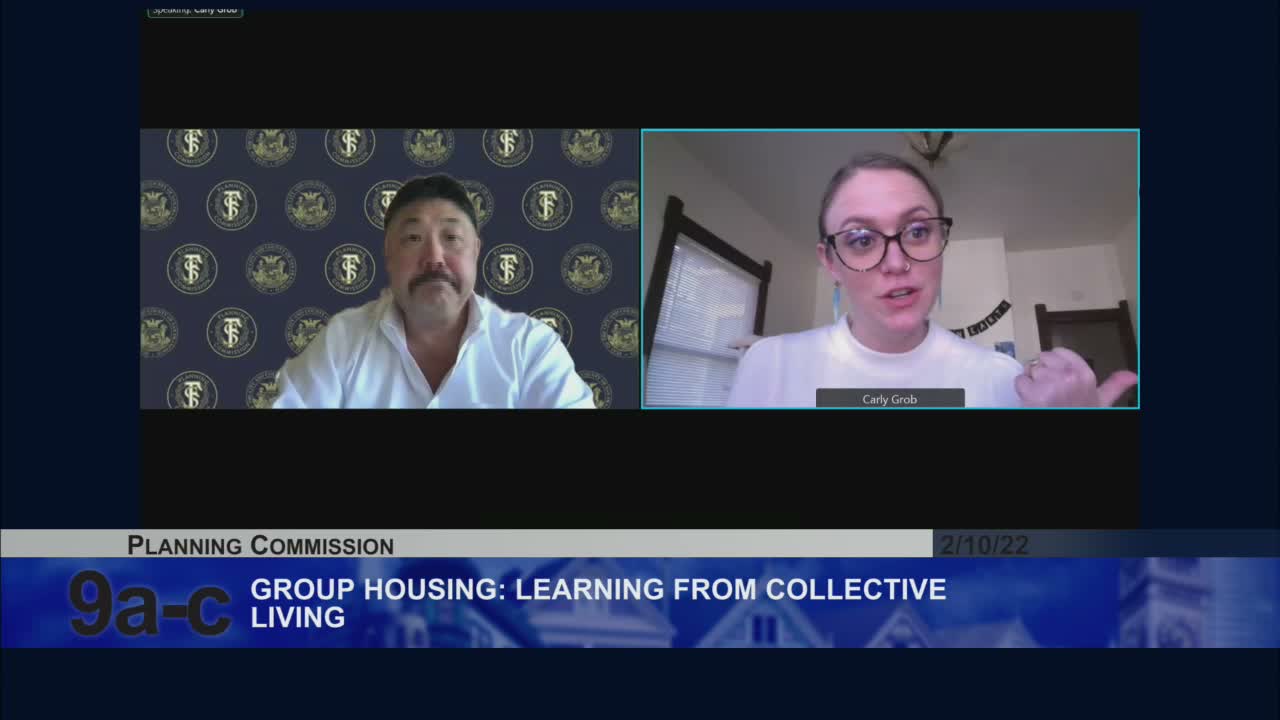
The San Francisco Planning Commission voted unanimously to recommend two ordinances that tighten the city's rulebook for so-called "group housing," citing a need to preserve living conditions and common amenities in high-density neighborhoods. The commission approved staff's recommended changes and asked staff and the sponsor to craft clarifying exemptions for nonprofit short-term family-stay facilities and student housing.
The ordinances, introduced by Supervisor Peskin, would redefine group housing to require substantially larger usable common space, increase the minimum provision of communal kitchens, and prohibit limited in-unit cooking facilities (small sink/fridge/2-burner setups) that have been allowed by interpretation. Planning staff also recommended a group-housing special use district (SUD) that would restrict new market-rate group housing in Chinatown and the Tenderloin, neighborhoods commissioners and community advocates said already have high concentrations of small-room housing.
Commissioners pointed to a four-year case-study review prepared by the California College of the Arts, which found patterns across 37 case studies that informed staff recommendations. The research team reported that meaningful communal living typically requires a large share of shared programmatic space (their longer-run observation suggested roughly 0.67 square feet of shared space for every square foot of private space, or around 40% of total interior area), and that one shared kitchen per roughly 15 units is a useful rule of thumb.
Veronica Flores of the Planning Department told the commission the department recommends increasing the proposed common-space ratio from 0.25 to 0.5 (roughly a third of a project's combined common and private space) and requiring at least 15% of common spaces to include kitchens so projects provide usable culinary facilities without mandating kitchens everywhere. "The intent isn't to prohibit things such as a microwave or a small mini fridge," Flores said, "but rather to limit an assortment of features that constitute a kitchen." (Verbatim quote taken from staff presentation.)
Supporters of the ordinances, including Tenderloin and Chinatown tenant advocates, neighborhood groups and several community organizations, told the commission the changes respond to years of resident concerns about small market-rate group housing and SRO conversions that produce limited cooking and social spaces while increasing density. Opponents, including some developers and industry groups, argued the restrictions are too prescriptive and could impede financing and innovation for certain housing models; they urged a working group to refine metrics and feasibility approaches.
After public testimony that spanned advocates, industry representatives, and dozens of residents, the commission approved a motion that (a) endorses staff's recommended modifications, (b) requests explicit exemptions or tailored rules for family-stay nonprofit facilities (e.g., Family House-type operations) and student housing, and (c) asks staff to form working groups on outstanding issues including SROs and potential technical solutions for kitchen metrics. Commissioner Diamond moved the motion; it passed 6-0.
What happens next: The commission's action forwards the strengthened definition and proposed SUD, with the requested clarifications and exemptions, to the Board of Supervisors. Supervisorial amendments and additional technical language are expected as staff, the sponsor's office, and community stakeholders resolve grandfathering, nonprofit exemptions and details about how kitchens and common spaces are measured.
The ordinances, introduced by Supervisor Peskin, would redefine group housing to require substantially larger usable common space, increase the minimum provision of communal kitchens, and prohibit limited in-unit cooking facilities (small sink/fridge/2-burner setups) that have been allowed by interpretation. Planning staff also recommended a group-housing special use district (SUD) that would restrict new market-rate group housing in Chinatown and the Tenderloin, neighborhoods commissioners and community advocates said already have high concentrations of small-room housing.
Commissioners pointed to a four-year case-study review prepared by the California College of the Arts, which found patterns across 37 case studies that informed staff recommendations. The research team reported that meaningful communal living typically requires a large share of shared programmatic space (their longer-run observation suggested roughly 0.67 square feet of shared space for every square foot of private space, or around 40% of total interior area), and that one shared kitchen per roughly 15 units is a useful rule of thumb.
Veronica Flores of the Planning Department told the commission the department recommends increasing the proposed common-space ratio from 0.25 to 0.5 (roughly a third of a project's combined common and private space) and requiring at least 15% of common spaces to include kitchens so projects provide usable culinary facilities without mandating kitchens everywhere. "The intent isn't to prohibit things such as a microwave or a small mini fridge," Flores said, "but rather to limit an assortment of features that constitute a kitchen." (Verbatim quote taken from staff presentation.)
Supporters of the ordinances, including Tenderloin and Chinatown tenant advocates, neighborhood groups and several community organizations, told the commission the changes respond to years of resident concerns about small market-rate group housing and SRO conversions that produce limited cooking and social spaces while increasing density. Opponents, including some developers and industry groups, argued the restrictions are too prescriptive and could impede financing and innovation for certain housing models; they urged a working group to refine metrics and feasibility approaches.
After public testimony that spanned advocates, industry representatives, and dozens of residents, the commission approved a motion that (a) endorses staff's recommended modifications, (b) requests explicit exemptions or tailored rules for family-stay nonprofit facilities (e.g., Family House-type operations) and student housing, and (c) asks staff to form working groups on outstanding issues including SROs and potential technical solutions for kitchen metrics. Commissioner Diamond moved the motion; it passed 6-0.
What happens next: The commission's action forwards the strengthened definition and proposed SUD, with the requested clarifications and exemptions, to the Board of Supervisors. Supervisorial amendments and additional technical language are expected as staff, the sponsor's office, and community stakeholders resolve grandfathering, nonprofit exemptions and details about how kitchens and common spaces are measured.
Don't Miss a Word: See the Full Meeting!
Go beyond summaries. Unlock every video, transcript, and key insight with a Founder Membership.
✓
Get instant access to full meeting videos
✓
Search and clip any phrase from complete transcripts
✓
Receive AI-powered summaries & custom alerts
✓
Enjoy lifetime, unrestricted access to government data
30-day money-back guarantee
