Planning Commission declines to endorse two proposed fourplex/upzoning ordinances, citing feasibility concerns
February 10, 2022 | San Francisco City, San Francisco County, California
This article was created by AI summarizing key points discussed. AI makes mistakes, so for full details and context, please refer to the video of the full meeting. Please report any errors so we can fix them. Report an error »
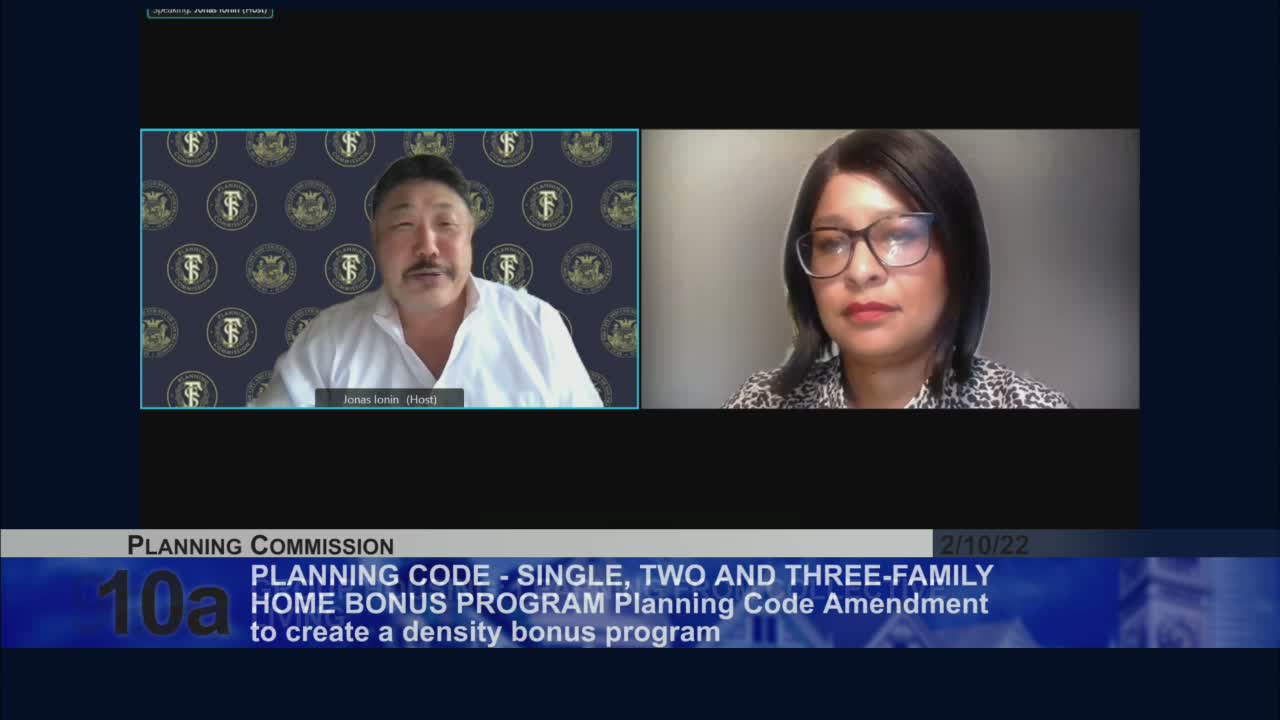
The Planning Commission voted 5-1 to disapprove two competing fourplex/upzoning ordinances introduced by Supervisors Safaie and Mar, citing staff's feasibility concerns and the need for a coordinated citywide approach that pairs zoning changes with funding and homeowner assistance.
Audrey Merloney of the Planning Department told commissioners the department supports the goal of small-scale density but flagged three major hurdles for the specific proposals under review: the current market and construction costs make small projects difficult to pencil; the affordability requirements imposed by these drafts create a large feasibility gap for small parcels; and the ordinances lack income-restriction or occupancy guarantees tied to the city's inclusionary programs. "Proportionally, the proposed affordability requirements are much higher than what we put on large projects," staff said, urging more analysis and programmatic support before advancing an upzoning that requires deep affordability on tiny projects.
Supervisor Safaie presented a streamlined-review approach tied to a partial affordability requirement and an exemption proposal for certain demolition controls. Supervisor Gordon Mar (presented by Leigh Levitt) proposed an approach that would permit four units plus an ADU where at least one bonus unit is capped at 100% AMI and be paired with a housing development incentive fund to help owner-occupants and small builders finance new units. Both sponsors argued the proposals are intended to create a locally controlled alternative to state statutes like SB 9 and to prioritize moderate-income affordability.
Commissioners and multiple public commenters, including housing advocates, tenant groups and local developers, differed sharply on whether the ordinances would actually produce new housing and for whom. Planning's external consultant (Century Urban) concluded that under current market assumptions many small projects would be infeasible—even without an affordability requirement—unless paired with subsidies or other structural changes. Several commissioners urged supervisors to coordinate across offices and create a comprehensive package that includes design standards, technical assistance, low-interest or forgivable loans and clearer grandfathering rules for pipeline projects.
After deliberation the commission approved a motion to disapprove both ordinances and to encourage the sponsors to develop a unified, programmatic approach that addresses feasibility and funding. The disapproval vote was 5-1, with Commissioner Coppell in dissent.
Audrey Merloney of the Planning Department told commissioners the department supports the goal of small-scale density but flagged three major hurdles for the specific proposals under review: the current market and construction costs make small projects difficult to pencil; the affordability requirements imposed by these drafts create a large feasibility gap for small parcels; and the ordinances lack income-restriction or occupancy guarantees tied to the city's inclusionary programs. "Proportionally, the proposed affordability requirements are much higher than what we put on large projects," staff said, urging more analysis and programmatic support before advancing an upzoning that requires deep affordability on tiny projects.
Supervisor Safaie presented a streamlined-review approach tied to a partial affordability requirement and an exemption proposal for certain demolition controls. Supervisor Gordon Mar (presented by Leigh Levitt) proposed an approach that would permit four units plus an ADU where at least one bonus unit is capped at 100% AMI and be paired with a housing development incentive fund to help owner-occupants and small builders finance new units. Both sponsors argued the proposals are intended to create a locally controlled alternative to state statutes like SB 9 and to prioritize moderate-income affordability.
Commissioners and multiple public commenters, including housing advocates, tenant groups and local developers, differed sharply on whether the ordinances would actually produce new housing and for whom. Planning's external consultant (Century Urban) concluded that under current market assumptions many small projects would be infeasible—even without an affordability requirement—unless paired with subsidies or other structural changes. Several commissioners urged supervisors to coordinate across offices and create a comprehensive package that includes design standards, technical assistance, low-interest or forgivable loans and clearer grandfathering rules for pipeline projects.
After deliberation the commission approved a motion to disapprove both ordinances and to encourage the sponsors to develop a unified, programmatic approach that addresses feasibility and funding. The disapproval vote was 5-1, with Commissioner Coppell in dissent.
Don't Miss a Word: See the Full Meeting!
Go beyond summaries. Unlock every video, transcript, and key insight with a Founder Membership.
✓
Get instant access to full meeting videos
✓
Search and clip any phrase from complete transcripts
✓
Receive AI-powered summaries & custom alerts
✓
Enjoy lifetime, unrestricted access to government data
30-day money-back guarantee
