Planning Commission briefed on Shared Spaces program extension, equity grants and new permit timeline
April 21, 2022 | San Francisco City, San Francisco County, California
This article was created by AI summarizing key points discussed. AI makes mistakes, so for full details and context, please refer to the video of the full meeting. Please report any errors so we can fix them. Report an error »
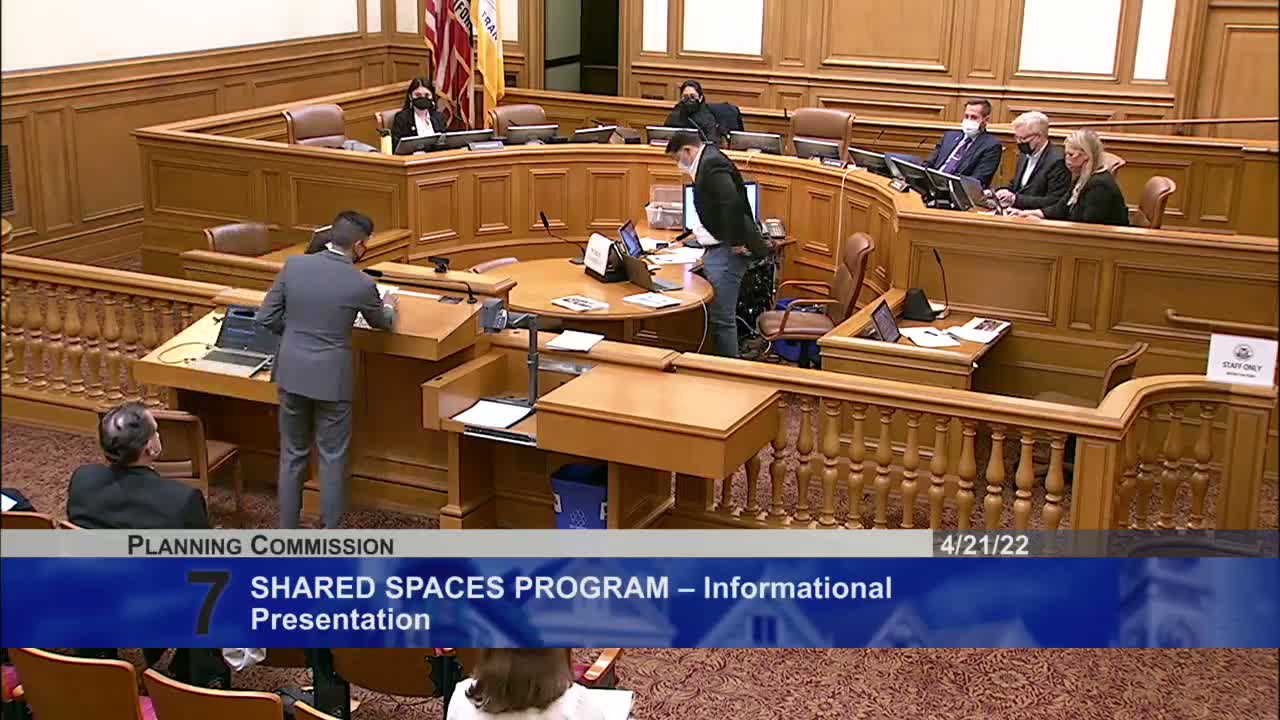
San Francisco — Planning Department staff on Thursday updated the Planning Commission on the Shared Spaces program and how new city legislation will change permitting and enforcement.
Robin Abad Aqibilo, director of the Shared Spaces Program, and deputy program manager Monica Munowich told commissioners the program — launched during the pandemic to let restaurants and community groups use curb space and sidewalks — will be codified with a formal permit expected next spring and that the Board of Supervisors’ recent ordinance extends pandemic-era fee waivers through March 2023. The department also announced a 60‑day public comment period for related guidance.
Staff described three enforcement priorities the city will address now: ADA accessibility, fire‑safety access for first responders and sight‑lines at intersections. Munowich showed a consolidated compliance checklist — a “single bill of health” — that inspectors from Public Works, Fire and the Municipal Transportation Agency can use in joint visits. She said field enforcement is already focusing on sites that present the most serious access or safety concerns.
On fees, staff previewed the permit charges that would apply under the codified program: roughly $1,000 for public parklets, $2,000 for movable parklets and $3,000 for commercial parklets, with a 50% fee waiver for businesses with $2 million or less in San Francisco gross receipts. Abad Aqibilo said the city is also running a targeted equity strategy, with technical assistance and a compliance grant cycle (closing April 30) to help smaller operators meet ADA and fire‑safety requirements.
Commissioners pressed staff on monitoring and escalation: Commissioner Imperial asked how staff will prioritize inspections and whether fines are assessed only after attempts to remediate. Staff said joint inspections are the primary tool and that fines are an escalation step after outreach and an opportunity to cure compliance issues. "Our focus is engagement and education first," Munowich said.
The presentation drew public comment from neighborhood merchants who said enforcement has been uneven in some corridors and urged clearer complaint paths. Staff said they will follow up on specific enforcement complaints raised at the hearing.
The department said it will return with more detailed program guidance as the codified permit and fee schedule are finalized.
Robin Abad Aqibilo, director of the Shared Spaces Program, and deputy program manager Monica Munowich told commissioners the program — launched during the pandemic to let restaurants and community groups use curb space and sidewalks — will be codified with a formal permit expected next spring and that the Board of Supervisors’ recent ordinance extends pandemic-era fee waivers through March 2023. The department also announced a 60‑day public comment period for related guidance.
Staff described three enforcement priorities the city will address now: ADA accessibility, fire‑safety access for first responders and sight‑lines at intersections. Munowich showed a consolidated compliance checklist — a “single bill of health” — that inspectors from Public Works, Fire and the Municipal Transportation Agency can use in joint visits. She said field enforcement is already focusing on sites that present the most serious access or safety concerns.
On fees, staff previewed the permit charges that would apply under the codified program: roughly $1,000 for public parklets, $2,000 for movable parklets and $3,000 for commercial parklets, with a 50% fee waiver for businesses with $2 million or less in San Francisco gross receipts. Abad Aqibilo said the city is also running a targeted equity strategy, with technical assistance and a compliance grant cycle (closing April 30) to help smaller operators meet ADA and fire‑safety requirements.
Commissioners pressed staff on monitoring and escalation: Commissioner Imperial asked how staff will prioritize inspections and whether fines are assessed only after attempts to remediate. Staff said joint inspections are the primary tool and that fines are an escalation step after outreach and an opportunity to cure compliance issues. "Our focus is engagement and education first," Munowich said.
The presentation drew public comment from neighborhood merchants who said enforcement has been uneven in some corridors and urged clearer complaint paths. Staff said they will follow up on specific enforcement complaints raised at the hearing.
The department said it will return with more detailed program guidance as the codified permit and fee schedule are finalized.
Don't Miss a Word: See the Full Meeting!
Go beyond summaries. Unlock every video, transcript, and key insight with a Founder Membership.
✓
Get instant access to full meeting videos
✓
Search and clip any phrase from complete transcripts
✓
Receive AI-powered summaries & custom alerts
✓
Enjoy lifetime, unrestricted access to government data
30-day money-back guarantee
