Planning Commission forwards San Francisco EV-charging code changes to Board after debate over fleet charging and job impacts
April 14, 2022 | San Francisco City, San Francisco County, California
This article was created by AI summarizing key points discussed. AI makes mistakes, so for full details and context, please refer to the video of the full meeting. Please report any errors so we can fix them. Report an error »
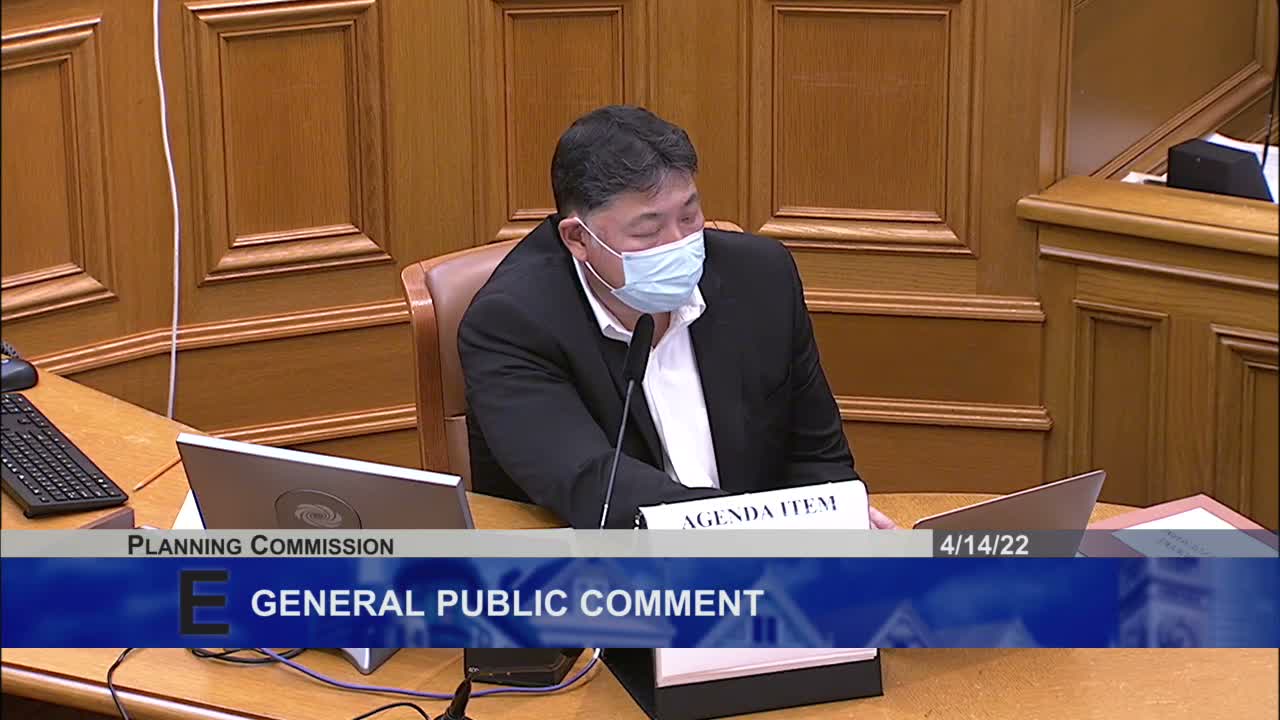
The San Francisco Planning Commission on April 14 voted 4–2 to send a planning-code amendment on publicly accessible electric-vehicle (EV) charging locations to the Board of Supervisors after a lengthy discussion about where 'fleet charging' should be allowed and how to monitor impacts on industrial (PDR) jobs.
The commission considered Case No. 2022-000549 PCA, a mayoral proposal to add two new use definitions to the planning code — EV charging locations and fleet charging — and to streamline conversions of existing automotive uses to EV charging in many zoning districts while preserving conditional-use review in other areas. Sarah Owens, Mayor Breed’s environmental policy advisor, said the package is part of the city’s climate strategy: "Cars are a major source of greenhouse gas emissions in San Francisco and around the world," and expanding public charging is necessary so residents without private parking can adopt zero-emission vehicles.
Why it matters: the ordinance aims to expand public charging access citywide — a priority given San Francisco’s target that 50 percent of new vehicles will be zero-emission by 2025 and 100 percent by 2030 — but commissioners and members of the public raised concerns that permitting EV infrastructure by right in certain industrial and neighborhood districts could hasten conversion of PDR (production, distribution, repair) sites and eliminate blue-collar jobs.
Planning staff described a package of modifications recommended in the case report: require conditional-use authorization for EV charging locations in certain C3 commercial districts, exempt conversions from some screening requirements, prohibit fleet charging in RC (residential-commercial) districts, and add an explicit code section to permit conversion of automotive uses to EV charging where appropriate. The mayor’s office said it is also considering allowing 100% fleet charging at some neighborhood-commercial (NC) districts with conditional use permission to address geographic equity.
Public comment split between industry and worker/evangelist groups. Cruise (a San Francisco-founded autonomous-vehicle company) told the commission that fleet charging with conditional-use review in NC and RC districts is an appropriate approach that allows community input while supporting electrification. Community groups and advocates asked the city to track conversions closely and study job impacts; one caller argued the city should prioritize transit improvements instead of adding more charging locations.
Commissioners focused their questions on monitoring and enforcement: where in the city 100 percent fleet charging would be permitted as-of-right, whether conversions would be tracked at a granular level (e.g., whether a site converted from a mechanic shop versus a parking lot), and how the legislation would address potential job loss in PDR areas. Liz Waddy, Director of Current Planning, said staff conducts due diligence on existing legal land use for every application using prior permits and historical files and that the department will track use categories to monitor conversions.
Motion and vote: Commissioner Diamond moved to adopt the legislation with staff’s recommended modifications and to incorporate the mayor’s office suggestion to allow fleet charging in specified NC districts with conditional-use review; the motion passed 4–2 (Diamond, Fung, Coppell and President Tanner voted Aye; Ruiz and Imperial voted No). The commission therefore forwarded the Planning Code Amendment to the Board of Supervisors for consideration.
Next steps: the ordinance proceeds to the Board of Supervisors, where the mayor and planning department said they will continue stakeholder engagement on fleet charging and work with SFMTA and SFPUC on fleet and public charging strategies. The commission asked staff to ensure monitoring provisions are clear so the city can identify whether conversions are replacing active PDR or are simply repurposing underused parking lots.
The commission considered Case No. 2022-000549 PCA, a mayoral proposal to add two new use definitions to the planning code — EV charging locations and fleet charging — and to streamline conversions of existing automotive uses to EV charging in many zoning districts while preserving conditional-use review in other areas. Sarah Owens, Mayor Breed’s environmental policy advisor, said the package is part of the city’s climate strategy: "Cars are a major source of greenhouse gas emissions in San Francisco and around the world," and expanding public charging is necessary so residents without private parking can adopt zero-emission vehicles.
Why it matters: the ordinance aims to expand public charging access citywide — a priority given San Francisco’s target that 50 percent of new vehicles will be zero-emission by 2025 and 100 percent by 2030 — but commissioners and members of the public raised concerns that permitting EV infrastructure by right in certain industrial and neighborhood districts could hasten conversion of PDR (production, distribution, repair) sites and eliminate blue-collar jobs.
Planning staff described a package of modifications recommended in the case report: require conditional-use authorization for EV charging locations in certain C3 commercial districts, exempt conversions from some screening requirements, prohibit fleet charging in RC (residential-commercial) districts, and add an explicit code section to permit conversion of automotive uses to EV charging where appropriate. The mayor’s office said it is also considering allowing 100% fleet charging at some neighborhood-commercial (NC) districts with conditional use permission to address geographic equity.
Public comment split between industry and worker/evangelist groups. Cruise (a San Francisco-founded autonomous-vehicle company) told the commission that fleet charging with conditional-use review in NC and RC districts is an appropriate approach that allows community input while supporting electrification. Community groups and advocates asked the city to track conversions closely and study job impacts; one caller argued the city should prioritize transit improvements instead of adding more charging locations.
Commissioners focused their questions on monitoring and enforcement: where in the city 100 percent fleet charging would be permitted as-of-right, whether conversions would be tracked at a granular level (e.g., whether a site converted from a mechanic shop versus a parking lot), and how the legislation would address potential job loss in PDR areas. Liz Waddy, Director of Current Planning, said staff conducts due diligence on existing legal land use for every application using prior permits and historical files and that the department will track use categories to monitor conversions.
Motion and vote: Commissioner Diamond moved to adopt the legislation with staff’s recommended modifications and to incorporate the mayor’s office suggestion to allow fleet charging in specified NC districts with conditional-use review; the motion passed 4–2 (Diamond, Fung, Coppell and President Tanner voted Aye; Ruiz and Imperial voted No). The commission therefore forwarded the Planning Code Amendment to the Board of Supervisors for consideration.
Next steps: the ordinance proceeds to the Board of Supervisors, where the mayor and planning department said they will continue stakeholder engagement on fleet charging and work with SFMTA and SFPUC on fleet and public charging strategies. The commission asked staff to ensure monitoring provisions are clear so the city can identify whether conversions are replacing active PDR or are simply repurposing underused parking lots.
Don't Miss a Word: See the Full Meeting!
Go beyond summaries. Unlock every video, transcript, and key insight with a Founder Membership.
✓
Get instant access to full meeting videos
✓
Search and clip any phrase from complete transcripts
✓
Receive AI-powered summaries & custom alerts
✓
Enjoy lifetime, unrestricted access to government data
30-day money-back guarantee
