Planners get sobering data on housing and office markets; commissioners focus on fees, CEQA and interagency delays
June 23, 2022 | San Francisco City, San Francisco County, California
This article was created by AI summarizing key points discussed. AI makes mistakes, so for full details and context, please refer to the video of the full meeting. Please report any errors so we can fix them. Report an error »
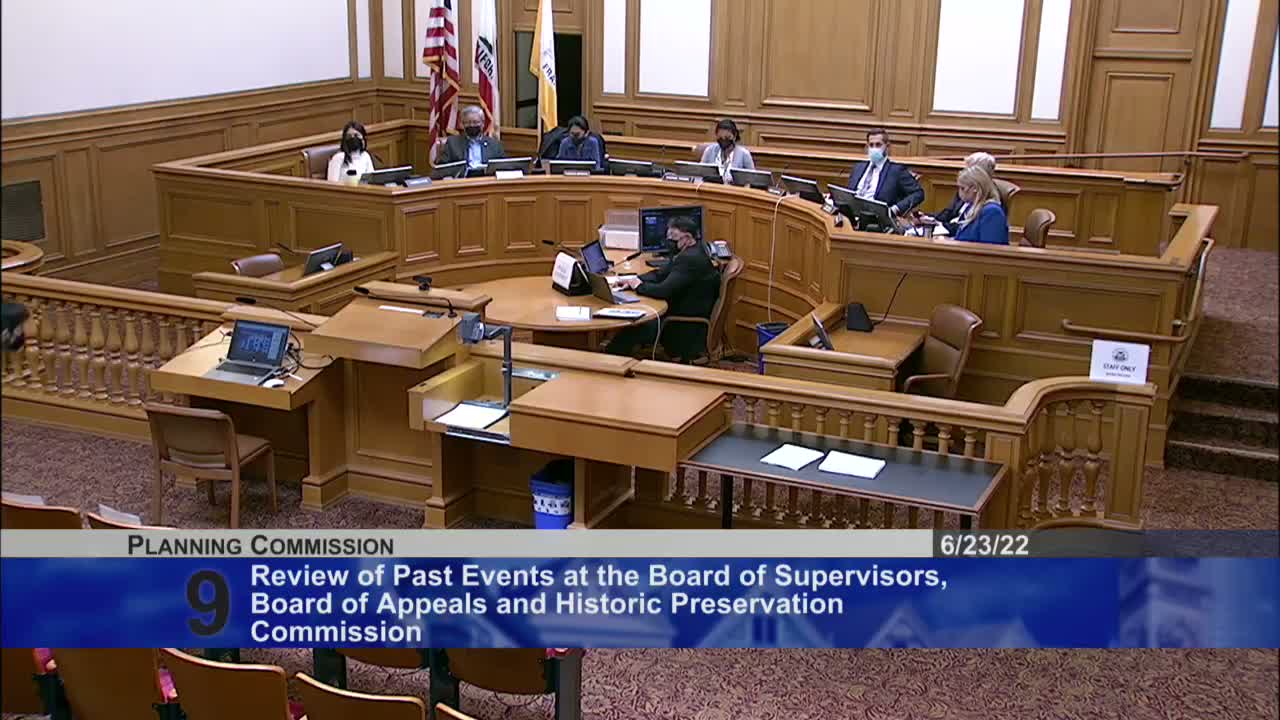
On June 23, 2022 the San Francisco Planning Commission heard a data-heavy briefing from Planning Department staff and the Chief Economist in the Controller's Office showing a marked slowdown in housing permitting and a dramatic increase in office vacancy.
The presentation by Joshua Switzky of the Planning Department and Ted Egan, chief economist in the Controller’s Office, framed the city’s development picture: “housing permits… are generally well below the 2019 trend,” Switzky said, and Egan warned that office vacancy climbed from about 6% pre-pandemic to roughly 22% by early 2022. Egan added that apartment rents in the city have held at about 14% below 2019 levels, a factor that reduces revenue assumptions for rental projects.
Why it matters: Commissioners said the trends complicate San Francisco’s ability to meet state housing goals and fund affordable-housing programs. Staff told the commission the city has a large pipeline of entitled and staged projects but that many are not moving quickly to building permits, and that fewer medium- and large-scale projects have been filed this year.
Key data and claims presented
- Switzky reported roughly 4,100 units are under construction, with almost 1,500 of those designated as below-market-rate units (about 36% of the total under construction).
- Switzky said roughly 1,161 units had been completed through mid-year and that the city was on pace to authorize a little under 2,000 units for the year—substantially below recent averages.
- Egan noted broad market effects: weakened rents and buyer interest in parts of the city, a large sublease pool in downtown office space and shifts in population and occupations linked to remote work.
- Egan said the city’s unemployment rate at the time was 1.9% but cautioned that mortgage rates above 6% and rising interest rates could further slow residential development.
Public commenters and industry perspective
Speakers from trade groups and developers urged faster entitlement and permit-processing timelines, lower or restructured fees, and more aggressive use of streamlining tools. Kujata Srivastava of SPUR, the group’s San Francisco director, said the city’s construction costs are among the highest and added: “there are a number of additional fees that cost $20,000 or more per unit,” and urged technical audits to reduce compliance costs.
Builders and designers repeated similar themes: the Residential Builders Association described delays in post-entitlement checks and site permits; several speakers said CEQA and discretionary reviews create long, costly timelines—Brett Gladstone, a land-use attorney, asked the commission to examine how long staff are given to complete Environmental Impact Report (EIR) documents and initial studies.
Commission debate and staff responses
Commissioners pressed staff on two practical questions: whether the trends make the state RHNA housing targets unattainable, and what concrete steps could shorten timelines. Joshua Switzky described an extensive pipeline of entitled projects and noted that many large projects are still in pre-construction phases; he said that, if market conditions permit, large multi-phase projects could substantially raise production when they move forward. On RHNA, he said the draft target of about 80,000–83,000 units over eight years implies producing more than 10,000 units a year, which is well above recent local averages.
On CEQA, staff acknowledged San Francisco’s environmental review timelines are longer than in many jurisdictions. Planning staff said they are pursuing programmatic approaches—including program-level EIRs and policy changes in the housing element—that could streamline later project review. Director Hillis also described pilot interagency efforts, such as coordinated plan checks for ADUs and Prop H expedited permitting for small businesses, and new work under the city’s permit center to improve cross-agency coordination.
What didn’t change: No formal policy decisions were made at the meeting. Commissioners directed staff to keep pursuing the housing-element work and interagency process improvements and to post the presentation slides online for public review.
Next steps: Staff will continue work on the housing element and related studies, the technical advisory committee on inclusionary rates is expected to reconvene, and commissioners suggested convening focused discussions on fees and timing to produce concrete options for the Board of Supervisors and the Mayor’s Office.
The presentation by Joshua Switzky of the Planning Department and Ted Egan, chief economist in the Controller’s Office, framed the city’s development picture: “housing permits… are generally well below the 2019 trend,” Switzky said, and Egan warned that office vacancy climbed from about 6% pre-pandemic to roughly 22% by early 2022. Egan added that apartment rents in the city have held at about 14% below 2019 levels, a factor that reduces revenue assumptions for rental projects.
Why it matters: Commissioners said the trends complicate San Francisco’s ability to meet state housing goals and fund affordable-housing programs. Staff told the commission the city has a large pipeline of entitled and staged projects but that many are not moving quickly to building permits, and that fewer medium- and large-scale projects have been filed this year.
Key data and claims presented
- Switzky reported roughly 4,100 units are under construction, with almost 1,500 of those designated as below-market-rate units (about 36% of the total under construction).
- Switzky said roughly 1,161 units had been completed through mid-year and that the city was on pace to authorize a little under 2,000 units for the year—substantially below recent averages.
- Egan noted broad market effects: weakened rents and buyer interest in parts of the city, a large sublease pool in downtown office space and shifts in population and occupations linked to remote work.
- Egan said the city’s unemployment rate at the time was 1.9% but cautioned that mortgage rates above 6% and rising interest rates could further slow residential development.
Public commenters and industry perspective
Speakers from trade groups and developers urged faster entitlement and permit-processing timelines, lower or restructured fees, and more aggressive use of streamlining tools. Kujata Srivastava of SPUR, the group’s San Francisco director, said the city’s construction costs are among the highest and added: “there are a number of additional fees that cost $20,000 or more per unit,” and urged technical audits to reduce compliance costs.
Builders and designers repeated similar themes: the Residential Builders Association described delays in post-entitlement checks and site permits; several speakers said CEQA and discretionary reviews create long, costly timelines—Brett Gladstone, a land-use attorney, asked the commission to examine how long staff are given to complete Environmental Impact Report (EIR) documents and initial studies.
Commission debate and staff responses
Commissioners pressed staff on two practical questions: whether the trends make the state RHNA housing targets unattainable, and what concrete steps could shorten timelines. Joshua Switzky described an extensive pipeline of entitled projects and noted that many large projects are still in pre-construction phases; he said that, if market conditions permit, large multi-phase projects could substantially raise production when they move forward. On RHNA, he said the draft target of about 80,000–83,000 units over eight years implies producing more than 10,000 units a year, which is well above recent local averages.
On CEQA, staff acknowledged San Francisco’s environmental review timelines are longer than in many jurisdictions. Planning staff said they are pursuing programmatic approaches—including program-level EIRs and policy changes in the housing element—that could streamline later project review. Director Hillis also described pilot interagency efforts, such as coordinated plan checks for ADUs and Prop H expedited permitting for small businesses, and new work under the city’s permit center to improve cross-agency coordination.
What didn’t change: No formal policy decisions were made at the meeting. Commissioners directed staff to keep pursuing the housing-element work and interagency process improvements and to post the presentation slides online for public review.
Next steps: Staff will continue work on the housing element and related studies, the technical advisory committee on inclusionary rates is expected to reconvene, and commissioners suggested convening focused discussions on fees and timing to produce concrete options for the Board of Supervisors and the Mayor’s Office.
Don't Miss a Word: See the Full Meeting!
Go beyond summaries. Unlock every video, transcript, and key insight with a Founder Membership.
✓
Get instant access to full meeting videos
✓
Search and clip any phrase from complete transcripts
✓
Receive AI-powered summaries & custom alerts
✓
Enjoy lifetime, unrestricted access to government data
30-day money-back guarantee
