Commission hears draft EIR for Housing Element 2022 update as hundreds of public comments call for equitable alternatives
June 09, 2022 | San Francisco City, San Francisco County, California
This article was created by AI summarizing key points discussed. AI makes mistakes, so for full details and context, please refer to the video of the full meeting. Please report any errors so we can fix them. Report an error »
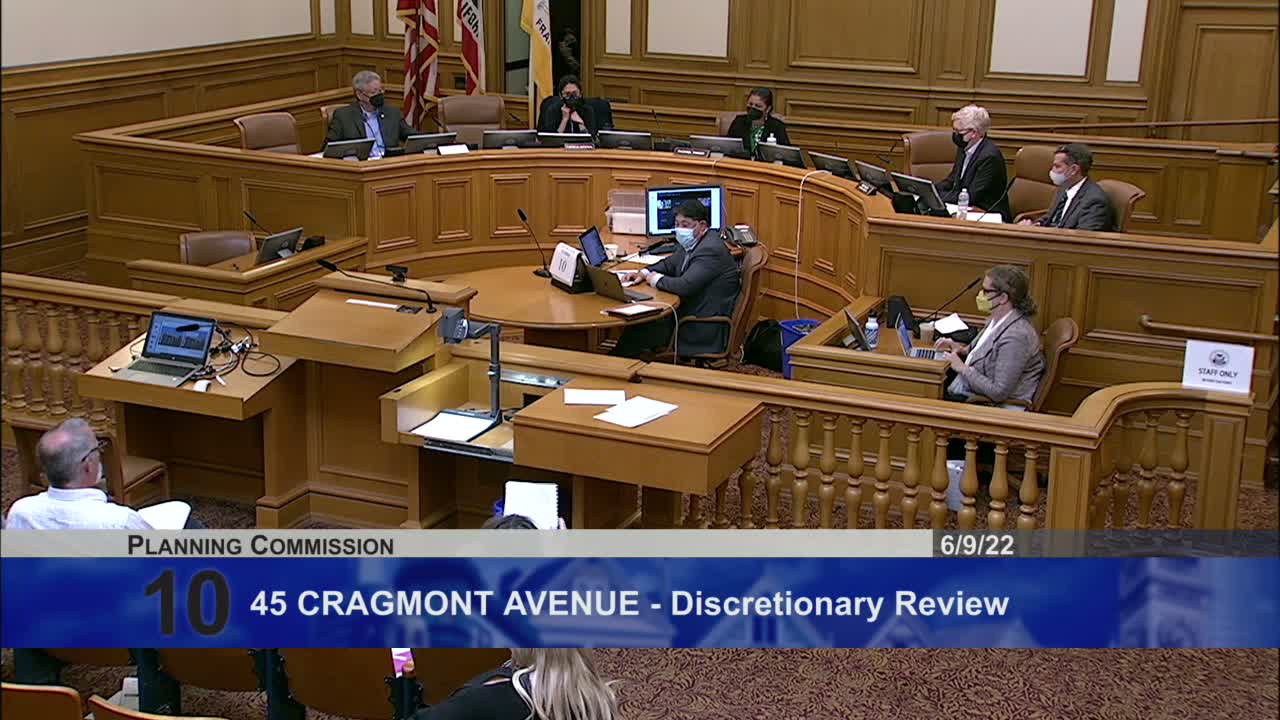
The San Francisco Planning Commission on June 9 took public comment on the draft Environmental Impact Report (EIR) for the Housing Element 2022 update, a programmatic CEQA document that evaluates the environmental effects of citywide housing-growth policies through 2050.
Planning staff described the EIR’s scope and baseline. Liz White, a senior planner on the EIR team, explained that the EIR compares a 2050 environmental baseline (approximately 102,000 new units projected by 2050 under the existing 2014 housing element and pipeline projects) to a proposed action that would accommodate roughly 150,000 new units citywide by 2050. White said the draft EIR takes a programmatic approach because the timing, locations and designs of future implementing projects are not yet defined. She summarized the EIR’s findings that implementation could have significant and unavoidable impacts in areas including utilities and service systems, wind, noise (from simultaneous construction), transportation, cultural and built resources, air quality and shadow; approximately 31 mitigation measures are proposed although some impacts could remain significant.
The department noted an errata posted May 19 to correct map text for alternatives figures and described an outreach schedule: the public comment period runs through 5 p.m. June 21, 2022 (extended because June 20 is Juneteenth); responses will be published in early January 2023 and the commission will consider EIR certification thereafter.
Public comment was extensive and largely centered on two themes: (1) the draft EIR should study alternatives and mitigation that materially prioritize production of deeply affordable housing and avoid policies that enable demolition and displacement, and (2) the EIR should more fully analyze infrastructure carrying capacity (water, wastewater, energy), climate change risks (sea-level rise, wildland-urban interface), and whether projected growth assumptions (e.g., RHNA-derived figures) are realistic. Multiple speakers representing the Race and Equity in All Planning (REP) coalition, tenants’ groups, neighborhood coalitions and individuals argued the EIR underestimates gentrification and displacement impacts and fails to present an equity-centered alternative (for example, a “build-affordable-first” alternative) that would prioritize public land and funding for permanently affordable housing.
Several commenters questioned the use of the 2050 environmental baseline and urged analysis that more explicitly models displacement and socioeconomic impacts, including the EIR’s treatment of demolition policies and the impacts of displacement on transportation and greenhouse-gas outcomes. Others urged more realistic assessment of infrastructure (water rationing, wastewater capacity, energy reliability) and urged that the EIR incorporate stronger mitigation timing, funding and delivery commitments rather than only project-level suggestions. Some commenters also questioned RHNA methodologies and the degree to which state-assigned housing numbers reflect local capacity.
Commissioners’ questions emphasized the need for clearer visual simulations of proposed height increases on side streets, the need for infrastructure coordination and funding plans to match proposed growth, and the challenge of reconciling programmatic analysis with the commission’s race-and-equity objectives. Commissioner Diamond listed a set of technical comments about visual simulations, recreational-facility capacity on the West Side, and potential zone-change permutations; Commissioner Moore and others urged stronger emphasis on producing very-low-, low- and moderate-income housing in implementation tools.
The commission did not take an immediate vote; staff will accept written comments through the close of the comment period and prepare responses. The record will show the public hearing and the department’s published errata and schedule for responses and return to the commission for certification.
Planning staff described the EIR’s scope and baseline. Liz White, a senior planner on the EIR team, explained that the EIR compares a 2050 environmental baseline (approximately 102,000 new units projected by 2050 under the existing 2014 housing element and pipeline projects) to a proposed action that would accommodate roughly 150,000 new units citywide by 2050. White said the draft EIR takes a programmatic approach because the timing, locations and designs of future implementing projects are not yet defined. She summarized the EIR’s findings that implementation could have significant and unavoidable impacts in areas including utilities and service systems, wind, noise (from simultaneous construction), transportation, cultural and built resources, air quality and shadow; approximately 31 mitigation measures are proposed although some impacts could remain significant.
The department noted an errata posted May 19 to correct map text for alternatives figures and described an outreach schedule: the public comment period runs through 5 p.m. June 21, 2022 (extended because June 20 is Juneteenth); responses will be published in early January 2023 and the commission will consider EIR certification thereafter.
Public comment was extensive and largely centered on two themes: (1) the draft EIR should study alternatives and mitigation that materially prioritize production of deeply affordable housing and avoid policies that enable demolition and displacement, and (2) the EIR should more fully analyze infrastructure carrying capacity (water, wastewater, energy), climate change risks (sea-level rise, wildland-urban interface), and whether projected growth assumptions (e.g., RHNA-derived figures) are realistic. Multiple speakers representing the Race and Equity in All Planning (REP) coalition, tenants’ groups, neighborhood coalitions and individuals argued the EIR underestimates gentrification and displacement impacts and fails to present an equity-centered alternative (for example, a “build-affordable-first” alternative) that would prioritize public land and funding for permanently affordable housing.
Several commenters questioned the use of the 2050 environmental baseline and urged analysis that more explicitly models displacement and socioeconomic impacts, including the EIR’s treatment of demolition policies and the impacts of displacement on transportation and greenhouse-gas outcomes. Others urged more realistic assessment of infrastructure (water rationing, wastewater capacity, energy reliability) and urged that the EIR incorporate stronger mitigation timing, funding and delivery commitments rather than only project-level suggestions. Some commenters also questioned RHNA methodologies and the degree to which state-assigned housing numbers reflect local capacity.
Commissioners’ questions emphasized the need for clearer visual simulations of proposed height increases on side streets, the need for infrastructure coordination and funding plans to match proposed growth, and the challenge of reconciling programmatic analysis with the commission’s race-and-equity objectives. Commissioner Diamond listed a set of technical comments about visual simulations, recreational-facility capacity on the West Side, and potential zone-change permutations; Commissioner Moore and others urged stronger emphasis on producing very-low-, low- and moderate-income housing in implementation tools.
The commission did not take an immediate vote; staff will accept written comments through the close of the comment period and prepare responses. The record will show the public hearing and the department’s published errata and schedule for responses and return to the commission for certification.
View the Full Meeting & All Its Details
This article offers just a summary. Unlock complete video, transcripts, and insights as a Founder Member.
✓
Watch full, unedited meeting videos
✓
Search every word spoken in unlimited transcripts
✓
AI summaries & real-time alerts (all government levels)
✓
Permanent access to expanding government content
30-day money-back guarantee
