Commission approves remodeled 79–81 Homestead despite neighbors' privacy and Ellis Act concerns
June 30, 2022 | San Francisco City, San Francisco County, California
This article was created by AI summarizing key points discussed. AI makes mistakes, so for full details and context, please refer to the video of the full meeting. Please report any errors so we can fix them. Report an error »
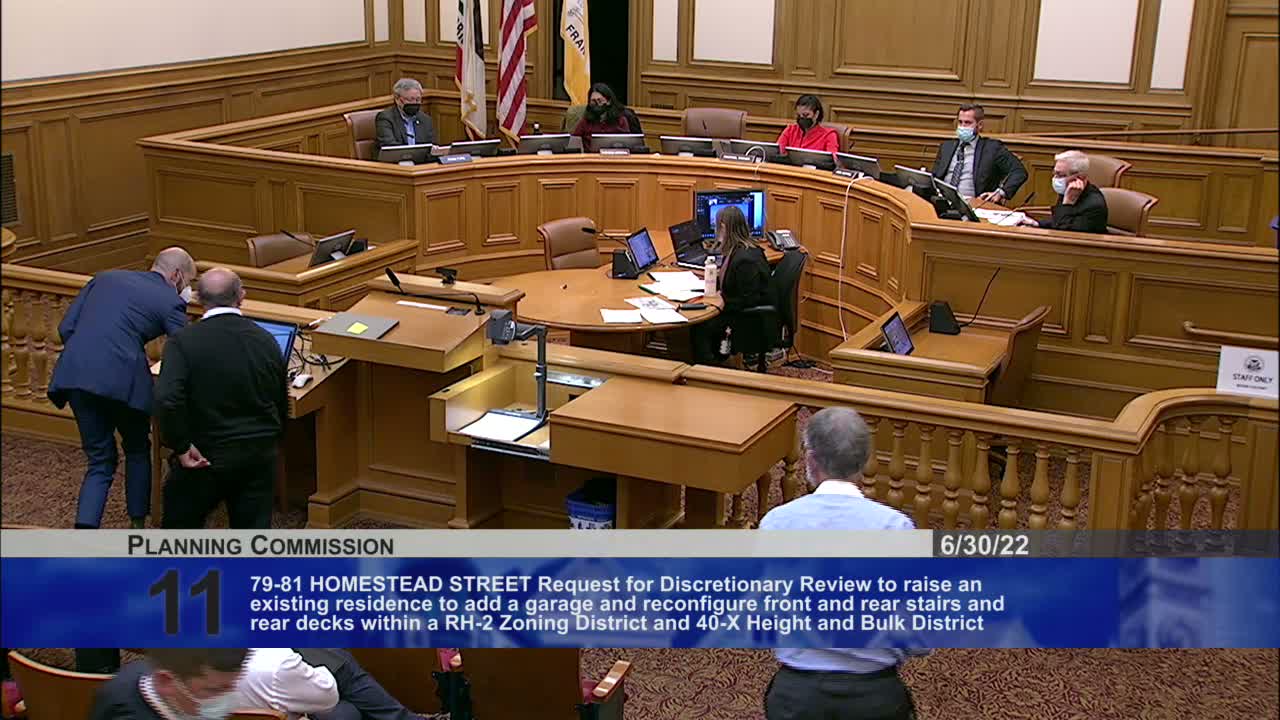
San Francisco — The Planning Commission on June 30 considered a discretionary‑review appeal of a remodeling and raising of an existing two‑unit building at 79–81 Homestead Street that would add a below‑grade garage, reconfigure rear decks and replace a hip roof with a flat roof. Neighbors argued the project would worsen privacy, increase massing into a mid‑block open space, remove on‑street parking and — critically for several speakers — followed an Ellis Act eviction that removed long‑term rent‑controlled tenants.
Neighbors requested that the commission require a conditional‑use review if the owner intended to merge the two units, prohibit tilt‑up solar panels via deed restriction, and narrow or re‑site the driveway to preserve on‑street parking. One former tenant testified she was evicted under the Ellis Act in 2019 and described landlord behavior she characterized as harassing.
Project architect Mark Thomas and owner Helene Cohen told the commission the scope of work is internal and vertical (raising the building to street level, inserting a compliant garage and rebuilding smaller rear decks and stairs), that the owner intends to maintain two units (one to be occupied by her and the other by family), and that modifications were made to address neighbor concerns (reduced height, removal of a peak roof, and adjustment of deck locations). The owner said her decision to leave the rental business followed health concerns and a desire to live in the smaller home in the future.
Planning staff recommended denial of discretionary review and approval as modified, concluding the project fit within the residential design guidelines and noting that privacy into backyards is not a standard protected by the RDGs. The commission voted 7‑0 not to take discretionary review and to approve the project with the staff‑recommended modifications (reduced decks, revised stairs and lowered height). Commissioners stressed the board’s concern about Ellis Act evictions in general but said the discretionary‑review standard requires evidence of exceptional or extraordinary circumstances tied to the design guidelines, which staff found lacking.
The commission’s action ends the discretionary‑review process for this permit; any building‑permit or utility‑service changes (for example, meter work) remain subject to DBI and other agencies’ review and appeal processes.
Neighbors requested that the commission require a conditional‑use review if the owner intended to merge the two units, prohibit tilt‑up solar panels via deed restriction, and narrow or re‑site the driveway to preserve on‑street parking. One former tenant testified she was evicted under the Ellis Act in 2019 and described landlord behavior she characterized as harassing.
Project architect Mark Thomas and owner Helene Cohen told the commission the scope of work is internal and vertical (raising the building to street level, inserting a compliant garage and rebuilding smaller rear decks and stairs), that the owner intends to maintain two units (one to be occupied by her and the other by family), and that modifications were made to address neighbor concerns (reduced height, removal of a peak roof, and adjustment of deck locations). The owner said her decision to leave the rental business followed health concerns and a desire to live in the smaller home in the future.
Planning staff recommended denial of discretionary review and approval as modified, concluding the project fit within the residential design guidelines and noting that privacy into backyards is not a standard protected by the RDGs. The commission voted 7‑0 not to take discretionary review and to approve the project with the staff‑recommended modifications (reduced decks, revised stairs and lowered height). Commissioners stressed the board’s concern about Ellis Act evictions in general but said the discretionary‑review standard requires evidence of exceptional or extraordinary circumstances tied to the design guidelines, which staff found lacking.
The commission’s action ends the discretionary‑review process for this permit; any building‑permit or utility‑service changes (for example, meter work) remain subject to DBI and other agencies’ review and appeal processes.
Don't Miss a Word: See the Full Meeting!
Go beyond summaries. Unlock every video, transcript, and key insight with a Founder Membership.
✓
Get instant access to full meeting videos
✓
Search and clip any phrase from complete transcripts
✓
Receive AI-powered summaries & custom alerts
✓
Enjoy lifetime, unrestricted access to government data
30-day money-back guarantee
