Planning commission advances revised four‑plex density‑bonus program after split vote
July 21, 2022 | San Francisco City, San Francisco County, California
This article was created by AI summarizing key points discussed. AI makes mistakes, so for full details and context, please refer to the video of the full meeting. Please report any errors so we can fix them. Report an error »
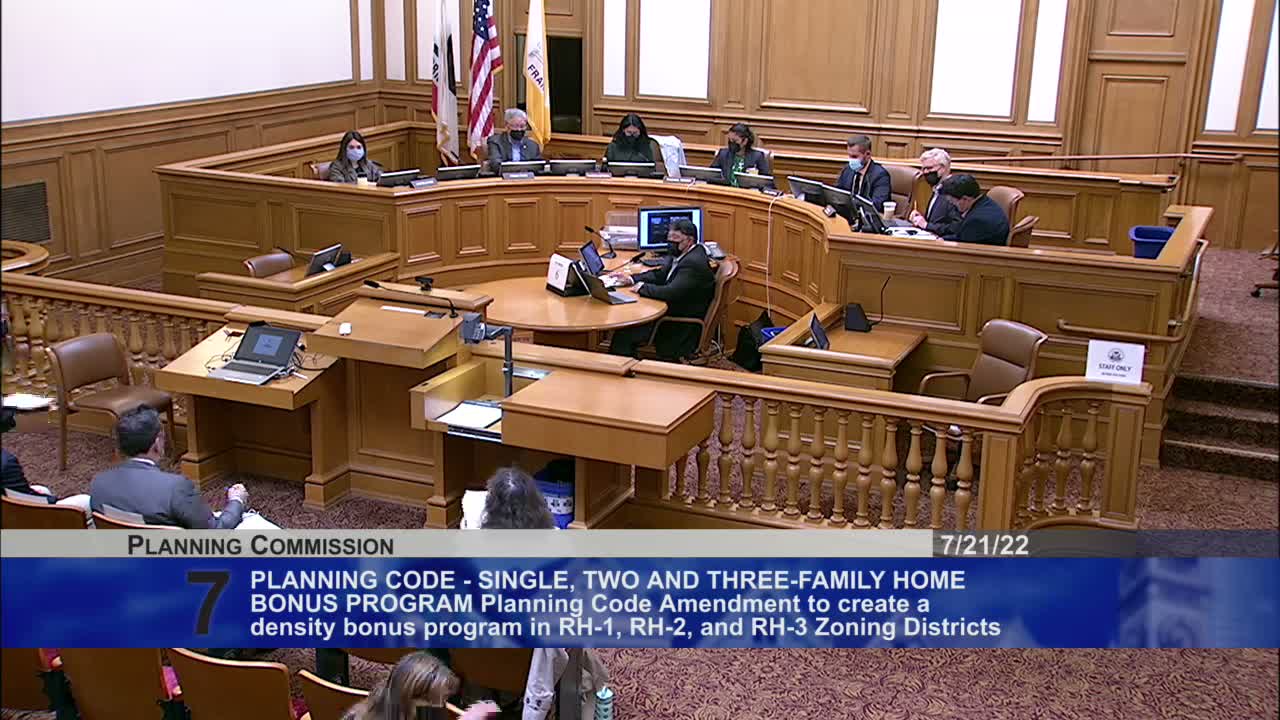
The San Francisco Planning Commission on July 21 advanced a revised four‑plex density‑bonus program by approving staff modifications and forwarding the ordinance to the Board of Supervisors on a 4–3 vote.
Supervisor Safaie, who introduced the legislation, told commissioners the version approved at the Board earlier that day had been vetoed and argued his revised ordinance would create new pathways for modest density in RH zoning districts while removing some eligibility limits. "We have to rezone. We have to create more vehicles for more density and more housing," Safaie said in his remarks.
The proposed density‑exception would allow up to four units on interior RH lots and six units on corner lots when a set of standards is met. Staff said the program would require either one on‑site affordable unit or an in‑lieu fee; a staff memo cited a maximum illustrative in‑lieu fee of about $170,823, based on a 740‑square‑foot unit, but staff and the sponsor indicated affordability requirements may be reconsidered in light of feasibility analyses.
Public testimony and commissioners’ questions centered on two fault lines: financial feasibility for small builders and anti‑displacement protections. Several speakers (including housing‑policy volunteers and tenant advocates) said independent analyses show a broad feasibility gap for small‑scale projects and warned that streamlined permitting without strong tenant protections could accelerate displacement. "Demolition control on rent‑controlled buildings is essential," one critic said.
Staff recommended a package of eight modifications, including: removing minimum‑lot eligibility constraints, refocusing fees on projects that do not add density, adding a one‑third proportionality requirement for unit mixes, pursuing objective design standards, and excluding properties with tenants in the last three years or those with recent Ellis Act activations.
Commissioners were divided. Supporters said the proposal opens opportunities for added density, particularly on corner lots, and offers several staff safeguards; opponents warned that the overlay may not produce feasible housing and could undermine the City’s housing‑element accounting. Commissioner Koppel moved to approve the ordinance with staff modifications; the motion passed 4–3, with Commissioners Ruiz, Imperial and Moore voting against.
What’s next: The commission’s approval forwards the ordinance and staff recommendations to the Board of Supervisors for further review and amendment. The Board will consider fiscal feasibility, displacement protections (including any lookback or Ellis Act provisions) and affordability mechanisms before adoption.
Supervisor Safaie, who introduced the legislation, told commissioners the version approved at the Board earlier that day had been vetoed and argued his revised ordinance would create new pathways for modest density in RH zoning districts while removing some eligibility limits. "We have to rezone. We have to create more vehicles for more density and more housing," Safaie said in his remarks.
The proposed density‑exception would allow up to four units on interior RH lots and six units on corner lots when a set of standards is met. Staff said the program would require either one on‑site affordable unit or an in‑lieu fee; a staff memo cited a maximum illustrative in‑lieu fee of about $170,823, based on a 740‑square‑foot unit, but staff and the sponsor indicated affordability requirements may be reconsidered in light of feasibility analyses.
Public testimony and commissioners’ questions centered on two fault lines: financial feasibility for small builders and anti‑displacement protections. Several speakers (including housing‑policy volunteers and tenant advocates) said independent analyses show a broad feasibility gap for small‑scale projects and warned that streamlined permitting without strong tenant protections could accelerate displacement. "Demolition control on rent‑controlled buildings is essential," one critic said.
Staff recommended a package of eight modifications, including: removing minimum‑lot eligibility constraints, refocusing fees on projects that do not add density, adding a one‑third proportionality requirement for unit mixes, pursuing objective design standards, and excluding properties with tenants in the last three years or those with recent Ellis Act activations.
Commissioners were divided. Supporters said the proposal opens opportunities for added density, particularly on corner lots, and offers several staff safeguards; opponents warned that the overlay may not produce feasible housing and could undermine the City’s housing‑element accounting. Commissioner Koppel moved to approve the ordinance with staff modifications; the motion passed 4–3, with Commissioners Ruiz, Imperial and Moore voting against.
What’s next: The commission’s approval forwards the ordinance and staff recommendations to the Board of Supervisors for further review and amendment. The Board will consider fiscal feasibility, displacement protections (including any lookback or Ellis Act provisions) and affordability mechanisms before adoption.
View the Full Meeting & All Its Details
This article offers just a summary. Unlock complete video, transcripts, and insights as a Founder Member.
✓
Watch full, unedited meeting videos
✓
Search every word spoken in unlimited transcripts
✓
AI summaries & real-time alerts (all government levels)
✓
Permanent access to expanding government content
30-day money-back guarantee
