Planning staff and equity advisory council lay out progress and gaps in centering racial and social equity
September 29, 2022 | San Francisco City, San Francisco County, California
This article was created by AI summarizing key points discussed. AI makes mistakes, so for full details and context, please refer to the video of the full meeting. Please report any errors so we can fix them. Report an error »
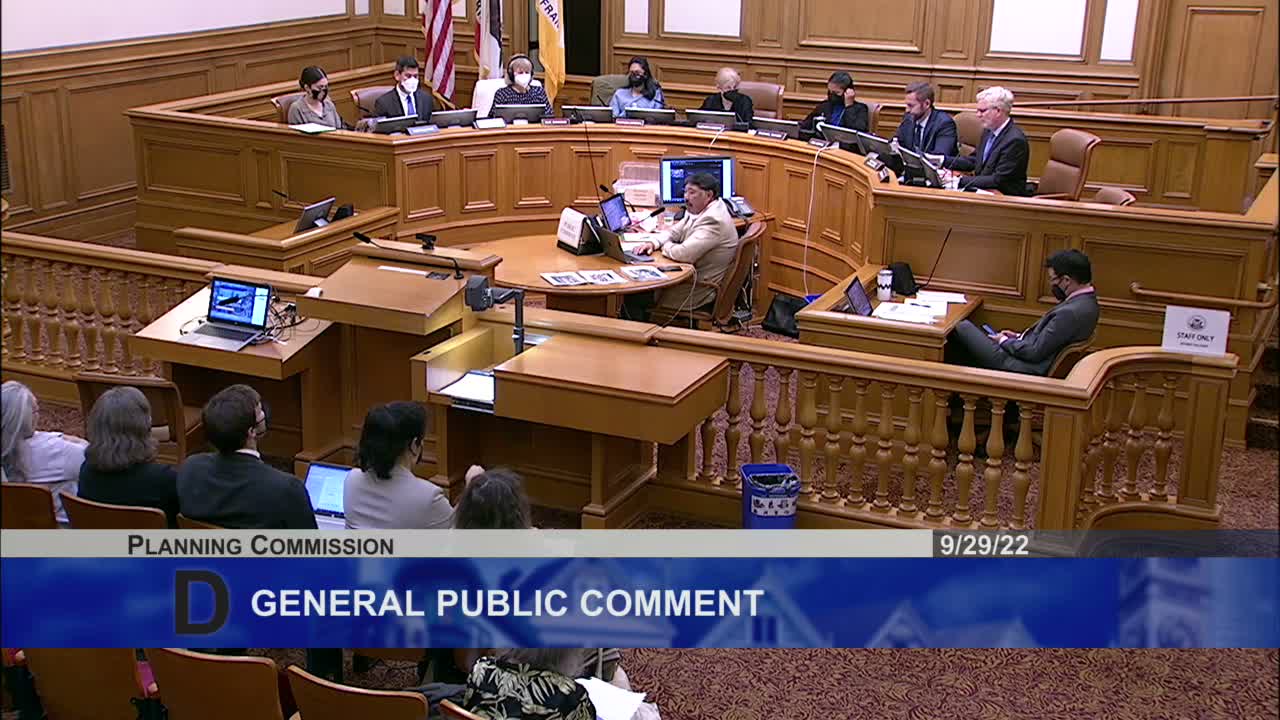
The Planning Commission heard a comprehensive briefing on the department’s work to center racial and social equity in planning. Staff described work internal to the department — including a budget equity tool, human resources equity guidelines and an allocation of roughly $750,000 for community engagement — and announced plans for an equity audit of planning code and equity impact analysis guidelines.
Equity Council members and community advocates told the commission the department has made meaningful changes but must deepen its work to stop displacement and expand affordable housing. Mary Travis Allen, president of the American Indian Cultural District advisory board, told commissioners that land acknowledgements and statements must translate into policies that protect communities and cultural legacies. William Ortiz Cartagena (Equity Council) praised the department’s candid conversations and urged the commission to sustain momentum and interagency coordination.
Advocacy groups — including the Race and Equity in All Planning Coalition, tenants’ groups and neighborhood coalitions — pressed staff to produce measurable outcomes, prioritize affordable housing and center community‑led land‑use plans. Multiple speakers asked the department to audit codes and to make sure state streamlining laws do not reduce community participation or protections for seniors and people with disabilities.
Commissioners discussed next steps including how to ensure implementation through budgets, interagency coordination and integrating equity work into the housing element and other general plan updates. Several commissioners requested more disaggregated workforce data, an ongoing role for the equity advisory council and formal mechanisms for budget accountability.
The item was informational; staff will return with additional detail on the equity audit, implementation metrics and the housing element’s equity analysis.
Equity Council members and community advocates told the commission the department has made meaningful changes but must deepen its work to stop displacement and expand affordable housing. Mary Travis Allen, president of the American Indian Cultural District advisory board, told commissioners that land acknowledgements and statements must translate into policies that protect communities and cultural legacies. William Ortiz Cartagena (Equity Council) praised the department’s candid conversations and urged the commission to sustain momentum and interagency coordination.
Advocacy groups — including the Race and Equity in All Planning Coalition, tenants’ groups and neighborhood coalitions — pressed staff to produce measurable outcomes, prioritize affordable housing and center community‑led land‑use plans. Multiple speakers asked the department to audit codes and to make sure state streamlining laws do not reduce community participation or protections for seniors and people with disabilities.
Commissioners discussed next steps including how to ensure implementation through budgets, interagency coordination and integrating equity work into the housing element and other general plan updates. Several commissioners requested more disaggregated workforce data, an ongoing role for the equity advisory council and formal mechanisms for budget accountability.
The item was informational; staff will return with additional detail on the equity audit, implementation metrics and the housing element’s equity analysis.
Don't Miss a Word: See the Full Meeting!
Go beyond summaries. Unlock every video, transcript, and key insight with a Founder Membership.
✓
Get instant access to full meeting videos
✓
Search and clip any phrase from complete transcripts
✓
Receive AI-powered summaries & custom alerts
✓
Enjoy lifetime, unrestricted access to government data
30-day money-back guarantee
